He is a Gift 26
"Son of the Human": a Chronos-Bound Expression
You know that the Pass Over is becoming beyond two days, and the Son of the Human is being handed over into the Being Fenced with Stakes.48At that time, the Arch Priests and the Elder Ones of the People were being led together into the Courtyard of the Arch Priest, the one who is being called Depression ("Kaiapha").49
δόλος - Bait for Fish
And they took counsel together in order that they might seize power and kill away the Salvation by fish bait.And they kept saying, "Not within the Feast Day!" so that a noisy commotion should not become within the People.
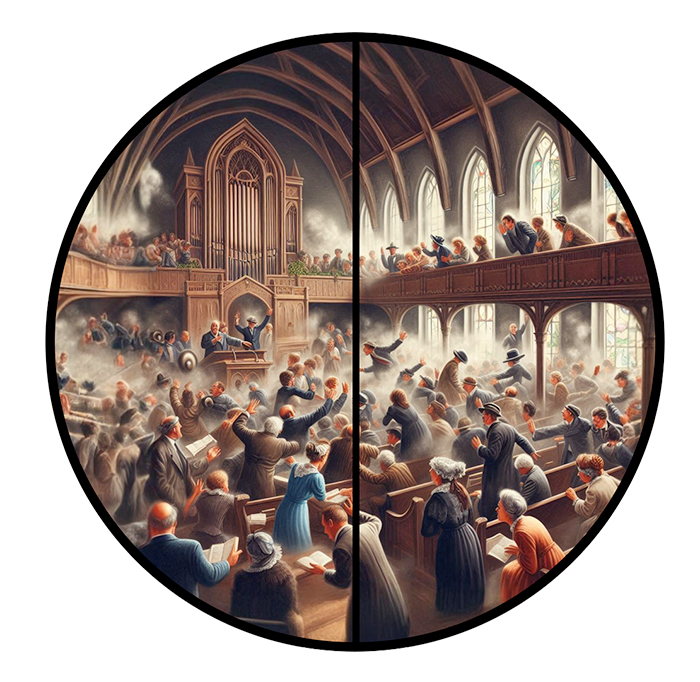
"We don't talk about those things on Feast Day!"
And the Salvation, he who became within House of Misery ("Bethany") within a house of Hearing ("Simon"), the Scaly One,
Her Little Chest
a woman drew near to self, she who is holding an alabaster box of very costly fragrant oil, and she poured down upon the Head of himself, he who is dedicated.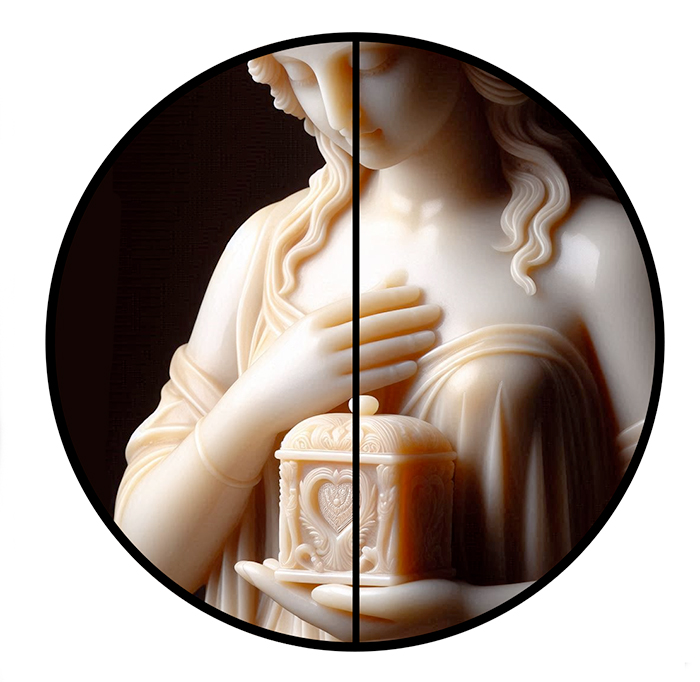
- Material: Alabaster is a soft stone that is easy to carve, making it ideal for crafting delicate containers. It has a smooth, translucent appearance that was prized in ancient craftsmanship.
- Use: Alabaster boxes were commonly used to store valuable and fragrant substances. They were sealed to preserve the contents, which were often costly and used sparingly.
- Design: The design of alabaster boxes varied, but they were typically small and often had a narrow neck to control the pouring of the contents.
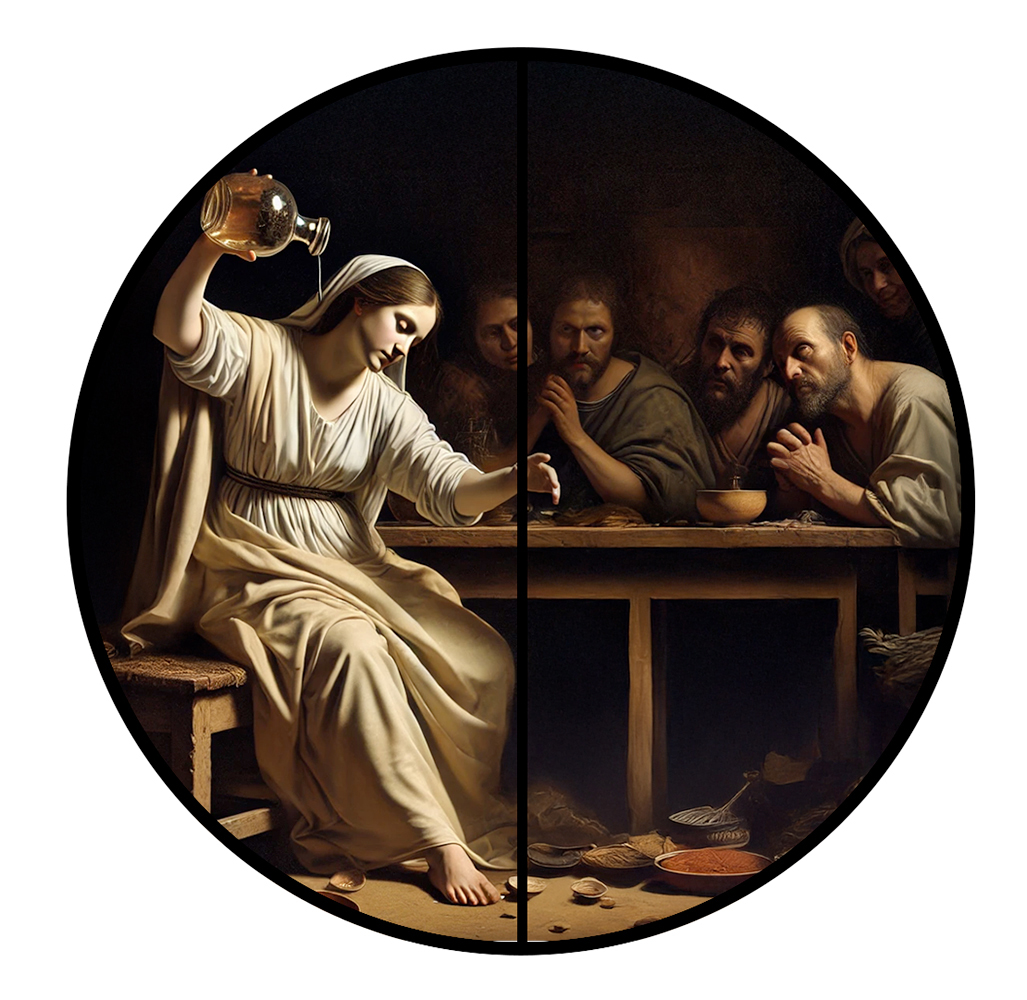
And the Learners, those who have perceived, became fermented/bubbling over,49a those who are saying, "Into what is herself, the Loss/Perdition?
For this thing was powerful to be sold for much, and to be given to cowering beggars.
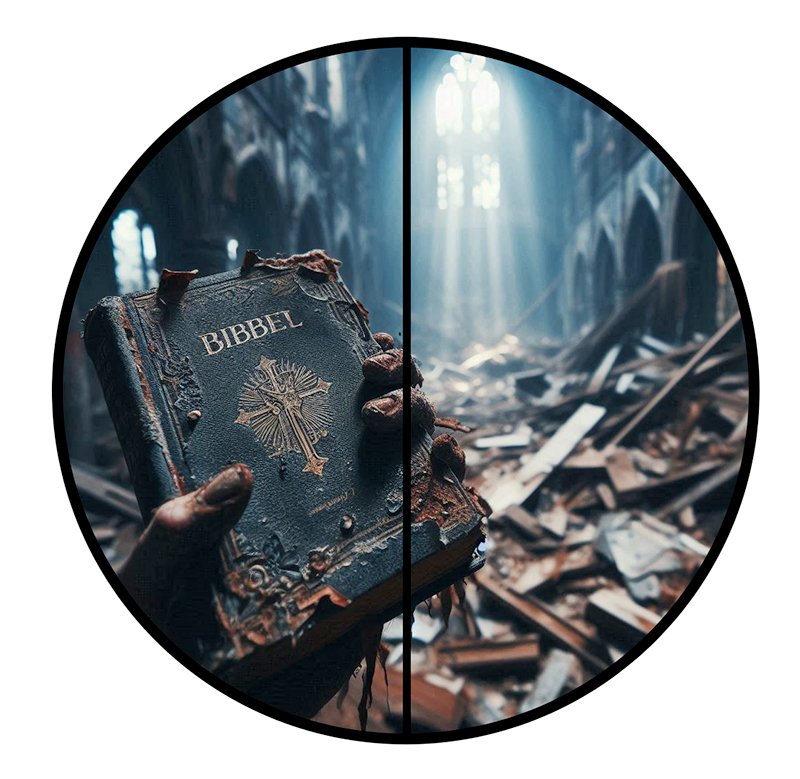
This thing was able to be sold for a lot (i.e. one's entire life and soul).
The Hebrew בבל BBL is consonantal only and means "to confuse," and could be pronounced in a variety of ways. Within the BIBLE, it represents the greatest catastrophe(s) upon mankind that ever happened: the attempt to unify human activity into a single, self-aggrandizing enterprise (tower) that exceeds its natural bounds as a concentrated chronos-based political, economic, and religious dominance, and a complete abomination of the feminine principle of "Agape Love" (as complement to masculine principle of "Logos") manifested in the Harlot of the BBL who "sits upon the Water multitudinous."
Into Myself!
And the Salvation, he who has recognized, said to themselves, "With what beatings you are presenting to the Woman! For she worked a beautiful work into myself!""(from 2875 /kóptō, "to hit, strike") – properly, a strike (blow) that is so hard, it seriously weakens or debilitates; (figuratively) deep fatigue, extreme weariness (wearisome toil)."
(cf. Strongs #G2873)For you are the whole time holding the Cowering Beggars in company with your own selves, and you are not holding myself the whole time!
She, Herself, His Body
For she, herself who has cast the Myrrh, this one, upon the Body of Myself she has made toward the Burying of Myself.Trustworthy One, I am speaking to yourselves, wherever the Good News, this one, should be proclaimed within the Whole Entire Order, it will be uttered also that which she, herself made into a memorial of herself.
The One
At that time, he who has led across, one of the Two and Ten, the one who is being called Caster Man of the Cities ("Judas Iscariot") toward the Arch Priests he said, "What are you willing to give to myself? I, myself will also hand over himself to yourselves." And the one weighed out in a balance to self thirty silver pieces.49bAnd away from that time he was searching for an opportunity, so that he might hand over himself.
One of the Twelve
Thirty silver
An expanse
In search of an opportune chance
A key for the Bolt Lock
And the Learners drew near to the First One of the Unleavened, those who are saying to the Salvation, "Where do you wish that we should prepare for yourself to eat the Pass Over?"
An Opportune time to Skip Time...to the Timeless Self
And the one said, "Bring under into the City toward such a man, and say to self, "The Teacher is speaking, the Opportune Time of Myself is near toward yourself! I am making the Pass Over in company with the Learners of Myself!"And the Learners made just as the Salvation arranged together to themselves and prepared the Pass Over.49c
And while she has become a late one, he was dedicated in company with the Two and Ten Learners.
And while they, themselves are eating he said, "Trustworthy One, I am speaking to yourselves that one from out of yourselves will hand myself over.
What? I'm not Handing myself to you?
And those who are being pained exceedingly, began to say to self, one apiece, "Is it not I, myself, master?"49d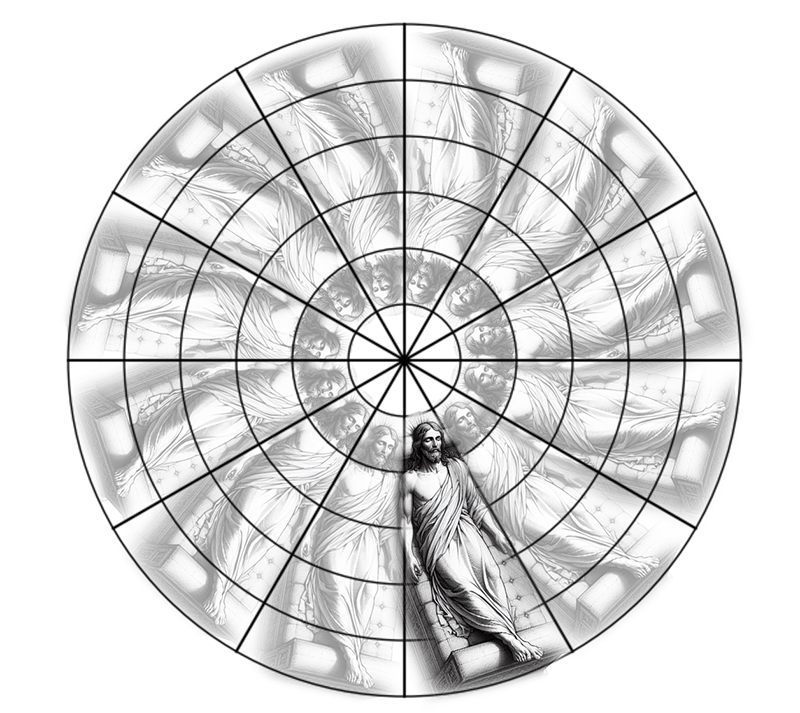
One from out of yourselves.
The Hour, the opportune time
And the one who has been separated said, "The one who has dipped the Hand in along with myself within the Bowl— this one will hand over myself.
leaping over
passing over
"so that he might make herself holy, he who has cleansed by the Bathing of the Water within a saying."
(Ephesians 5:26 RBT)Parable of Two Sons (Matt. 21:28)
Indeed the Son of the Human is bringing under just as it is written around to himself! But woe to that Human through whom the Son of the Human is handed over! It was being a beautiful thing to self, if that Human was not fathered!"And he who has been separated, Caster, the one who is handing over himself, said, "Is it not I, myself, Teacher of Myself ("Rabbi")?" He is saying to self, "You, yourself have spoken it!"
ἔκλασεν - break, deflect, inflect
And while they, themselves are eating, the Salvation, he who has taken hold of a bread loaf and he who blessed, deflected. And he who has given to the Learners said, "Take hold, eat! This one is the Body of Myself!""This one is my body"
The Greek verb κλάω originally denotes “to break, fracture, or snap” (e.g., wood, spears, vine shoots: Od. 6.128; Il. 11.584; Thphr. CP 1.15.1). In technical and metaphorical contexts the meaning shifts from literal breakage to deviation or bending, giving rise to the senses “deflect,” “inflect,” or “follow a non-straight course.” It was not a word used in the sense of "tearing off a piece" of something. Thus the odd vernacular of "break a bread" became a religious idiom, since it is quite difficult to snap bread, unless it is completely stale and hard. In all the uses of κλάω "break" in the NT, bread is never the direct object, except once in Mark 8:19.
Most modern translations can't help but add the word "it" under the assumption that the verb must be referring to the bread. But it is an assumption only.
(κλάω – Deflect)And he who has taken hold of a cup and he who has gave eucharist/thanks, gave to themselves, he who is saying, "Drink from out of self, everyone!"
διαθήκη - a Disposition, Testament, Will
For this one is the Blood of Myself of the Testament, the one which is being poured out around to multitudes into a release of misses.And I am speaking to yourselves, I should never drink away from this moment from out of this one of the Offspring of the Vine, until the Day of that one when I should drink self, a new one, in company with yourselves, within the Queen of the Father of myself!
And those who have sung praises came out into the Mount of the Olive Trees.
At that time he is speaking to themselves, the Salvation, "Every one of yourselves, you will be scandalized within myself, within This Night, for it has been written, I will hit the Shepherd and the Little Sheep of the Flock will be scattered abroad."
τὸ ἐγερθῆναί με - The Awakening of Myself
And after the Awakening of Myself, I will lead ahead of yourselves into the the Circuit.50And he who has been separated, the Small Stone, said to self, "Even if everyone will be scandalized within yourself, I, myself will never be scandalized!
The Salvation kept bringing to light to self, "Trustworthy One, I am speaking to yourself, that within this Night, before a rooster crowing out, three times you will reject myself.
The Small Stone is saying to self, "If even it is necessary myself to die in sync with yourself, I will never reject yourself!" And all the Learners spoke in the same way.
At that time, the Salvation is coming in company with themselves into a spot which is called, Olive-Oil Press ("Gethsemane"), and he is speaking to the Learners, "Sit down right here, until whom, he who went away there, I might offer prayers."
And he who has taken from the Small Stone, and the Two Sons of Endowment ("Zebedee"), he began to be hurt and deeply distressed.
At that time he is speaking to themselves, "She is a very sad one all around, the Soul-Life of myself until death! Remain in here and stay awake in company with myself!"
Offering Prayers from Ahead, Backwards
And he who has gone forward, a little one, he fell against a face of himself, he who is offering prayers and he who is speaking, "Father of myself, if it is possible, let this Cup go past away from myself, yet I am not wishing as myself, but rather as yourself!"And he is coming toward the Learners, and he is finding themselves, those who are sleeping, and he is speaking to the Small Stone, "In this way you had no strength to keep awake one seasonal time in company with myself!
Stay awake and offer prayers so that you should not enter into a temptation, the Spirit indeed eager, but the Flesh, a weak one!
He who went away backwards from out of a second, he offered prayers, he who is speaking, "Father of myself, if it is not possible for this thing pass by unless I should drink self, let the Desire of yourself become!"
And he who came backwards found themselves, those who are sleeping, for the Eyes of themselves kept being those who have been weighed down.
And he who has sent away themselves backward, he who went away, offered prayers from out of a third one, he who spoke the Selfsame Word backward.
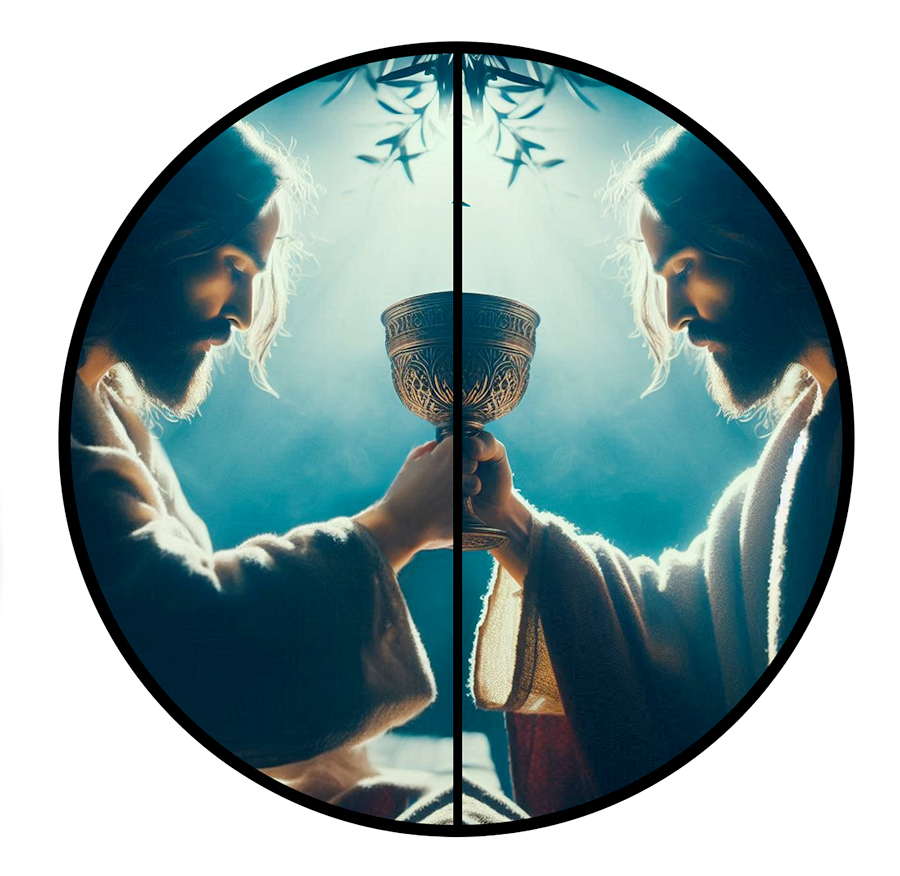
A strong arm.
At that time, he is coming toward the Learners, and he is speaking to themselves, "You are sleeping henceforth, and you are ceasing. Behold! The Seasonal Time, she has drawn near, and the Son of the Human is being handed over into hands of missers!
Awake! Let us lead! Behold! The one who is handing over myself has drawn near!
Exodus from Pharaoh
And while he, himself is still uttering, Behold! Caster, one of the Two and Ten came, and in company with himself a Multitude multitudinous in company with daggers and wood away from the Arch Priests and Elders of the People!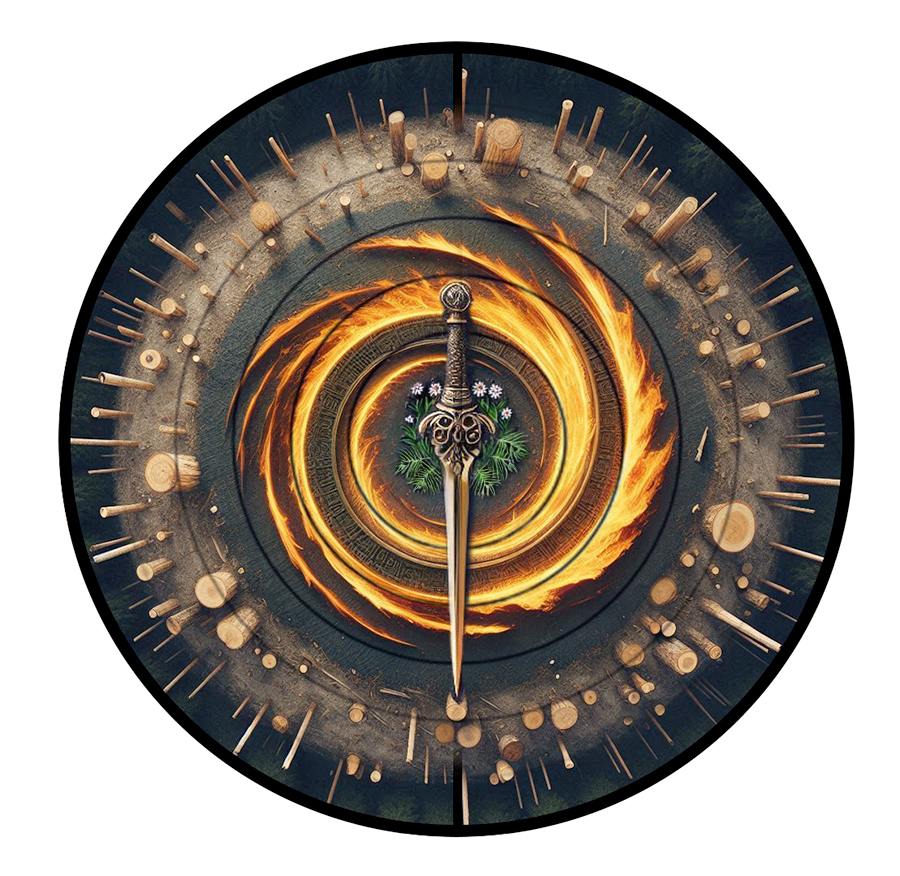
"For he who is living, the Word of the God, and an active one, and sharper through every double-mouthed dagger, and he who is being penetrated until a division of soul-life and spirit, of both joinings and inner-marrows and critical of inner thoughts and ideas of hearts."
(Hebrews 4:12 RBT)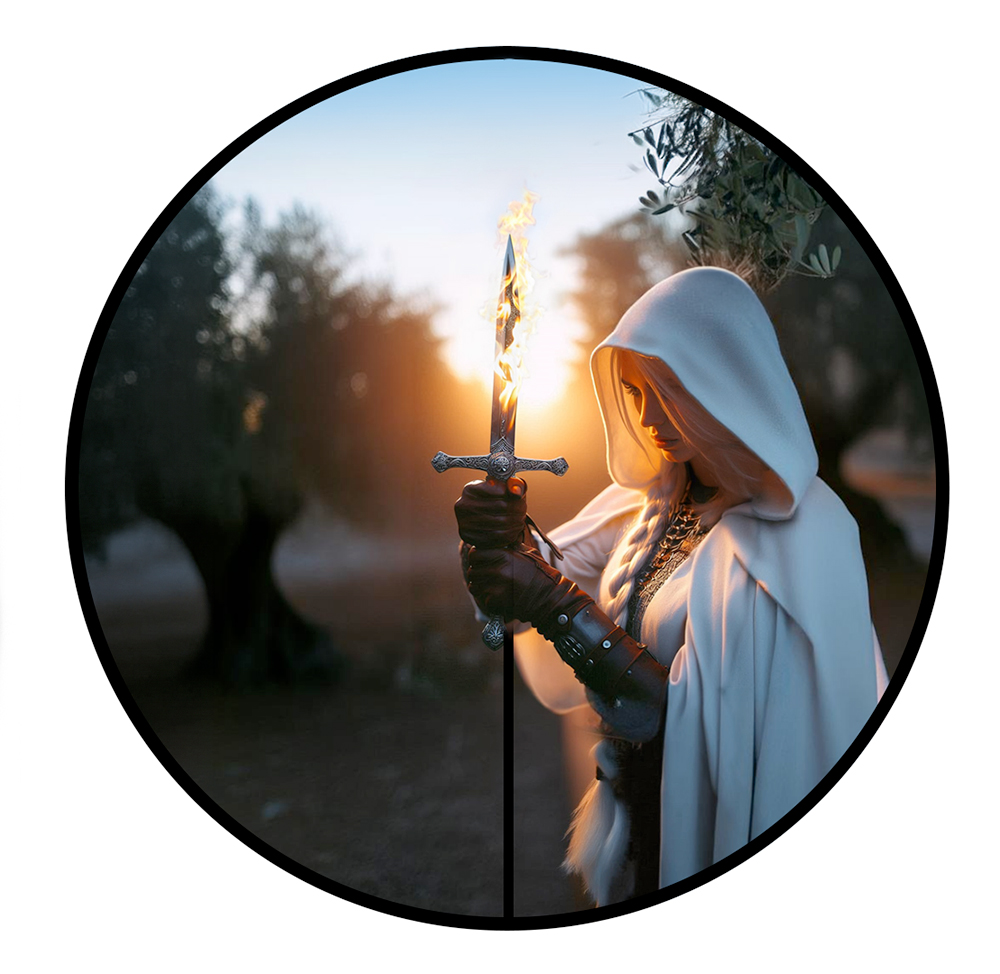
"And the self eternal Man is driving out, and he is causing the self eternal Cherubim to encamp from the front to the Protected-Garden of Delight and the self eternal flame of the Sword of the One who Overturns/Inverts Herself, to keep watch over the self eternal Road of the Wood of the Living Ones.
(Genesis 3:24 RBT)φιλήσω - I should regard with affection
And the one who is handing over himself gave to themselves a sign, he who is saying, "Him whom I should philo-love, he, himself is. Prevail over himself!"51κατεφίλησεν - Kiss Down, fervently, Affectionately, Repeatedly
And immediately he who has drawn near to the Salvation, said, "Rejoice Teacher of Myself (Rabbi")!" And he kissed down fervently himself.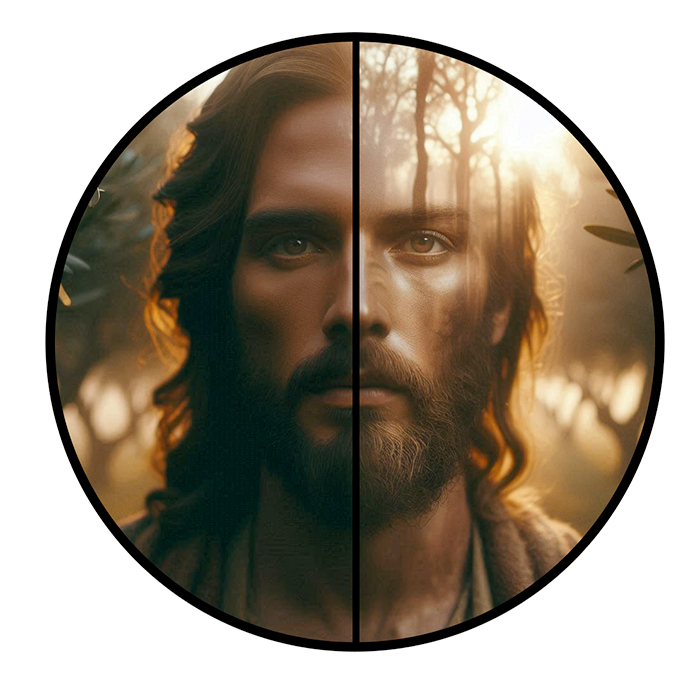
The verb καταφιλέω is a compound of κατά (kata, "down") and φιλέω (phíleō, "to kiss" or "to love"). κατεφίλησεν means "he/she kissed down" or "he/she kissed fervently". κατεφίλησεν indicates an action where someone kissed someone or something with emphasis or intensity, often used in a context where the act of kissing is thorough or deeply affectionate. In classical texts, it might describe a person kissing someone repeatedly or with great emotion.
πάρειμι - to be present, at Hand
And the Salvation said to self, "Comrade! Upon what are you being present?" At that time, those who have drawn near cast the Hands upon the Salvation, and they prevailed over himself.The Peace Taken Violently
And behold! One of those in company with Salvation, he who has stretched forth the Hand, dragged off the Dagger of himself, and he who hit the Born-Bondman of the Arch Priest, took away the Ear of himself.Return Her
At that time the Salvation is speaking to self, "Turn back the Dagger of yourself into the Position of herself, for everyone of those who have taken hold of a dagger, within a dagger they will perish."Or Else...
Or do you think that I don't have power to summon close the Father of myself, and he will stand beside myself at this very moment more than twelve legions of angels?
λεγιῶνας - a Legion: a division of the Roman army, numbering about 6,000 infantry with additional cavalry.
How therefore should she be filled up, the Writings, that she must become thus?
Within that one, the Seasonal Time, the Salvation said to the Multitude, "Just as against a plunderer you have come out in company with daggers and wood to collect together myself! According to a day within the Sacred Place I was sitting down, he who is teaching, and you did not take control over myself!
And this entire thing has become, so that the Writings and the Prophets would be filled up!" At that time the Learners, everyone of those who have sent away himself, they escaped.
And the ones who have prevailed over the Salvation, they led away toward Depression ("Caiaphas"), the Arch Priest, where the Scholars and the Elder Ones gathered together.
And the Small Stone was accompanying self from far away until the Courtyard of the Arch Priest, and he who has come inside was sitting in company with the Under-rowers to perceive the Tele-aim.
And the Arch Priests and the entire Joint Sitting-Council kept seeking after a false witness down from the Salvation, in such a way that they could condemn himself to death.

συνέδριον - joint sitting/session

And they did not find of multitudes of those who have drawn near of false witnesses. But lastly, those who have drawn near, two.
They said, "This one was bringing to light that I have power to overthrow the Sanctuary of the God, and straight through three days, to construct!"
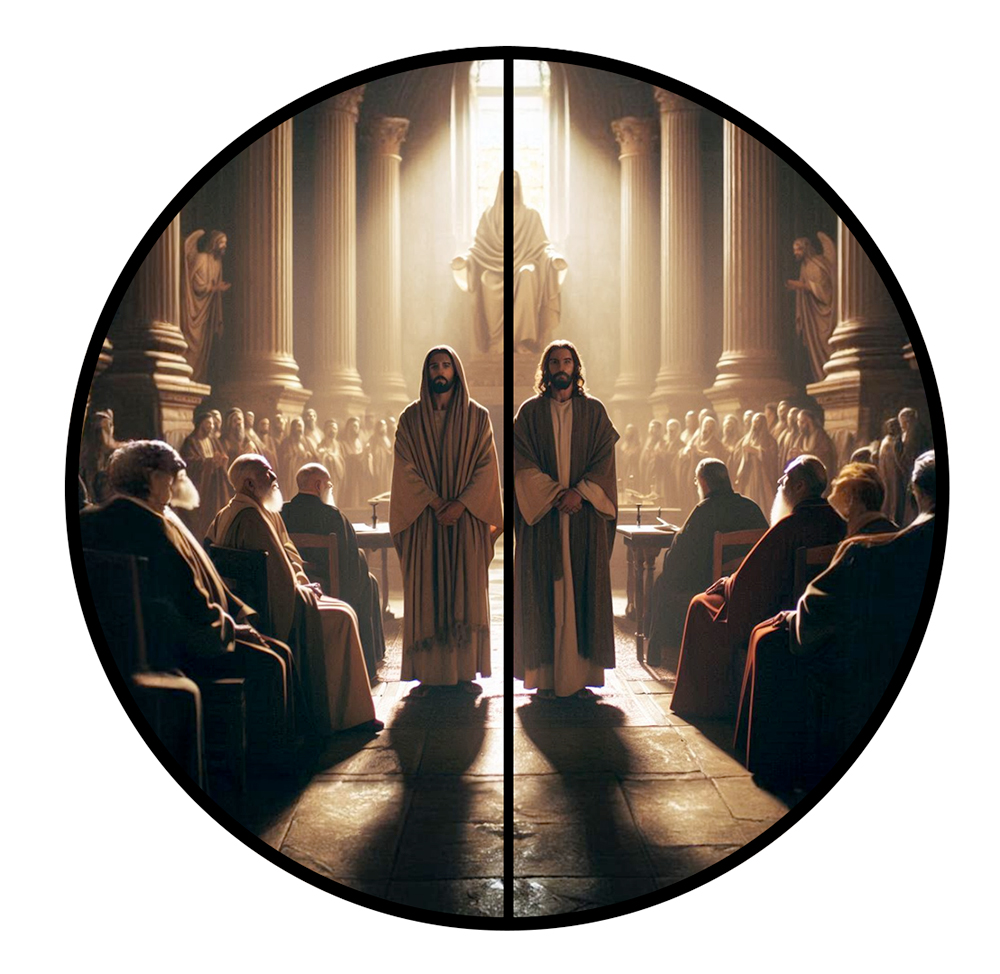
"When you perceive the abomination..."
And he who has stood up, the Arch Priest, said to self, "You are separating no one, what are these ones of yourself testifying against?"And the Salvation kept being silent. And the Arch Priest said to self, "I am making yourself swear according to the God of the one who is living, that to ourselves you should answer if you, yourself are the Anointed One, the Son of the God!"
The Salvation is saying to self, "You, yourself have spoken! Nevertheless, I am speaking to yourselves away from this very moment you will see the Son of the Human, he who is sitting down from out of right-sides of the Powerful One, and he who is coming upon the Clouds of the Heavenly One!"
At that time, the Arch Priest tore asunder the Outer Garments of himself, he who is saying, "He blasphemed, what need do we still hold of witnesses?" Behold! you have heard the Blasphemy!
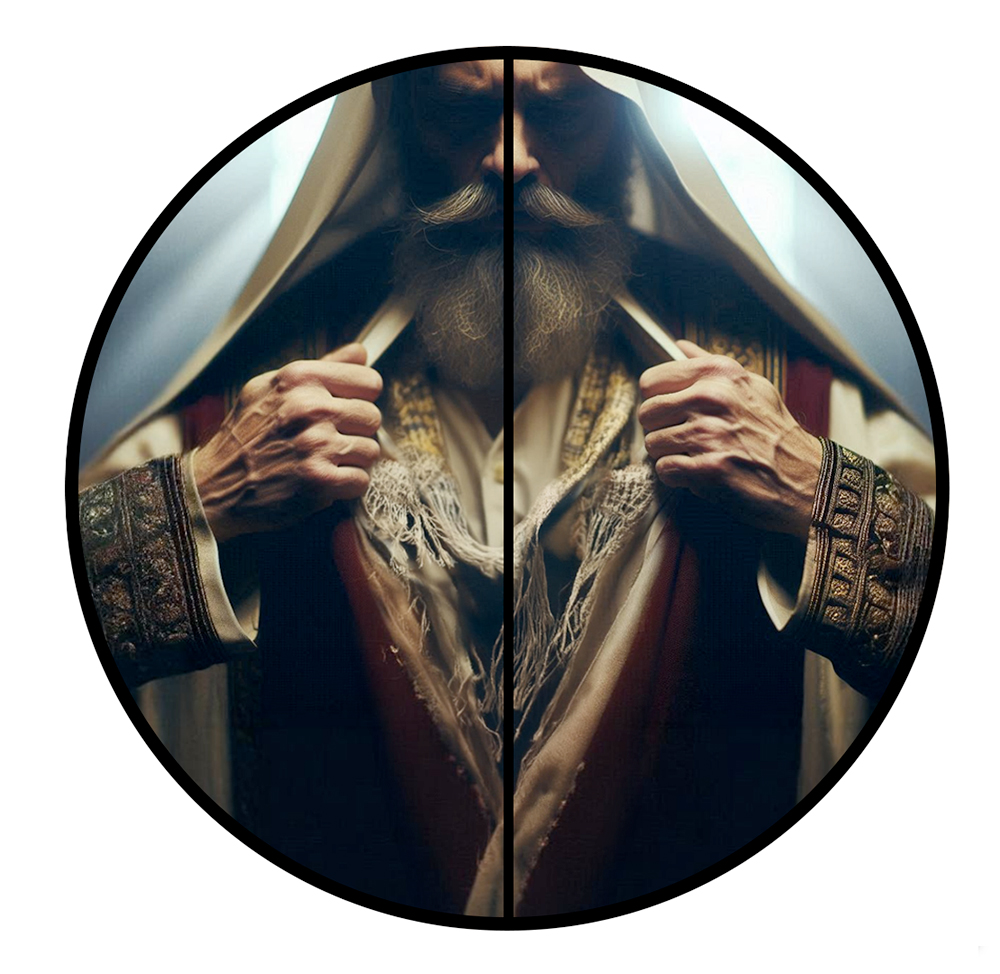
How does it seem to yourselves? And the ones who have been separated said, "He is a bound one of death!"
At that time, they spat into the Face of himself, and struck himself with a fist, and the ones struck with a rod,
those who are saying, "Prophesy to ourselves, Anointed One! Who is the one who struck yourself?"
The Two Maidens
And the Small Stone was sitting outside within the Courtyard, and she came near to himself, one, a young maiden, she who is saying, "You, yourself also were being in company with Salvation the Circuiter ("Galilean")!"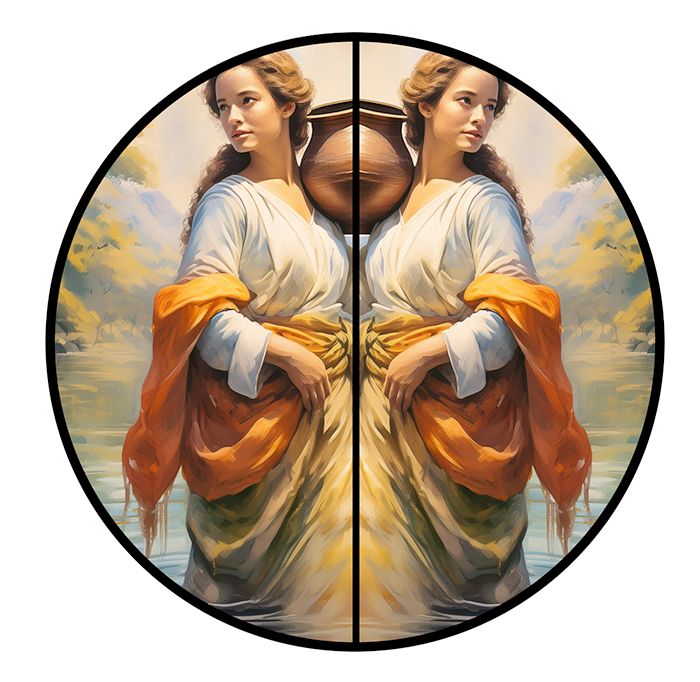
And the one denied in front of all, he who is saying, "I do not see what you are saying."
And he who has gone out into the Gateway, another one perceived himself, and she is saying to the ones in that place, "This one was being in company with Salvation the Protector ("Nazarene")!"
And he denied backward, along with a vow, that I do not see the Human."
And those who have drawn near beyond a little, those who have stood ready, spoke to the Small Stone, "Truly you, yourself are also from out of themselves! For also the Babble of yourself, she is making yourself obvious!"

At that time, he began to call down curses and to swear oaths that, "I do not see the Human!" And immediately a rooster crowed out.
And he was reminded, the Small Stone, of the Saying of Salvation, he who said that before a rooster crowing out, three times you will reject myself. And he who went outside wept bitterly.
Footnotes
The Leap Over
Greek τὸ σταυρωθῆναι THE being staked.
Every NT Greek manuscript has the same text. And every single translation of it that we have seen, even the literal ones, leaves out the definite article the.
In Koine Greek, an articular infinitive (τὸ γίγνεσθαι, τὸ παραδίδοσθαι, τὸ σταυροῦσθαι) suspends sequence. It treats the verb not as something that occurs but as a condition, domain, or mode of existence.
Aonically, the statement is describing a structural configuration, not a future episode.
Thus:
-
“the Leap-Over is becoming” = the transition-state is active as an ongoing condition of the system.
-
“the being-handed-over” = a mode in which the human-agent is in a state of exposure or transfer across boundaries.
-
“the being-staked” = a condition of fixation, anchoring, or being pinned into a particular structural relation.
None of these require temporal unfolding.
In an aionic frame, “two days” is not a chronological duration but a threshold of phases—a metaphor for the outward/visible cycle of the organismic or conscious system.
“Beyond two days” = beyond the domain of cyclic alternation, beyond oscillation, outside the rhythm of “evening–morning” phenomenology.
“Son of the Human” is more about the structural element than a literal person. Aonically, huios tou anthrōpou (Hebrew בן־אדם) designates the representative human locus, the emergent self-node produced by embodiment within chronos.
Thus, the phrase describes:
-
the human locus (anthrōpos), and
-
its emergent interior identity (huios, “derivative,” “offspring,” “projection”).
υἱὸς τοῦ ἀνθρώπου "son of the human " is a chronos-bound expression Syntactically, the expression is genitive of source/origin. It denotes what issues from, arises out of, or is generated by anthrōpos, i.e., the temporal, mortal, chronologically-bounded human condition. This of course is opposed to what would be generated by theos (son of God). In purely linguistic terms:
-
υἱός = that which proceeds from a source, the generated product
-
τοῦ ἀνθρώπου = the human sphere, with its temporality, decay, and limitation
Taken without theological loading, the phrase can be read simply as:
“that which comes into existence through human temporal generation.”
It is tied to succession, lineage, emergence within time. It is inescapably chronos-based.
“Being handed over into the being-staked” describes a transition of modes. Not betrayal, suffering, or time-based sequence. It describes a shift in the state of the human locus:
-
Handed over = transferred across domains, exposed, de-centered, released from its prior configuration.
-
Into the being-staked (palisaded) = entering a mode of fixation or anchoring—where the self becomes rigidly localized or structurally constrained (staked all the way around like a fence)
In systems-theory terms, we can interpret it like this:
-
a phase transition from oscillatory mode → constrained/fixed mode,
-
applied to the consciousness-locus (“Son of the Human”),
-
occurring within a larger transition (“Leap-Over”) situated beyond alternating cycles (“two days”).
“Being-staked” (σταυροῦσθαι understood via its older sense of palisading, fencing-in, restricting movement, limiting a field) represents the extremity of chronos-pressure—the constriction, the shutting in of a being within its temporal finitude, thus the expression υἱὸς τοῦ ἀνθρώπου names precisely the being that is most exposed to that chronos-finitude. A being generated via temporal succession is the one that can be most profoundly “palisaded.” Palisading marks the point where the system’s boundaries become static, its states cannot reorganize, and negentropic potential goes to zero. Nothing flows through; nothing cycles. This is why the “being-staked” is not a transformation but a terminal fixation event.
To put all this into laymen terms: Picture it without any timeline at all. The saying is describing how the human self shifts states, not how events unfold. “The Leap-Over” is the moment when a person’s awareness moves beyond its usual back-and-forth cycle—beyond the ordinary alternation of moods, impulses, and sensory rhythm (the outer rings “two days”). In that boundary-zone, the inner human identity—the part that normally feels located, reactive, and tied to circumstance—is “handed over,” meaning it loses its usual grip and transfers into a different mode. “Being staked” is a metaphor for the self becoming fixed or held in place. So the line is describing a psychological or existential transition: when consciousness crosses out of its normal oscillating pattern, the self becomes exposed, transferred, and finally anchored into "the moment." It’s not predicting an event; it’s mapping a structural shift in human experience.
The “being-staked” in the aionic frame it isn’t a reward; it’s the catastrophic point where the chronos-self can’t keep functioning. It's no triumph but rather a structural failure. When the outward, impulsive identity hits a limit it can’t cross, it collapses. Something in a person gets fixed, not elevated—pinned into immobility. Systems that get staked like that don’t evolve; they break.
The image is one of irreversible decoherence rather than a transformation. Instead of the two layers (the aionic field and the chronos self) coming into alignment, the outer layer loses flexibility (the two days). Once it’s staked, all the adaptive, negentropic possibilities shrink. Biological systems in that state don’t regenerate; they head toward shut-down.
So if someone hits this kind of “state-collapse,” they are toast: nothing about it points toward an aionic life-mode. It’s the opposite of emergence or synchronization. It’s the point where the temporal structure can’t bear its own load anymore—where the loop stops cycling and just… drops.
That’s why the saying carries weight. It’s naming the moment where a human being, if they stay in a purely chronos orientation, eventually reaches a terminal constraint. Not transcendence—just the end of the line.
Strongs NT #2533 Καϊάφα. Caiaphas. The Depresser
"supposed by many to be the same as כֵּפָא, a stone, a rock; others more correctly equivalent to כָּיְפָא, depression, Targ. on Proverbs 16:26 (according to Delitzsch (Brief and. Röm. ins Hebrew etc., p. 28) קַיָפָא)"
Thayers Greek Lexicon
In the Targum, specifically on Proverbs 16:26, the word appears to be associated with the latter meaning, signifying a "depression."
Proverbs 16:26 says "for he has pressed/drove down upon himself the mouth." The Hebrew for "pressing/driving" is אכף (akaph). The verb אכף is found only in this verse. In Arabic it came to mean "saddle". Cf. Strongs Hebrew #404.
The Targumim are ancient Aramaic translations and interpretations of the Hebrew Bible, originating during the Second Temple period to provide explanations and translations for Aramaic-speaking Jewish communities. These oral traditions were eventually codified into written texts, with Targum Onkelos and Targum Jonathan among the most well-known, believed to have been standardized around the early centuries CE but reflecting much earlier origins.
ἀγανακτέω to ferment (of wine), was used metaphorically for irritation, indignation. (cf. Logeion ἀγανακτέω)
When used with money, or silver, ἔστησαν doesn't mean merely to count out, but to set in a balance and weigh out. What is in the other side of the balance? The same. (cf. LSJ ἵστημι A.IV)
The Passover
I am making the Passover = the Learners of Myself are making the Passover = I am making along with the Learners of Myself the Passover
In these sayings, temporal language is attempting to describe a non-temporal transition. The agents (Learners) are aligning with a still-point (“Unleavened”), where nothing expands, gets stretched out, empties out, or decays. What looks like a scheduled festival becomes a state-change, the “Pass Over Feast of Knowledge,” a transition from one mode of being to another.
Backtracking from the traditional interpretation of a "betrayal" we find that the word παραδίδωμι primarily means give, grant, hand over to another, transmit. In classical and Hellenistic Greek, παραδίδωμι does not carry the modern, moralized sense of “betray” that English imposes. The notion of treachery or disloyalty is entirely contextual, appearing only when what is “handed over” is something one is expected to protect (a city, a person, a secret).
In most usages—teaching a child, delivering letters, transmitting knowledge, granting permission—the verb is neutral or even positive. The modern English “betray” is thus a misleading simplification; it conflates delivery or surrender with moral fault, which is not intrinsic to the Greek (see LSJ, Bailly, Pape, Slater Pindar, Abbott-Smith NT)
Handing yourself over...to yourself.
The teacher (which is the eternal self) is signaling that a phase-window of alignment (“opportune time”) is approaching—not a moment on a clock, but a convergence in relational structure. One learner’s configuration will redirect the outward state inward (“hand over”), causing the human-derived configuration (“son of the human”) to "invert" out of the temporal lattice (an outer darkness in separation). It is in this "outer darkness" of temporality that he is stretched out thinner and thinner by the moment as the "measuring rod" of chronos time only damns him and beats him silly until there is nothing left. This is because he is being measured against a timeless inner man, the Anointed One, never to measure up even for a moment. He goes through endless cycles of moral boom and bust like a broken record. The endless friction heats him up and scorches him (and those around him). The vain attempts at moral "christ-like living" pound him thin until he is utterly flat. Where the "timeless eternal aonic man" suffered at the hand of his "temporal chronos outer man" due to separation (afflicting the Christ by trying to be christ-like), they are now made whole into a complete man, the outer self aligned with the inner "little man of the eye."
The narrative, read in this mode, is not a sequence of events but a description of how a chronos-bound system interacts with a non-sequential one when a transition of states is about to occur.
1. פָּסַח (pasach) — the verb
Root meaning: to step lightly, to limp, to skip, to hop, to move in a non-linear gait.
Cognates in Semitic show the same semantic pole: irregular motion, skipping across, stepping past.
In other words, פָּסַח denotes discontinuous locomotion.
Not a steady walk → but a broken, hopping motion that jumps over intervals.
This fits well with the idea of non-sequential transition.
2. פֶּסַח (pesach) — the noun
The noun does not mean “a hopping.” It is a nominalization that underwent semantic specialization:
- pretermission
- passing over
- omission of striking
- skipping a target
In philological terms, פֶּסַח denotes a chosen non-action, an intentional omission, a withheld blow, or a selective bypass.
Thus the semantic field is:
to hop → to skip → to bypass → to pretermit.
3. Aonic relevance: “pretermission” = non-linear crossing of a boundary
When taken outside chronological sequencing:
-
פָּסַח = the manner of transition → non-linear, hopping, skipping over intervals.
-
פֶּסַח = the effect of that transition → a boundary is crossed without engaging the sequence between the two sides.
In aonic terms:
פֶּסַח denotes a transition that occurs without traversal of the intermediate states of chronos.
It is a pretermission of temporal sequence.
In other words:
The hop (פָּסַח) explains the mechanism.
The pretermission (פֶּסַח) explains the outcome.
The system “skips over” the temporal wall rather than climbing it step by step.
The Greek phrase Μήτι ἐγώ εἰμι is idiomatic and depends on context.
Μήτι – a particle used in questions expecting a “no” answer. It generally signals that the speaker expects denial or surprise.
ἐγώ εἰμι – “I myself am.”
So Μήτι ἐγώ εἰμι literally is: “It is not I?” or “Am I not the one?” There is a subtle nuance between whether it is used in the sense of "surely it is not me" where the speaker is afraid that it is them, and the sense of "Is it not me" where the speaker is surprised that it is not them.
The nuance hinges on the speaker’s expectation and emotional stance toward the proposition:
-
“Surely it is not I” – the speaker fears or dreads that it might be them. The question carries a sense of apprehension or avoidance. The expectation is negative: the speaker assumes it probably is not them, but the possibility that it is them is alarming.
-
“Is it not I” – the speaker is surprised or seeking confirmation. Here, the question expresses mild incredulity or clarification: the speaker might expect that it is them, or is puzzled that it seems otherwise.
In Greek, μήτι often signals this contrast: the particle sets up an expectation of denial, but the tone—fearful vs. surprised—depends on context and emotional coloring.
Greek τὸ ἐγερθῆναί με the Awakening Myself.
Again, every translation we have seen, leaves out/disregards the definite article the. The Infinitive verb "to awaken" and "me/myself" here are in the accusative. Hence "me/myself" is the object of the infinitive verb.
Strongs #G5368. φιλέω love, show affection
In this verse, φιλήσω is the future tense form of the Greek verb φιλέω, which means "to love" or "to regard with affection." It indicates that someone will express affection or love in the future. For example, in Odyssey 4.171, it would be used to convey a future action of loving or showing affection.
Where did "kiss" come from?
The verb can be used to express outward signs of love, particularly through actions like kissing. For example, it can describe kissing on the mouth or the cheek. It can also refer to approving or liking things, such as objects or events. Additionally, φιλήσω can denote showing affection or approval in various contexts, like enjoying a feast or favoring certain things.
"If anyone is not loving [φιλέω] the Master, let him be Anathema! Our Lord You Are ("Maran-atha")!
1 Corinthians 16:22 RBT