He is a Gift 8
Drawn out of the Sea
And behold! a scaly one20d who has drawn near was prostrating/kissing to self, he who is saying "Master, if you are desiring, you have power to cleanse myself."λέπρα, λέπρας, ἡ (from the adjective λεπρός), Hebrew צָרַעַת, "leprosy" literally, morbid scaliness, a most offensive, annoying, dangerous, cutaneous disease, the virus of which generally pervades the whole body...
In Chronos, being is divided up moment by moment, one moment begetting the next moment, (e.g. a son of a human) resulting in a fragmented, "scaly" self instead of a "one piece interwoven fine linen" self where all moments are begotten as one (aonic) being (e.g. son of God).
And he who has stretched out the Hand fastened to himself, he who is speaking, "I want! be cleansed!" And immediately he was cleansed from the Scaliness of himself.
And he is speaking to self, the Salvation, "Take heed that you speak to no one, but rather lead yourself under, point it out to the Priest, and bring the Gift whom Drawn Out ("Moses") arranged into a witness to themselves.
And as he, himself came into Covering of Comfort, a Captain of a Hundred Men ("Centurion") drew near to self, he who is calling close to his side himself.
And he who is saying, "Master, the Little Boy of myself has been thrown within the House, a side-dissolved one, he who is grievously touchstone-tortured!"
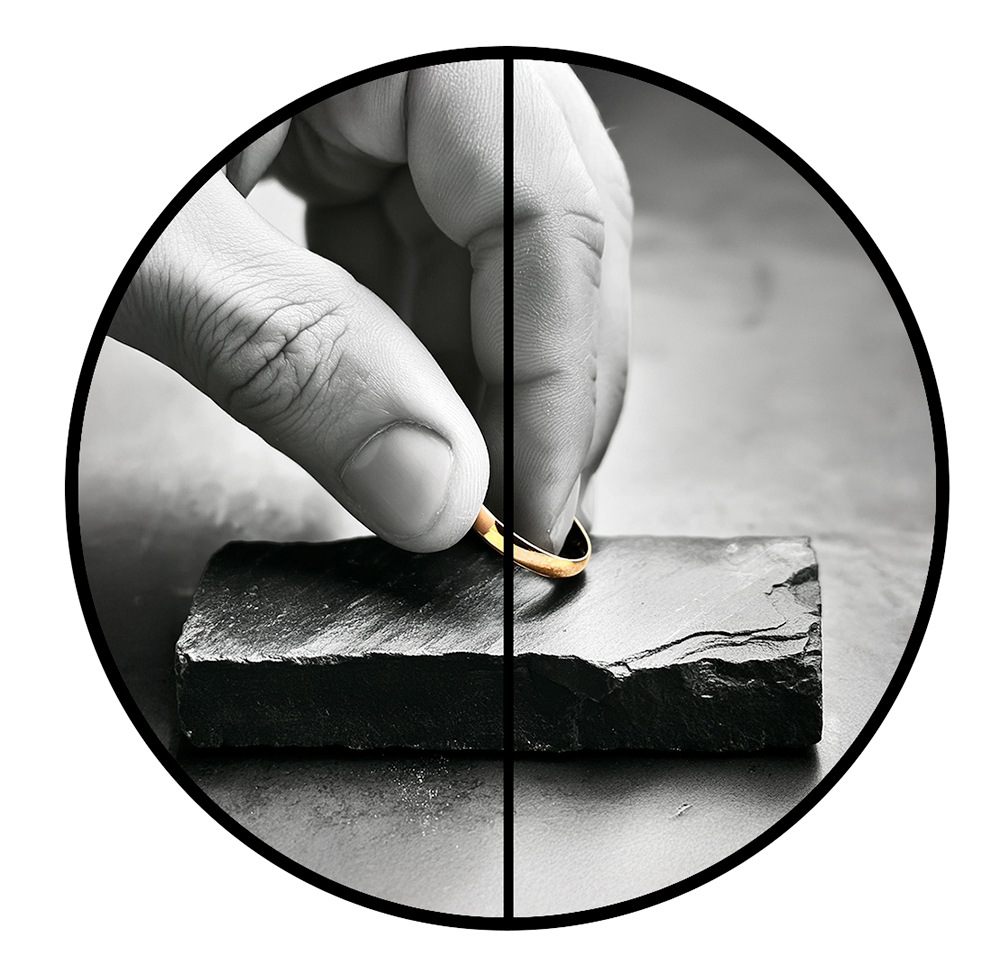
Ancient touchstones were typically made of fine-grained, dark-colored stones such as slate, jasper, or lydite (a type of dark siliceous stone). These stones provided a good contrast for the gold streaks. The gold or silver to be tested, such as a coin or jewelry, was rubbed against the touchstone, leaving a streak of metal on its surface. This streak contained small particles of the metal being tested. Acidic substances would then be applied by goldsmiths and traders to observe the reaction of the acid with the gold streak. If the streak fades or disappears, it indicates the presence of other metals in the alloy, and the degree of the reaction can give an estimate of the gold's purity. Pure gold would show no reaction.
And he is speaking to self, "I, myself, he who has come, will treat himself."
A Powerful Word
And he who has been separated, the Captain of a Hundred Men, brought to light, "Master, I am not sufficient so that you should come under the Roof of myself, but only speak a logos ratio, and the Boy Child of myself will be healed."Bringing to Light
For also myself, a man I am under an authority, he who is arranging in order, he who is holding under myself soldiers, and I am saying to this one, 'Transport across' and he is transporting across, and to the other one, 'Come' and he is coming, and to the Born-Bondman of myself, 'Make this' and he is making."And the Salvation, he who has heard, was amazed and said to those who are accompanying, "Trustworthy One, I am speaking to yourselves, I have found close beside no one such a great trust within the God Contends!
(Queen) Basileia of Joy vs. (Kingdom) Basileia of Weeping
And I am speaking to yourselves that multitudes away from risings and sinkings will arrive and will recline up in company with Father of Multitude ("Abraham") and He Laughs ("Isaac") and Heel Chaser ("Jacob") within the Queen of the Heavenly Ones.And the Sons of the Kingdom will be cast out into the External Darkness, there he will be the Lamenting One and the Biting One of the Teeth.21
And the Salvation said to the Captain of a Hundred Men, "Bring under, let her become to yourself as you have trusted!" And the Child was healed within the Seasonal Time, that one.
And the Salvation, he who has come into the House of Small Stone, perceived the Mother-in-law of himself, she who has been thrown, and she who is on fire.
And he fastened to the Hand of herself, and the Fiery Heat let herself go free, and she was woken up and kept ministering to self.
Unclean Spirits
And as she has become a late one, they brought toward himself those who are controlled/demonized multitudinous, and he drove out the Spirits by a word, and everyone of those who are evilly holding, he treated,22so that might be filled up the one who was spoken of straight across through He Is Liberates Himself ("Isaia-hu"), the Prophet, he who is being spoken, 'He, Himself has taken the Weaknesses of ourselves, and he bore the Miseries.'
And the Salvation, he who has perceived a multitude all around himself, gave orders to go away into the Beyond.
And one scholar, he who has drawn near, said to self, "Teacher I will accompany yourself, wherever you might go away."
And the Salvation is speaking to self, "The foxes are holding on to lairs, and the Winged Ones of the Heavenly One encampments, but the Son of the Man is not holding in the place where he may recline the Head.

And another one of the Learners of Self said to self, "Master, allow myself first to go away and to pay funeral rites to the Father of myself."22a
You're Already Being Dead!
And the Salvation is speaking to self, "Accompany myself and hurl away the Dead Ones to pay funeral rites to the Dead Ones of their own selves."
"And according to as much as it is laid/stored up to the Men to die off once, and beyond this a separating, so also the Anointed One [is stored up], he who is offered into the Multitudes..."
(Hebrews 9:27 RBT)And he who has stepped in to self, into the Ship, the Learners of Self accompanied self.
A quake in the Sea: Dead Sleep down below
And behold! He has become a mega earthquake within the Sea, wherefore the Ship is being covered underneath the Breaker Waves, but himself was sleeping.and those who have drawn near woke up himself, those who are saying, "Master, Save, we are being destroyed away!"
And he is speaking to themselves, "What cowards you are, those of little trust!" Then, he who has been woken up, bestowed honor on the Winds, and the Sea, she became a mega serene one.
And the Humans marveled, those who are saying, "Of what kind is this one, that also the Winds and the Sea listen under to self?"
δαιμονίζομαι - Controlled by Demonic Influence, Incredibly Difficult to Deal With
And of him who has come of himself into the Other Side, into the Place of the Troops ("Gad-arenes"), two of those who are controlled by demonic power from out of the Memorials encountered himself, those who are coming out exceedingly difficult/hard-to-deal-with ones, whereas nobody had the strength to pass across through the Road of that one.
μνημ-εῖον, Dor. μνᾱμεῖον, Ion. μνημήϊον, τό, memorial, remembrance, record of a person or thing
(cf. LSJ μνημεῖον)And behold! they were cawing [like ravens], those who are saying, "What is to ourselves and to yourself, son of the God? Have you come here in front of an opportune time to touchstone-torment ourselves?"
Rebekah "Stall Fed"
And she was far away from themselves, a herd of multitudinous pigs, she who is being fed/tended.And the Demonic Influences were summoning close himself, those who are saying, "If you cast out ourselves, dispatch/send forth ourselves into the Herd of the Pigs."
ὑπάγω - Lead/Bring Under
And he said to themselves, "Bring under!" But the ones who have come out went away into the Pigs. And behold! The entire herd urged on down the Cliff Side into the Sea, and they died away within the Waters.And the ones who are pasturing escaped, and those who have gone away into the City announced everything, also the things of the ones who are being controlled/demonized.
Outer Limits
And behold! the whole City came out into an encounter with the Salvation, and those who have perceived called in close himself, in order that he might pass over, away from the Limits of themselves.Footnotes
In Hebrew the word translated "leper" is צרוע which is actually a passive verb meaning "he who is scourged" from the root צרע "to scourge." Leprosy as a noun is the feminine צרעת literally meaning "a scourging." Coincidentally, or perhaps not, the meaning of צר עת as split into two words is compression of time.
צָר
Root צרר, semantic field:
- narrow, constricted (physical or psychological)
- distress, trouble, constraint
- also “enemy,” from the idea of one who presses or oppresses.
The core image is compression, pressure, constraint.
עֵת
- “time,” “moment,” “appointed moment.”
When combined, צר + עת yields:
- “a time of distress,”
- “a moment of pressure,”
- “a constricted time,”
- “a time pressed tight.”
The nuance is not emotional only, but structural:
a time-period understood as narrowed, lacking space for maneuver, a moment when conditions are compressed or closing in.
Strongs 932, βασιλείας queen, kingdom. There is an obvious contrast being made here. The same speaker in the same breath speaking of two completely opposing thoughts — one of Joy and Laughter, and the other Weeping and Gnashing of Teeth. Both thoughts are directed at the word βασιλείας which has the two meanings, Queen, and Kingdom. Commentaries took this for a Hebrew idiom for "the Jews" but this contradicts its meaning in Matt 13 where "sons of the basileia" are called "good seed." See our study, Queen of The Heavenly Ones.
Nearly all translations we have seen have changed the adverb kakos "wrongly/evilly" to the word "sick" or "ill."
The word has a simple, basic meaning in all its forms:
- Strongs #G2560 as an adverb kakos, "evilly/wrongly/badly"
- Strongs #G2556 as an adjective kakos, "evil/bad"
- Strongs #G2549 as a noun kakia, "wicked/wretched evil"
"Sick/ill" is a gross misrepresentation of the word, and completely ignores the adverbial function. 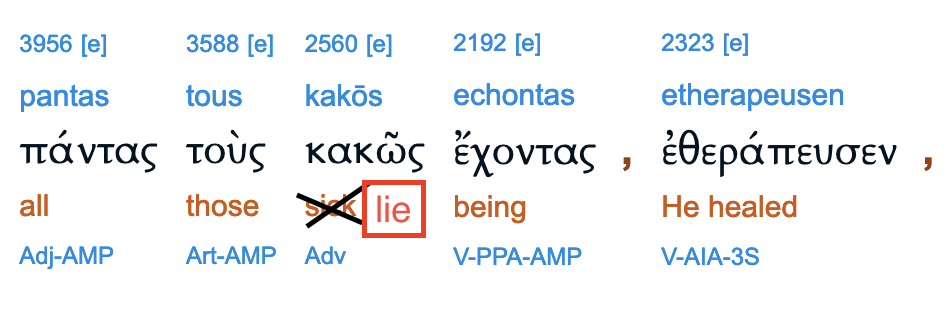
The practice was to assign a "sense" to a word as though the New Testament authors themselves gave a new sense since the true translation didn't make sense to the translators or seemed contradictory to perceived contexts/traditions. Even when such a sense is not found in Classical/secular Greek, the assumption is that the NT provides all sorts of new meanings for old words. But these "new" senses are not defined by the authors themselves, instead they are assumed by translators.
The verb ἐτάφη (aorist passive of θάπτω) is commonly translated as “was buried,” but its semantic range in Classical and Hellenistic Greek includes the full spectrum of funerary rites, not merely interment. In Greek cultural and religious practice, θάπτειν refers to the proper ritual treatment of the dead—laying out the body, public mourning, procession, interment or cremation, and tomb offerings. Thus, ἐτάφη is more precisely rendered “was given funeral rites”, indicating not just physical burial but the socially and ritually sanctioned honor of the deceased (cf. Il. 21.323; Od. 11.52; Soph. Antigone). Failure to receive such rites was considered a profound dishonor.