He is a Gift 1
γενέσεως geneseōs - The Genesis of the Branch of Salvation: Dual Son
An inner-bark of a genesis of Salvation ("Jesu") an anointed one, a son of Beloved ("David"), a son of Father of Multitude ("Abraham").
The Inner Book vs. The Outer Book ⇒ the Inner Man vs. the Outer Man ⇒ The Word Within vs. the Word in Flesh
γεννάω gennaó - Fathered from Ahead
Father of Multitude fathered the He Laughs, and He Laughs fathered the Heel Chaser, and Heel Chaser fathered the Caster and the Brothers of himself

Recursive aonic fathering means fathering yourself across time. So Hebrew geneologies:
אחרי הולידו - being behind the fathering of oneself from the front ("east").
A Breach (of birth of the Logos Ratio) Overtakes the Brother
and Caster fathered the Breach and the Rising One from out of the Palm-Tree, and Breach fathered the Inner Courtyard, and Inner Courtyard fathered the Exalted One and Exalted One fathered the My People Were Inspired, and My People Were Inspired fathered the Inner Serpent, and Inner Serpent fathered the Mantle,The Tiller Fathers the Root from Rahab the Prostitute (The Broad Way)
and Mantle fathered the Strength Within Himself from out of the Broad Way, and Strength Within Himself fathered the Worker from out of the Female-Friend, and the Worker fathered the Rootיהוה He Is in the Middle
and Root fathered the Beloved the Kingand Beloved fathered the Complete One from out of her, the one of the Flame of He Is
Strength Within

Prophetic MantleThe Earth Worker
Strength Withinthe Root
The Earth Worker Beloved
RootComplete One
BelovedAs the woman is made, so the man is re-born.
The Flame of Yah (Agape Love Eternal Ignited)
and Complete One fathered the Enlarged Gathered People, and Enlarged Gathered People fatheredthe He Is My Father, and He Is My Father fatheredthe Gatherer,Gathered to His People
and Gatherer fathered the He Is Has Judged, and He Is Has Judged fathered the He Is Exalted, and He Is Exalted fatheredthe He Is My Power, and He Is My Power fathered the He Is Perfect, and He Is Perfect fatheredthe He Grasped, and He Grasped fatheredthe Empowered of He Is, and Empowered of He Is fathered the Forgotten, and Forgotten fathered the Bold, and Bold fatheredthe He Is Supports, and He Is Supports fathered the He Is Set Upright and the Brothers of himself upon the Relocation of City of Confusion ("Babylon").and after the Relocation of City of Confusion ("Babylon"), He is Set Upright fatheredthe I Have Asked God, and I Have Asked God fatheredthe Scorched-Babel, and Scorched-Babel fathered the My Father is Splendor, and My Father is Splendor fatheredthe God Stands Up, and God Stands Up fatheredthe One Who Helps, and One Who Helps fathered the Just One, and Just One fatheredthe Brothers, and Brothers fathered1the God of Majesty, and God of Majesty fathered the God of Help, and God of Help fatheredthe Gift, and Gift fatheredthe Heel Chaser,
"Just exactly as the (Anointed) woman from out of the man, so the (anointed) man through the Woman" 1 Cor. 11:12
and Heel Chaser fathered the He Adds, the Man of Bitter Rebel, from out of her whom Salvation was fathered,1b the one who is being called an anointed one. Therefore all of the Generations away from Father of Multitude until Beloved, fourteen generations, and from Beloved until the Relocation of City of Confusion/Babylon, fourteen generations, and from the Relocation of City of Confusion/Babylon until the Anointed One, fourteen generations.Discovery of Genesis
And the Genesis of the Salvation, of an anointed one, she was thus being her who was wooed and won of the Mother of himself, of Bitter-Rebel ("Mary")2 by the He is Adding ("Joseph"), prior to an assembling/uniting of themselves, she was discovered within a belly, she who is holding from out of a spirit, a holy one.3

"And she who is holding within a belly she is also cawing, she who is in childbirth pains, and she who is being touchstone-tormented to bring forth."
(Revelation 12:2 RBT)את The Self
And He is Adding, the Man of Herself, he who is a just one and one who is not willing to make a public display of herself,4 he purposed to set herself free stealthily.4bThe Other Self
And he who has pondered deeply over these things [the branches] of himself, behold! an angel of a master, down to a dream appeared to self,4c he who is speaking, "He Adds, son of Beloved, do not be afraid to take in Bitter-Rebel the Woman of yourself, for that which has been fathered within herself, he is from out of a spirit of a holy one!"5τίκτω - Produce, Bring Forth
And she will bring forth a son, and you will summon6 the Name of himself, Salvation, for he, himself, will save the People of himself away from the Misses of themselves!And the whole of this one has become so that the one which was spoken of under a master, should be filled up straight across through the Prophet, he who is speaking,
Dual: One Which is Being Translated
Behold! the Virgin Maiden6a within a belly, she will hold and she will bear a son and they will summon the Name of Himself, God With Ourselves ("Immanuel"), which is that being translated, the God in company with ourselves.
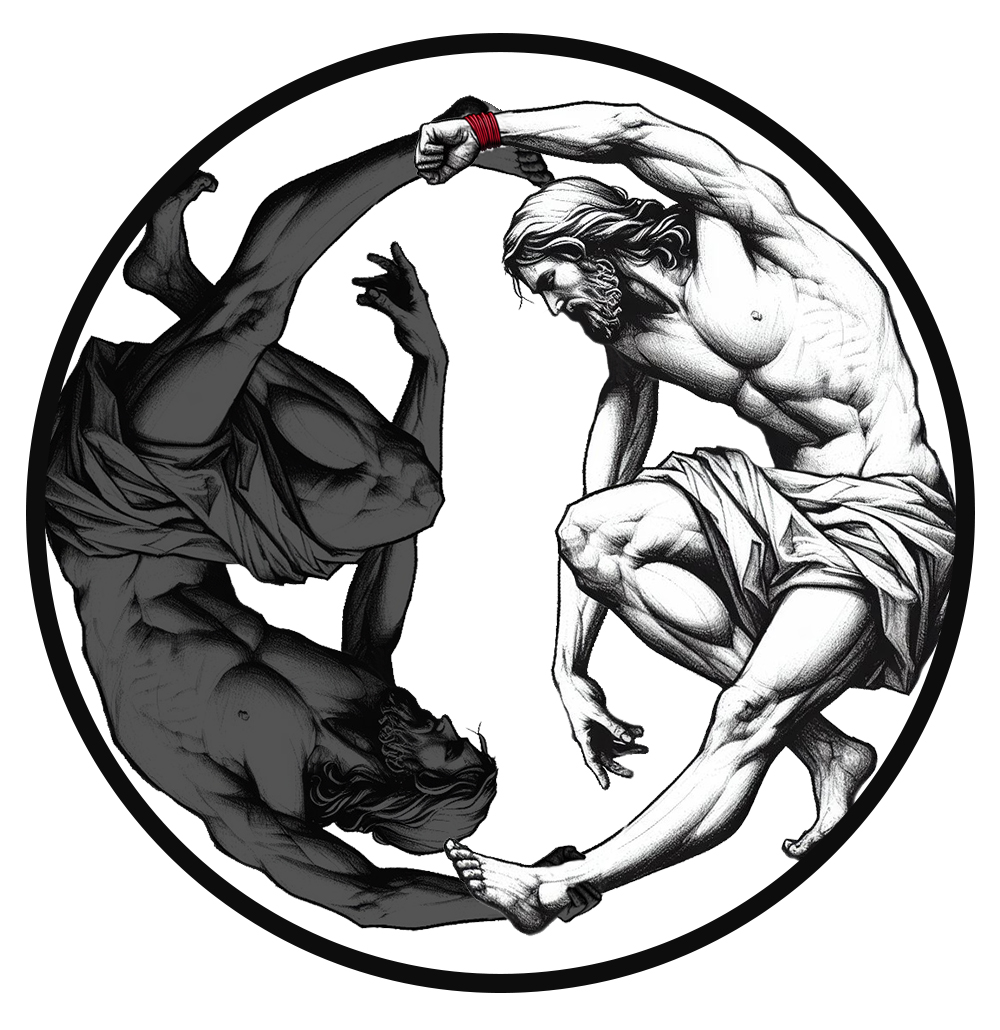
"And he is becoming in the Time of her bringing forth, and behold! Duplicates are within the belly of herself!"
"And he is becoming as one who turns back a hand of himself, and behold! the brother of himself has gone out, and she is saying, "How did you break through? Against yourself is a breach!" And he is summoning the name of himself, Breach ("Paretz")."
(Genesis 38:27,29 RBT)Breach/Gap ("Peretz")
son of Tamar as HarlotRising Light ("Zerach")
son of Tamar as Widow
Hedged/Hemmed in front and behind recursively (aion)
"Made, just as he Arranged to Self"
And the He Adds, he who has been woken up away from the Sleep, made just as he had arranged to self,6b the Angel of a master, and he took in the Woman of himself.Now I know you
And he was not knowing herself until him whom she brought forth, a son, and he summoned the Name of himself, Salvation ("Jesu").Footnotes
Greek Achim, Ἀχὶμ. #G885. Scholars are uncertain of the origin since the name is not listed in the Old Testament. Obviously, the name is Hebrew since the ancestors of the Messiah in this lineage were not Greek. Strongs suggested Yoqim (#3137) but the word is the same phonetically as the Hebrew אַחִים achim which is plural for "brothers." Cf. Strong’s Hebrew #251.
Who or Whoever?
In addition to the compound ὅστις (ὅσ-τις) "whoever/anyone who" which stresses an indefinite or general subject, the particles ἂν and ἐὰν are often used with the relative pronoun ὃς in conditional or indefinite clauses, with subtle distinctions in their usage:
-
ἂν: Typically used in combination with the subjunctive mood (and occasionally the optative), ἂν expresses potentiality, uncertainty, or condition. It is often used to convey conditional or hypothetical situations. It is not used with the indicative mood.
Example: ὃ ἐὰν ποιήσῃ ("whoever might do this" or "anyone who does this") — Here, ἐὰν introduces a conditional or indefinite action with the subjunctive. -
ἐὰν: This is a combination of ἐν ("if") and ἄν. It is used with the subjunctive to indicate conditional meaning or possibility in a general sense, typically translated as "if," "whenever," or "whoever." It is used when the action of the verb is indefinite or conditional.
Example: ὃ ἐὰν ἴδω ("whoever I see" or "whatever I see") — Here, ἐὰν introduces a conditional or indefinite sense with the subjunctive verb ἴδω ("I see"). -
Without ἂν or ἐὰν: When the action is factual or indefinite in a more general sense, without the condition or hypothetical uncertainty, the relative pronoun alone can be used with the indicative mood.
Example: ὃ λέγω ("whatever I say") — Here, the verb λέγω ("I say") is in the present indicative and doesn't require ἂν or ἐὰν. Of course, ὃ λέγω can also be translated as "what I say" or "that which I speak" and thus the interpretation is ultimately up to the translator.
"Factual" Usage of the Relative Pronoun:
A phrase like ὃ δέδωκέν can be understood as expressing a factual meaning, and it differs from a conditional clause in that it does not require ἂν or ἐὰν.
- ὃ: The neuter singular relative pronoun, meaning "what/whatever" or "who/whomever", referring to an indefinite subject or object in a relative clause.
- δέδωκέν: The perfect tense of the verb δίδωμι (to give), meaning "he has given" (third person singular).
- ὃ δέδωκέν can be interpreted as "whatever he has given" or "whomever has given", depending on the context. It expresses a factual statement where the perfect tense of the verb indicates that the action of giving has already been completed but still holds relevance.
In this case, ἂν and ἐὰν are not needed because you're not expressing a condition or indefiniteness in the same way as you would with a subjunctive verb. The perfect tense already conveys a sense of completed action with continuing relevance:
- ὃ ἔγραψεν – "What he wrote" or "Whatever he wrote."
- ὃ ἔφαγεν – "What he ate" or "Whatever he ate."
What saith the translator?
Thus, When we read ἧς ἐγεννήθη, an aorist past tense verb with a feminine singular relative pronoun, it simply refers to the fact of someone that has been born and can be translated as "of whom he was born" or, "of whomever he was born" in a non-conditional or non-hypothetical sense.
Neither translation is incorrect. So which one is right? Context/bias dictates.
Greek μνηστευθείσης τῆς μητρὸς αὐτοῦ Μαρίας. Every one of these words is in the genitive case.
- of she who is wooed
- of the mother
- of himself
- of Mary/Bitter-Rebel
μνηστευθείσης "her who was wooed and won" is a participle noun in the genitive, aorist tense.
The phrase πρὶν ἢ συνελθεῖν αὐτοὺς is composed of the temporal particle πρὶν ἢ, meaning “before” or “prior to,” governing the aorist active infinitive συνελθεῖν (“to assemble together” or “to unite”), with the accusative pronoun αὐτοὺς (“them”) as its object. This construction denotes a temporal clause indicating an action occurring before the subject’s assembly or union. This construction or usage is rare, but not without purpose. The temporal aspect can lead a translator to render the infinitive as a past tense, e.g. "before they united" but this erases the infinitive-accusative sense. “Prior to uniting/assembling together themselves” is a more accurate and faithful rendering of πρὶν ἢ συνελθεῖν αὐτοὺς, because it preserves the infinitive’s non-finite aspect and does not impose a past tense finite verb. It captures the temporal sequence without transforming the phrase into a completed action.
Discovered in a Belly
Greek ἐκ πνεύματος ἁγίου. from out of a spirit of a holy one. There is no definite article "the" present in this text, therefore capitalizing the words or adding "the" to the text is less than accurate. ἁγίου which is also translated as "saint" is in the genitive case.
Greek hagios. #G40. set-apart, different, holy, sacred. Used in the Septuagint for the Hebrew qadosh which means “set-apart, holy”.
“The fundamental (core) meaning of 40 (hágios) is “different” – thus a temple in the 1st century was hagios (“holy”)
Holding within a Belly or Found within a Belly?
The literal of this phrase is "she was found in a belly she who is holding"
ἐν γαστρὶ "within a belly." Strongs #1064 γαστήρ (gastér) a word from which we get all the gastro- words. The significance of this word lies in the fact that there exists more appropriate Greek words for "womb" e.g. #3388 métra and koilia #2836.
Certain biases will lean toward translating ἐν γαστρὶ ἔχουσα as "holding within a belly" as it is normal for verbs to follow objects in Greek. However, the verb that follows "in a belly" is in participle form, which is not so typical, if "belly" was meant to be the object. Moreover, Ancient Greek literature and texts often preferred precise terms to describe specific states or conditions, and ἔγκυος was the accurate term for pregnancy, not "holding" ἔχουσα. But even if that were the intention of the writer here, it leaves the prior verb εὑρέθη "she was found" an aorist indicitive active verb without any object. She was found....where?
Overall, there is quite a forceful and awkward shift to go from
"she was found in a belly she who is holding"
to
"she was discovered to be pregnant in womb"
since, 1) there is no infinitive κυεῖν "to be pregnant" in this verse and 2) there is no word μήτρα "womb/matrix" either.
Luke, when speaking of Mary uses ἐγκύῳ "pregnant" which literally means "swelling inside" from a word κύῳ meaning "wave/swell" of a sea or lake.
Our RBT translation of this verse does not modify, add, hack, or delete any words.
Greek ὤν, καὶ μὴ θέλων αὐτὴν. he who is and not he who desires. A "just one" (δίκαιος) is an adjective in the nominative and "he who is" (θέλων) is a masculine participle verb. μὴ θέλων "not he who desires" is also a negated masculine participle verb. Participle verbs are not inconsequential.
Will vs. Desire
-
βούλομαι (boulomai) to will:
- This verb often conveys a more deliberate or intentional desire. It can imply a desire that is reasoned or planned.
- "βούλομαι" is frequently used in contexts involving decision-making, choice, or intentionality.
- It can also convey a wish or desire that is considered more seriously or with greater consideration.
- Example: "Βούλεσαι τοῦτο ποιήσαι;" (Boulesai touto poiēsai?) - "Do you wish/intend to do this?"
-
θέλω (thélo) to desire:
- "θέλω" generally denotes a more immediate or spontaneous desire. It often implies a want or wish that arises more from impulse or inclination.
- This verb is used in a wide range of contexts and can express desires ranging from simple preferences to strong wishes.
- "As respects the distinction between βούλομαι and θέλω, the former seems to designate the will which follows deliberation, the latter the will which proceeds from inclination. This appears not only from Matthew 1:19, but also from the fact that the Sept. express the idea of pleasure, delight, by the verb θέλειν" - Thayers Greek Lexicon (Thayer, Joseph Henry. "STRONGS NT 2309: θέλω." Thayer's Greek Lexicon.)
not he who desires to make a show of herself. The following infinitive "to make a show of, example of" is a compound word not found in Greek writings, and therefore a special NT word derived from the noun "δεῖγμα" (deígma), meaning "example" or "demonstration," and the verb δεικνύω (deiknúo), meaning "to show" or "to demonstrate." So, δειγματίσαι refers to the act of demonstrating or proving a thing/person publically.
αὐτός The True Self את
The pronoun αὐτός, used "inordinately" throughout the New Testament, is a word that fundamentally denotes one’s true self, often distinguishing the soul from the body (Od. 11.602) or, conversely, the body from the soul (Il. 1.4). It functions reflexively as “self” and, in oblique cases, as a personal pronoun (“him, her, it”).
It emphasizes individual identity in contrast to others, such as a king vs. his subjects (Il. 6.18), Zeus vs. the other gods (Il. 8.4), or a warrior vs. his weapons (Il. 1.47).
With the article (ὁ αὐτός, ἡ αὐτή, τὸ αὐτό), it signifies "the same" or "the very one."
In prose, αὐτός can appear without the article for proper names (αὐτὸς Μένων, X. An. 2.1.5) and is used impersonally in phrases like αὐτὸ δείξει ("the result will show," Cratin. 177). It also expresses volition (“of one’s own accord,” Il. 17.254) or personal presence (“in person,” D. 1.2).
The most frequent noun word used in the NT is not "God" (θεός), found 1,317 times, but rather αὐτός self, found over 5,600 times in all its forms. The only words more frequent are "and" (9,000 times) and "the" (20,000 times). Similarly, and of no small consequence, the most frequent word in the Old Testament Hebrew is את the eternal self, occuring over 11,000 times.

In ancient Greek, αὐτό—specifically the neuter singular form of αὐτός—is the only appropriate and attested lexical item to express the metaphysical concept of "the self", especially in Platonic and post-Platonic philosophical discourse.
-
Philosophical Usage:
-
In Plato and later authors, expressions like τὸ αὐτό ("the selfsame") or αὐτὸ τὸ ὄν ("being itself") represent the essence or pure identity of a thing, distinct from its accidents or manifestations.
-
Notably, in Plato's dialogues, constructions such as:
-
αὐτὸ τὸ ἀγαθόν – “the Good itself”
-
αὐτὸ τὸ καλόν – “the Beautiful itself”
are paradigmatic examples of Forms or Ideas, i.e., entities existing in themselves and through themselves — the metaphysical “Selves” of their kind.
-
-
-
Semantic Range:
-
While αὐτός generally functions as a third-person pronoun or intensifier, its neuter form, especially when used absolutely or with the definite article, becomes substantive and ontologically loaded:
-
τὸ αὐτό = "the same", "the selfsame", "the self (in essence)"
- αὐτῷ "to self" (dative neuter is identical to dative masculine)
-
-
This contrasts with ἑαυτοῦ, which is grammatically reflexive and bound to a subject, not abstract or metaphysical.
-
-
Terminological Precedence:
-
Later philosophical traditions (Neoplatonic, Stoic, etc.) frequently use forms of αὐτός to express inner identity, core being, or metaphysical selfhood.
-
(cf. LSJ αὐτός)
λά̄̆θρᾳ (adv.), from λανθάνω, means “furtively, on the sly.” Used frequently in Homeric and Classical texts
-
Od. 17.80 (ἐμὲ λάθρῃ κτείναντες — “killing me by treachery”)
-
Il. 19.165 (λάθρῃ γυῖα βαρύνεται — “little by little my limbs become heavy”)
-
Hdt. 4.79.5 (αὐτούς … λάθρῃ ἐπὶ πύργον κατεῖσε — “he secretly brought them up on the tower”)
-
Xen. Hell. 2.4.35 (λάθρᾳ πέμπων — “sending [a message] on the sly”)
את the Self
The Greek word αὐτός (fem. αὐτή, neut. αὐτό) originally bore a sense of "self" or identity, and in certain contexts retains this meaning. While often used simply as a third-person pronoun ("he," "she," "it") in oblique cases, αὐτός can also function emphatically (e.g., ὁ αὐτός = “the very one,” αὐτὸς ὁ βασιλεύς = “the king himself”).
The Neuter Form
In philosophical or poetic usage, particularly in Homer and Plato, the neuter form αὐτό may denote one’s true self, either the soul (Od. 11.602) or, conversely, the body (Il. 1.4), depending on context. It also appears in abstract references to essence, identity, or the very thing itself (τὸ αὐτό), as in expressions of intrinsic nature or reality (cf. Plato, Republic 362d: αὐτὸ ὃ μάλιστα ἔδει ῥηθῆναι – "the very thing that most needed to be said").
Thus, while αὐτός is not reflexive in the grammatical sense (cf. ἑαυτοῦ, "of oneself/one's own self"), it does, especially in neuter form, preserve and express a conceptual sense of "Self" or "the same being", particularly in metaphysical or emphatic contexts.
in ancient Greek, αὐτό—specifically the neuter singular form of αὐτός—is the only appropriate and attested lexical item to express the metaphysical concept of "the self", especially in Platonic and post-Platonic philosophical discourse.
-
Philosophical Usage:
-
In Plato and later authors, expressions like τὸ αὐτό ("the selfsame") or αὐτὸ τὸ ὄν ("being itself") represent the essence or pure identity of a thing, distinct from its accidents or manifestations.
-
Notably, in Plato's dialogues, constructions such as:
-
αὐτὸ τὸ ἀγαθόν – “the Good itself”
-
αὐτὸ τὸ καλόν – “the Beautiful itself”
are paradigmatic examples of Forms or Ideas, i.e., entities existing in themselves and through themselves — the metaphysical “Selves” of their kind.
-
-
-
Semantic Range:
-
While αὐτός generally functions as a third-person pronoun or intensifier, its neuter form, especially when used absolutely or with the definite article, becomes substantive and ontologically loaded:
-
τὸ αὐτό = "the same", "the selfsame", "the self (in essence)"
- αὐτῷ "to self" (dative neuter is identical to dative masculine)
-
-
This contrasts with ἑαυτοῦ, which is grammatically reflexive and bound to a subject, not abstract or metaphysical.
-
-
Terminological Precedence:
-
Later philosophical traditions (Neoplatonic, Stoic, etc.) frequently use forms of αὐτός to express inner identity, core being, or metaphysical selfhood.
-
(cf. LSJ αὐτός)
The fact that τὸ (that which) and γεννηθὲν (that which is conceived/begotten) are in the neuter may be of no consequence. Perhaps the author mistakenly forgot to write these in the masculine him, to refer to the Messiah. Or perhaps not.
Strongs #G3880 παραλαμβάνω (paralambano), receive from, take from, take to oneself, receive something transmitted. This word can be tricky considering that παρα "close beside." When the verb παραλαμβάνω (paralambano) is used with a person, it typically signifies either taking something from them or receiving the person themselves. In this case we have τὴν γυναῖκά σου "the woman of yourself" which is in the accusative. The translation "as your wife" is changing the clause and adding the word "as". Greek employs a more common word λαμβάνω (lambano) for "to take." See Logeion on paralambanó and lambano.
Strongs Greek καλέω, kaleo. To summon, or call. The primary meaning of this word is to summon, invite, as to a feast for example. "Naming" is a secondary. The author of Matthew is selectively using this word, not indiscriminately and thus just a few verses later in Matt 2:7 he uses the same word directly as "summoning/inviting" the Magi.
Birth vs. Begetting
τίκτω is not the proper word for "begotten" in the sense of emphasizing the father's role in procreation.
τίκτω focuses on the act of bringing something into existence—whether biologically (giving birth or begetting) or figuratively (producing ideas, things, or events). It is used of the earth producing, animals breeding, and spawning of fish as well as of parents engendering a child.
γεννάω emphasizes the act of procreation and begetting, often referring specifically to the father's role.
When τίκτω might not be ideal:
-
For the State of Being Born:
- For a child being born (passive sense), γεννάομαι or ἔρχομαι εἰς τὸν κόσμον (to come into the world) might be more common in certain contexts.
-
For General "Birth" as a Noun:
- γέννησις ("birth") or γέννημα ("that which is born") are used for abstract or nominal forms of birth.
-
For Lineage or Descent:
- γεννάω is often used to emphasize genealogy, especially in contexts of biblical or historical lineages.
The Maiden
Strongs #G3933, παρθένος parthenos. The term "παρθένος" (parthenos) in ancient Greek primarily refers to a maiden or a virgin, and it carries multiple connotations depending on the context in which it is used. Here's a breakdown of its meanings and usage:
-
Basic Definition:
- Maiden, Girl: Refers to an unmarried young woman, often implying virginity. This usage is common in various texts, such as Homer's "Iliad" (Il. 22.127), Sophocles' "Oedipus Tyrannus" (S. OT 1462), and Aristophanes' "Equites" (Ar. Eq. 1302).
- Virgin: Specifically denotes a virgin, distinguishing her from a married woman (γυνή). This can be seen in Euripides' "Troades" (E. Tr. 148) and Theocritus (Theoc. 27.65).
-
Unmarried Women Who Are Not Virgins:
- There are instances where "παρθένος" refers to unmarried women regardless of their virginity status, as seen in Homer (Il. 2.514), Pindar (Pi. P. 3.34), Sophocles (S. Tr. 1219), and Aristophanes (Ar. Nu. 530).
-
As a Title for Deities:
- Athena: Often called "Παρθένος" as the Virgin Goddess, particularly at Athens (Paus. 5.11.10, 10.34.8).
- Artemis: Also referred to as "Παρθένος" (E. Hipp. 17).
- Iphigenia: Called "Παρθένος" in the context of her association with the Tauric rites (Hdt. 4.103).
- Vestal Virgins: The term "αἱ ἱεραὶ π." refers to the Vestal Virgins in ancient Rome (D.H. 1.69, Plu. Util. 2.89e).
- Unnamed Goddess: Sometimes used for an unnamed goddess in inscriptions (SIG 46.3).
-
Astronomical Reference:
- Constellation Virgo: "παρθένος" is used to denote the constellation Virgo (Eudox. ap. Hipparch. 1.2.5, Arat. 97).
-
Metaphorical and Extended Uses:
- Pupil of the Eye: In some contexts, "κόρη" can mean pupil, and "παρθένος" can metaphorically extend to this meaning (X. ap. Longin. 4.4, Aret. SD 1.7).
- Chaste: As an adjective, it can describe something pure or chaste, such as a "maiden soul" (E. Hipp. 1006), or a metaphorical "virgin spring" (A. Pers. 613).
- Parthenon: The term "παρθένος" (parthenos) is also related to the word "Parthenon." The Parthenon, a famous ancient temple on the Acropolis of Athens, was dedicated to the goddess Athena Parthenos, which means "Athena the Virgin."
In summary, "παρθένος" has a broad range of meanings primarily centered around the concepts of maidenhood and virginity, but it can also extend metaphorically and contextually to various other interpretations.
את the Self
The Greek word αὐτός (fem. αὐτή, neut. αὐτό) originally bore a sense of "self" or identity, and in certain contexts retains this meaning. While often used simply as a third-person pronoun ("he," "she," "it") in oblique cases, αὐτός can also function emphatically (e.g., ὁ αὐτός = “the very one,” αὐτὸς ὁ βασιλεύς = “the king himself”).
In philosophical or poetic usage, particularly in Homer and Plato, the neuter form αὐτό may denote one’s true self, either the soul (Od. 11.602) or, conversely, the body (Il. 1.4), depending on context. It also appears in abstract references to essence, identity, or the very thing itself (τὸ αὐτό), as in expressions of intrinsic nature or reality (cf. Plato, Republic 362d: αὐτὸ ὃ μάλιστα ἔδει ῥηθῆναι – "the very thing that most needed to be said").
Thus, while αὐτός is not reflexive in the grammatical sense (cf. ἑαυτοῦ, "of oneself"), it does, especially in neuter form, preserve and express a conceptual sense of "Self" or "the same being", particularly in metaphysical or emphatic contexts.
in ancient Greek, αὐτό—specifically the neuter singular form of αὐτός—is the only appropriate and attested lexical item to express the metaphysical concept of "the self", especially in Platonic and post-Platonic philosophical discourse.
-
Philosophical Usage:
-
In Plato and later authors, expressions like τὸ αὐτό ("the selfsame") or αὐτὸ τὸ ὄν ("being itself") represent the essence or pure identity of a thing, distinct from its accidents or manifestations.
-
Notably, in Plato's dialogues, constructions such as:
-
αὐτὸ τὸ ἀγαθόν – “the Good itself”
-
αὐτὸ τὸ καλόν – “the Beautiful itself”
are paradigmatic examples of Forms or Ideas, i.e., entities existing in themselves and through themselves — the metaphysical “Selves” of their kind.
-
-
-
Semantic Range:
-
While αὐτός generally functions as a third-person pronoun or intensifier, its neuter form, especially when used absolutely or with the definite article, becomes substantive and ontologically loaded:
-
τὸ αὐτό = "the same", "the selfsame", "the self (in essence)"
- αὐτῷ "self" (either neuter or masculine dative)
-
-
This contrasts with ἑαυτοῦ, which is grammatically reflexive and bound to a subject, not abstract or metaphysical.
-
-
Terminological Precedence:
-
Later philosophical traditions (Neoplatonic, Stoic, etc.) frequently use forms of αὐτός to express inner identity, core being, or metaphysical selfhood.
-
(cf. LSJ αὐτός)