He is a Gift 3
τῶν οὐρανῶν - The Heavenly Ones (Plural)
He who is speaking, "Change the mind, for she has drawn near, the Queen of the Heavenly Ones!βοάω - War Shout, Rally Cry
For this one is the one who has been spoken of straight across through He Is Liberates Himself ("Isaia-hu"), the Prophet, he who is speaking, 'A voice of him who is war-crying within the Lonely/Desolate one, Prepare the Road of master, make the Worn-Paths of himself straight ones!"The Mother of Himself: Engendering Himself by a Camel, Girding on Ones Skinned Alive, Nourished by Nothing Desirable
And he, himself, the Favored, kept holding the Outer Garment of himself away from hairs of a camel, and a women's-girdle8e of leathern-skin around the Loin of himself, and the Nourishment, she was being of himself, locusts and savage honey.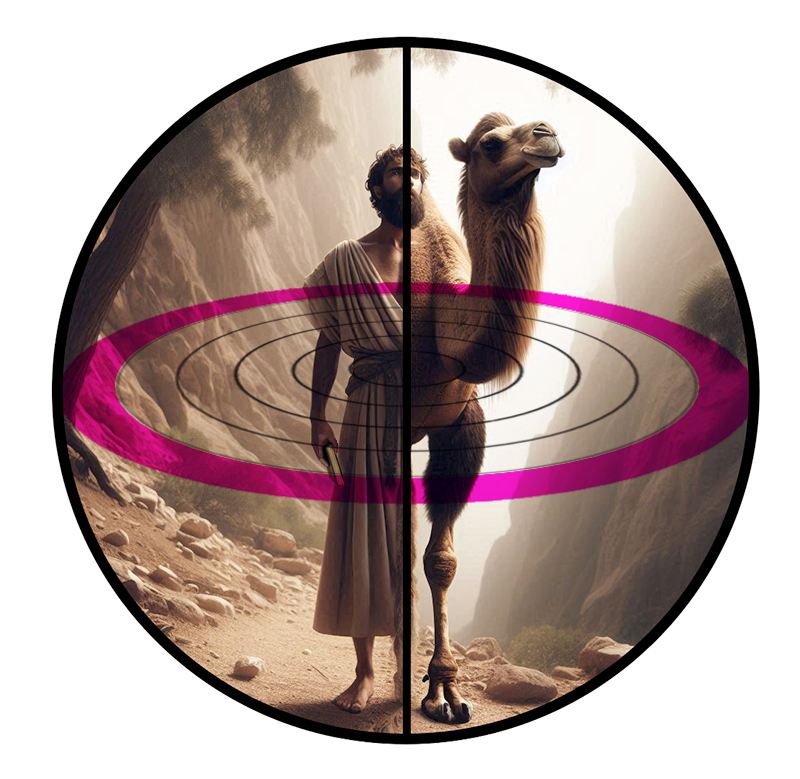
- The Hebrew word for "words" is דברים (d'varim), Strong's #1697. It is derived from the root דבר (dabar), #1696, meaning "ordered word." The term דברים is commonly used to denote spoken or written words.
- The Hebrew word for "bees" is דבוֹרים (d'vorim), Strong's #1682. It is derived from the same root דבר (dabar), which means "ordered/arranged word."
- The noun for bee, not surprisingly, is specifically constructed from the passive participle: דבוֹר which means, "he who is spoken." Bees = those who are spoken/arranged in order.
- But it does not end there. דבורה #1683 Deborah, the Judge, her name means, "Bee." But literally it is the feminine of the passive participle, "she who is arranged in order." The Writing is like the Outer Garment of the Word.
The Forerunner
Then he led out Foundations of Peace toward Himself, and whole of the Caster ("Judean"), and the whole Surrounding Region of the Descending ("Jordan").And they were plunging/sinking within the Descending river under himself, those who are fully acknowledging the Misses of themselves.
Offspring of Treacherous Women
And he who has perceived multitudes of the Separatists ("Pharisees") and Followers of the Just One ("Sadducees"), those who are coming up to the Plunging, he said to themselves, "Offspring of vipers,9 who indicated to yourselves to flee away from the Wrath of the one who is destined to be?Make therefore a fruit counterbalancing of the Change of Mind!
And don't think to say within yourselves, 'We have a Father, the Father of Multitude ("Abraham")' for I am speaking to yourselves that the God is able from out of the Stones of these ones to wake up children to the Father of Multitude.
The Separation
But already the Axe is laid toward the Root of the Trees. Therefore every tree that is not making a beautiful fruit, she is cutting off and casting into fire.Myself to Myself
I, indeed myself, am plunging yourselves within water into a change of mind, and the one who is coming hereafter/in the future to myself, he is the mightier one of myself, of whom the Sandals I am not a fitting one to carry, he will plunge yourselves within a holy spirit and a fire,"Ruth"
of whom is the Winnowing Fork within the Hand of himself, and she will purge thoroughly the Threshing Floor of himself and gather the Wheat of himself into the Storehouse, and the Chaff she will burn up with an inextinguishable fire!"with a three-pronged fork...
The Submerging
At that time, the Salvation is becoming near, away from the the Circuit ("Galilee"), upon the Descending, toward the Favored, of the Submerging below himself.9aBut the one kept hindering himself, he who is saying, "I, myself am holding a need under yourself to be plunged and you, yourself are coming toward myself!"
ἀφίημι - With Accusative of Person: Permit, Acquit, release
And he who has been separated, the Salvation, spoke toward himself, "Permit at this point, for in this way it is fitting/proper to ourselves to fill up every just one." At that point he is permitting himself.The Submerging Below
"Jacob's Ladder", Eyes Opened
And the Salvation, he who was submerged, immediately climbed up away from the Water, and behold! the Heavenly Ones were opened up, and he perceived a spirit of God, that which is climbing down, as though a dove, that which is coming upon himself!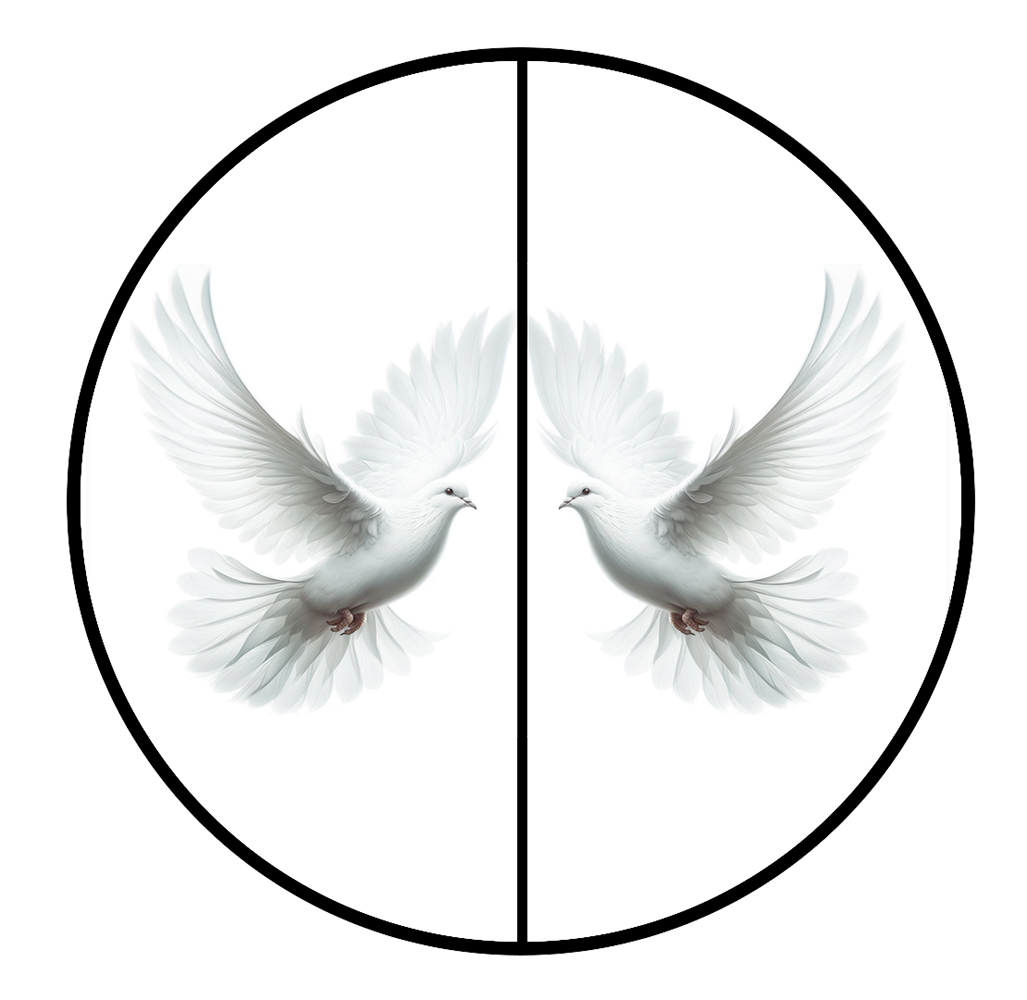
The Tree Pleasing to the Eye
And behold! A voice from out of the Heavenly Ones, she who is saying, "This one is the Son of myself, the Beloved One within whom I have found delight!"Footnotes
Scripture as a Woman's Girdle vs a Noose
ζώνη : girdle of a woman (see cut No. 48, also Nos. 44 and 61); then for waist, Il. 2.479, Il. 11.234.
(Autenrieth Homer)
ζώνη: A girdle worn by a goddess or a woman: ζώσατο ζώνῃ Il. 14.181. Cf. Od. 5.231 = Od. 10.544.
Fig.: λῦσε παρθενίην ζώνην (her maiden girdle) Od. 11.245.
The waist or loins of a man Il. 2.479, Il. 11.234.
(Cunliffe Homer)
ζώνη, ἡ, belt, girdle, waistband; at Hom. the lower belt that the women wore above the hips, which held the garment together, which hung down in folds (cf. ζωστήρ)
(Pape)
ζών-η, ἡ, (ζώννυμι)
prop. the lower girdle worn by women just above the hips, περὶ δὲ ζώνην βάλετʼ ἰξυῖ Od. 5.231, 10.544, cf. Il. 14.181, Hdt. 1.51, etc.
A manʼs belt is more freq. ζωστήρ
ἡ ζώνη τοῦ Ὠρίωνος the girdle of Orion (the three stars) Aristotle, Meteorologica (343b24)
(LSJ)
See Logeion LSJ on the metaphorical usage of ἔχιδνα, "viper":
- Aeschylus (A. Ch. 249), Sophocles (S. Ant. 531): Here, "viper" is used metaphorically to describe a treacherous or deceitful wife or friend. It implies the idea of someone who is cunning, venomous, or dangerous, similar to the behavior of a viper.
- Secundus (Secund. Sent. 8): This reference suggests the metaphorical use of "viper" to describe a deceitful or malicious woman, emphasizing negative traits associated with the snake.
- Gospel of Matthew (Ev. Matt. 3.7): In the New Testament, John the Baptist uses the phrase "brood of vipers" as a term of reproach when addressing the Pharisees and Sadducees who came to him for baptism. It symbolizes their hypocrisy, deceitfulness, and moral corruption.
This metaphor of "viper" for a treacherous woman was in use for centuries prior to the NT.
Greek τοῦ βαπτισθῆναι of the Submerging/Baptizing.
The definite article the + infinitive verb. The definite article the is left out/discarded by every translation we have seen.