He is a Gift 2
μάγοι - Magicians, astrologers, seers, interpreters of dreams, augurs, soothsayers, sorcerers
And of the Salvation, of the one who was fathered within House of the Bread Loaf ("Bethlehem") of the Caster ("the Judean") within days of Heroic ("Herod"), the King, behold! magicians away from rising ones6c came alongside into Foundations of Peace ("Jerusalems"),ἀπὸ ἀνατολῶν → away from risings
ἐκ τῆς ἀνατολῆς → out of the East
of the mind, ἀ. θυμοῦ away from, i.e. alien from(cf. LSJ ἀπό I.2,3)
"Wow"
τίκτω - Engendered by the Casters
those who are saying, "Where is he? The King who was begotten of the Casters ("Judeans")? For we perceived the Star of Himself within the Rising One ("the East") and we came to fall in worship to himself!"7
ἀνατολή - "rising above the horizon, of any heavenly body, e.g. the sun" (cf. LSJ)
Day Star/Dawn Star
The only planet that spins backwards....
leading the way to the Day...
"Current theory holds that Venus initially spun in the same direction as most other planets and, in a way, still does: it simply flipped its axis 180 degrees at some point..."
(cf. Scientific American)Ἱεροσόλυμα - Jerusalems
And he who heard, the King, Heroic, he was stirred to and fro, and also every Foundation of Peace ("Jerusalem") in company with himself.7aἐταράχθη - to stir, trouble
"upon the waters of resting places he refreshes myself."
(Psalm 23:2 RBT)συνάγω - Bring together, Compile, Collect
And he who collected all of the Arch Priests and scholars of the People, he kept learning along beside themselves where the Anointed One is being fathered.8Working their Magic: Bethlehem too Young to Bear or Not?
And those ones said to self, "Within House of the Bread Loaf of the Caster ("the Judean"), for in this way he has been inscribed straight across through the Prophet, And you, yourself House of the Bread Loaf, an earthly one of Caster ("Judah"), are in no way a littlest one within the Leaders of Caster ("Judah"), for from out of yourself he will come forth, he who is leading the way, anyone who will shepherd the People of myself, the God Contends ("Israel")!"
"And your eternal self, House of Bread of Fruitfulness, is too young/little to be within thousands of Caster ("Judah"); He went out away from yourself to myself to become a ruler within God Contends, and the origins of himself are from the front/east, from days of eternity!"
(Micah 5:2 RBT)ταράσσω
I.2 to trouble the mind, confound, agitate, disturb, disquiet, Trag., Plat., etc.: absol. to cause confusion, Plat. (cf. LSJ ταράσσω)
At that time, Heroic, he who has cited the Magicians stealthily, made precise from beside themselves the Chronological Time of the one who is shining of a star.
ἀκριβῶς - Precise Accuracy (The Sharp Shooter)
And he who has sent themselves into House of the Bread Loaf said, "Those who have been carried along, closely examine with precise accuracy around to8a the Little Child, and when you find, bring back tidings to myself, such that I also, he who has come, may prostrate/kiss to self.
ἀνατολή - A rising (of sun and stars): The Star within a Star, Led to the Roof "On Top of the Place"
And the ones who have heard the King, they traveled across, and behold! The Star, him whom they perceived within the Rising One, he kept leading themselves forward, until he who has come stood ready on top of where the Little Child was being.ἀστέρα
estera
Esther, (Persian stâra, star).
Star of the Right "South"
In ancient cultures, directions were often named relative to one's orientation.
Greek OrientationIn Greek, "east" is associated with the word for "rising" (Ἀνατολή, Anatolē), which comes from the verb ἀνατέλλω (anatellō), meaning "to rise," referencing the sun rising in the east.
Hebrew OrientationIn Hebrew, directions are named based on facing east:
- "South" is called yamin (ימין), which means "right hand," because when facing east, the south is on the right.
- "North" is called s'mol (שמאל), which means "left hand/obscured/shut up" because the north is on the left when facing east.
This orientation reflects the significance of the east as the primary direction, from which other directions are derived. The association of "east" with "rising" in Greek and the Hebrew word for "south" meaning "right hand" both highlight how each culture's language and understanding of direction are influenced by facing the east, the direction of the sunrise.
On the other hand (pun intended), in various Semitic languages, the root "שׂמל" (s-m-l) or similar roots can convey meanings of "dark" or "sinister," which are often metaphorically linked to being hidden or obscure. In ancient times, the left side was sometimes associated with negative connotations, secrecy, or things that are concealed.
Lifting the Eyes Up
And those who perceived the Star rejoiced with an exceeding mega joy.Those who fell vs. Those who opened themselves
And those who came into the House perceived the Little Child in company with Bitter-Rebel, the Mother of himself, and those who fell, they prostrated to self. And those who have opened the Treasure-Storehouses of themselves they brought to self gifts, gold and frankincense and myrrh.8bχρηματίζω - Sleepers Negotiating Business Affairs, Bending Down, Stuck in the Past
And those who transacted business in accordance with a dream, to not bend back toward Heroic, they withdrew backward by different road into the Position of Themselves.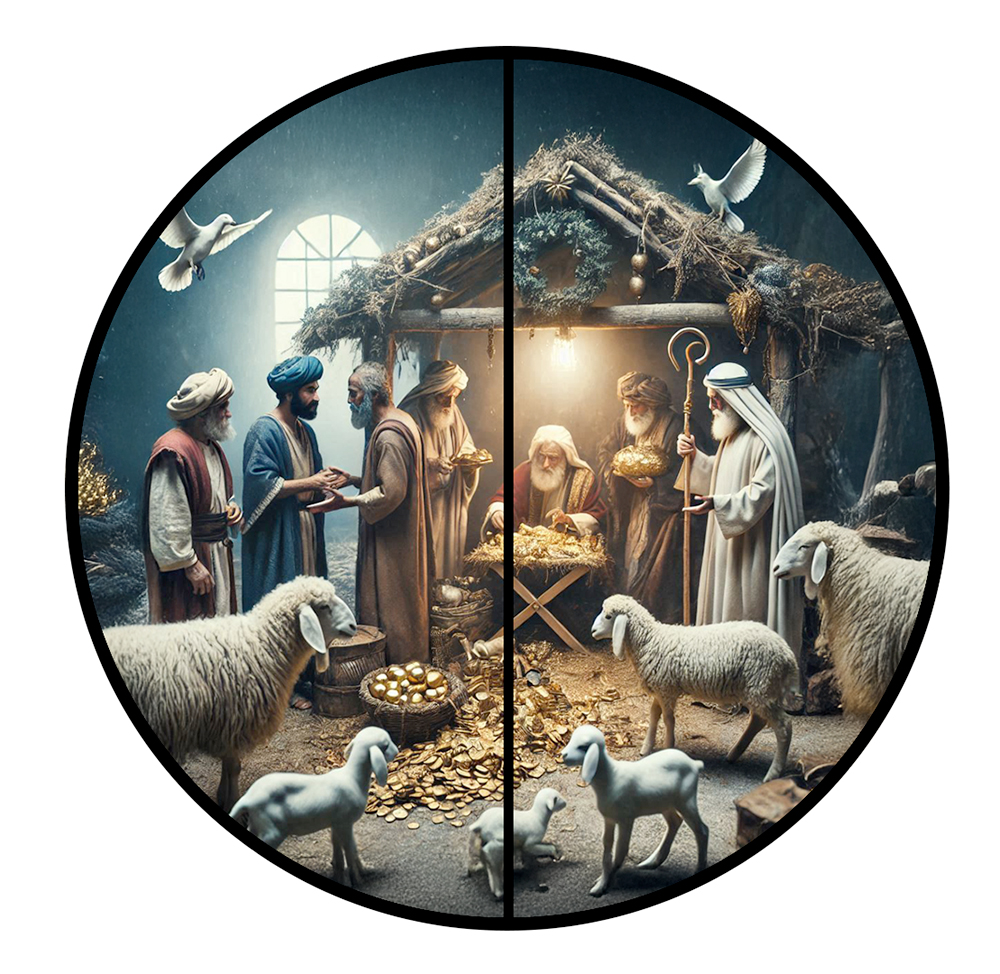
The Greek verb χρηματίζω (chrēmatizō) is a term derived from χρῆμα (chrēma, meaning "thing," "property," or "money"). Its primary meaning relates to conducting business, deliberating, or negotiating.
The passive χρηματίζομαι would be understood as "is engaged in business" or "is involved in financial transactions."("Divinely warned" is an interpretation of an extended meaning of "given a response by an oracle" as seen in Plutarch's "De Defectu Oraculorum" (On the Decline of the Oracles 2.435c). This sense of "divinely warned" was thus considered a "specialized" used only in the New Testament. It was never used in such a sense otherwise. Ultimately, tradition usurped definition.)
χώραν - the position, proper place of a person or thing (cf. LSJ 3)
Of the Self Destruction
And while they, themselves went backward—behold! An angel of a master is appearing in accordance with a dream, he who is saying to the He Adds ("Joseph"), he who has woken up, "Take in the Little Child and the Mother of himself, and flee into Dual Siege ("Egypt"), and be there until I should speak to yourself, for Heroic is destined to search for the Little Child of the Destroying of Self!"8cעשו Esau = "What They Made", A Sa'iyr, A Hairy One
"I have loved your eternal selves! He Is has spoken! and you all have said, Within what way have you loved ourselves? Is not What They Made ("Esau") a brother to Heel Chaser ("Jacob")? The whisper of He Is, And I love self eternal Heel Chaser! And self eternal What They Made, I have hated!"
(Malachi 1:2,3 RBT)(עשו #6213 - they made, they constructed, they offered, they prepared, they have done
Born Of the Night, Takes them In
And the one who has been woken up, he took in the Little Child and the Mother of himself of night, and he withdrew backward into Dual Siege ("Egypt")."Bro!"
"Take in the Child of Self-Destruction and the Mother of himself, and flee into Dual Siege ("Egypt")"
Not from out of Bethlehem: τῆς τελευτῆς - the Finishing, Consummation
And he was being there until the Finishing of Heroic, so that she might be filled up, that which was spoken under a master straight across through the Prophet, the one who is speaking "From out of Dual Siege ("Egypt") I have summoned the Son of Myself."
ἀναιρέω - take up for oneself, pick up, take up new-born children, adopt (Orphans)
At that time, Heroic, he who has perceived that he had been deluded under the Magicians, was exceedingly enraged, and he who has sent away/dispatched, took up all of the Little Boys, those within House of the Bread, and within all the Limits of herself, away from two cycles of time ("of two years") and downward, according to the Chronological Time which he had made precise alongside the Magicians.
At that time she was filled up, the one who was spoken of straight across through He is Lifts Him ("Jeremiah"), the Prophet, he who is speaking,
"They are not"
A voice within High Place ("Ramah"), she has been heard, weeping and lamenting, multitudinous! Ewe ("Rachel"), she who is weeping for the Children of herself and she did not want to be consoled/comforted because they are not!"
And as he, the Heroic, accomplished/finished, behold! An angel of a master is manifesting according to a dream, to the He Adds ("Joseph") within Dual Siege,
They are Dead
he who is speaking, he who woke up, "Take in the Little Child and the Mother of itself and transport across into an earthly one of God Contends, for they have died—the ones who are seeking after the Soul-Life of the Little Child!"
And the one who has been awakened took in the Little Child and the Mother of himself and entered into an earthly one of God Contends.
Left The Judean
And he who heard that People-Ruling ("Archelaus") is reigning as king over the Caster ("the Judean"), anti/in place of the Father of himself, of Heroic, he was afraid to go there, and he who was engaged in business according to a dream, retraced into the Portions of the Circuit ("Galilee").8d
נצרת - Guarded Place
And he who has come has settled down into a city, she who is being called Guarded One ("Nazareth"), so that might be filled up the one which was spoken of straight across through the Prophets, that a Protector ("Nazarene") will be summoned.
Footnotes
Strongs #G395 The Greek ἀνατολῶν is a plural noun, and means "risings/rising ones." Normally interpreted "of the east" but this disregards the plural, and adds a definite article "the" that does not exist.
ἀνατολῶν literally conveys "of risings," but said to extend idiomatically to the regions (pl.) where the sun rises. Over time, this literal sense of "rising" shifted to its more metaphorical meaning, referring to the regions in the East.
The plural and singular must be distinguished in the text, simply because both forms are used by the same writer within the same context, with a definite article and without. Translating both in the same way is certainly not respecting the author or reader.
Strong's Greek #792 ἀστέρα, estera. a star.
Parallels אסתר the pronunciation almost exactly. See Strongs Hebrew #635, ester. Esther, (Persian stâra, star).
“the King who was brought forth of the Judeans” (ὁ βασιλεὺς ὁ τεχθεὶς τῶν Ἰουδαίων) is a grammatically valid and meaningful formulation in Greek, and obviously with a distinct nuance from the canonical renderings of ὁ τεχθεὶς βασιλεὺς τῶν Ἰουδαίων. With a nominative "king" stuck right between "born" and "the Judeans/Jews" and the flexible word ordering of Greek, which way should it be interpreted?
| Greek phrase | Literal syntax | English sense | Emphasis |
|---|---|---|---|
| ὁ τεχθεὶς βασιλεὺς τῶν Ἰουδαίων | participle first → “the one born [as] king of the Judeans” | “the king of the Judeans who was born” | stresses the event of birth as revealing kingship |
| ὁ τεχθεὶς βασιλεὺς τῶν Ἰουδαίων | noun first → “the king who was born of the Judeans” | “the king who was brought forth from the Judeans” | stresses identity (king) and origin (from the Judeans/Jews) |
The Genitive case here would most naturally be interpreted as a Genitive of Separation (e.g., from the Judeans) or a Partitive Genitive (e.g., one of the Judeans). The verb τίκτω literally means "to bring forth into the world, engender" and usually takes a or the preposition ( + genitive) to denote the parent (the source of birth). One wouldn't expect a group or nation to engender a child, and thus the idea overlooked. But then, that is wholly dependent on contextual interpretation and moreover the word τίκτω is used in such metaphorical sense:
In Greek literature, τίκτω (and its related forms) is used not only for physical birth but also to describe generation, production, and causation in abstract, moral, cosmic, and literary contexts. Have a look at these examples:
1. Producing social or natural phenomena
-
λέγω τὴν χώρην λιμὸν τέξεσθαι (Hdt. 7.49)
-
“I say that the land produces famine.”
-
Here τίκτει is used metaphorically: the land is mother to famine, producing it as an effect of scarcity or mismanagement.
-
Sense: environment or conditions generating outcomes.
-
-
ἐπειχθῆναι πρῆγμα τίκτει σφάλματα (Hdt. 10.ζ)
-
“When a matter is handled harshly, it gives birth to mistakes.”
-
Metaphorical causation: human actions produce consequences, conceptualized as offspring.
-
Sense: agency or effect as generative.
-
2. Moral and ethical generation
-
τὸ γὰρ δυσσεβὲς ἔργον … τίκτει (Aeschylus, Ag. 759; cf. 763, Ch. 805)
-
“An impious deed brings forth (generates) consequences.”
-
τίκτει here expresses moral causality: an immoral act begets further evil.
-
Abstract “birth” of consequences, reinforcing the causal imagery of τίκτω.
-
-
ἡ ἐπιθυμία … τίκτει ἁμαρτίαν (Ep. Jac. 1.15)
-
“Desire engenders sin.”
-
Metaphorically, psychological states produce moral outcomes.
-
-
μὴ θράσος τέκῃ φόβον (Aeschylus, Supp. 498)
-
“May boldness not give birth to fear.”
-
Expresses a proverbial or conditional causation, still using birth imagery.
-
3. Cosmic and natural generation
-
τῆς … τεκούσης φῶς τόδʼ εὐφρόνης (Id. Ag. 279)
-
“Of her, bringing forth light, fair-minded.”
-
Often applied to deities or cosmic principles, like Night as a “mother” producing Day or Sun.
-
Personification: natural entities generate physical or temporal phenomena.
-
-
ὃν αἰόλα νὺξ … τίκτει … Ἅλιον αἰτῶ (S. Tr. 95)
-
“Whom swift Night gives birth to, the Sun.”
-
Cosmogony: night generates the day; again τίκτει = metaphorical birth, not biological.
-
-
τ. [νόμους] (Id. OT 870)
-
“Brings forth laws” — metaphorical generation of institutions.
-
4. Literary and artistic generation
-
τ. ἀοιδάς (Eur. HF 767)
-
“Generates songs” — creative production.
-
-
τ. ῥήματα (Ar. Ra. 1059)
-
“Produces words” — speech or literary composition framed as offspring.
-
-
πολλοὺς καὶ καλοὺς λόγους (Pl. Smp. 210d)
-
“Generates many fine speeches” — rhetorical or intellectual creation as metaphorical birth.
-
5. Abstract or material causation
-
ὕδωρ δὲ πίνων οὐδὲν ἂν τέκοι σοφόν (Cratinus, 199)
-
“Drinking water would give birth to nothing wise.”
-
τίκω indicates potential generation: consuming something does not generate wisdom.
-
-
τῷδε κέρδει … κέρδος ἄλλο τίκτεται (A. Th. 437, pass.)
-
“From this gain, another gain is born.”
-
Passive, impersonal, abstract: τίκτει expresses succession or derivation, the “birth” of one outcome from another.
-
Little known, much ignored fact, the Greek here for Jerusalem Ἱεροσόλυμα is grammatically plural. More interesting is that it is referred to with a feminine all/every. Scholars worked hard to come up with explanations (for not translating either the feminine or plural):
"the unusual coupling of the feminine πᾶσα with the neuter plural Ἱεροσόλυμα is easily explained by the supposition that the appellative idea, ἡ πόλις, was in the writer's mind"
Thayers Greek Lexicon
Scholarly explanations often seem to be used as excuses not to translate what is there, i.e. justifications for putting what is written out of public view.
It is odd to use the word "πᾶσα" (which is feminine) with "Ἱεροσόλυμα" (which is neuter plural), because they don’t go together in Greek grammar. The scholar's explanation is that the writer is mentally associating "Ἱεροσόλυμα" (Jerusalem) with a different word "πόλις" (city), which is feminine. In other words, the writer screwed up, but the scholars, who can read minds of ancient writers, understand what he intended. Therefore, the public does not need to see or be bothered by the "discrepency."
There are in fact two forms for this name used in the NT:
The singular Ἰερουσαλήμ
And the Greek neuter plural Ἱεροσόλυμα
The writer knows what he is writing, and his intentions behind using a feminine all with Jerusalems don't need to be changed.
Strong's Greek #1122, γραμματεύς (grammateús). Translates to "scribe" or "biblical scholar" in biblical contexts, especially in the New Testament.
Here's a breakdown of its usage and meanings:
- Secretary: Referring to a state-clerk or administrative officer (Acts 19:35).
- Military Officer: In some instances, it refers to a military officer (Judges 5:14, 2 Kings 25:19).
- Scribe or Biblical Scholar: This is the most common usage, particularly in the New Testament. It refers to experts in Jewish law and scripture, often seen as teachers of the Law. In Greek, it's used to describe those knowledgeable in religious matters and skilled in interpreting and teaching the Law. It's synonymous with νομοδιδάσκαλος (nomodidáskalos, teacher of the law) and νομικός (nomikós, legal expert). For example, in Matthew 2:4 and other Gospel passages, it's used in phrases like "scribes and chief priests" to denote religious authorities. They are often portrayed as opponents of Jesus and his teachings, as in Matthew 5:20. In 1 Corinthians 1:20, it's used metaphorically to contrast the wisdom of the world with the wisdom of God.
He is being begotten/fathered. γεννᾶται (gennatai) is in the present tense. It indicates an ongoing action or a state in the present time. So, it can be translated as "he is begotten" or "he is being begotten" depending on the context. This is different than "bringing forth/bearing."
The form συναγαγών is the aorist active participle masculine nominative singular of συνάγω, “to bring together, gather, or assemble.” Depending on context, it may denote
- literal collecting or gathering—of persons (e.g., armies, assemblies), objects (e.g., grain, ships), or animals;
- metaphorical assembly, such as forming unions (familial or political), composing speeches or thoughts, drawing conclusions, or concentrating mental attention;
- hostile action, such as driving enemies together into danger or precipitating conflict; or
- constructive acts like fabricating or producing something by joining parts.
See Liddell, H. G., Scott, R., Jones, H. S., A Greek-English Lexicon, rev. ed. (Oxford: Clarendon Press, 1996), s.v. συνάγω.
The verb πορεύομαι (root: πορ-) is a deponent verb. It is formally middle/passive and not active. Often used in an active sense, "to go" or "to proceed." However, in certain contexts—especially in poetic or dramatic texts—it can bear a genuinely passive sense, signifying "to be driven," "to be carried," or "to be led along." For example, μέγας βοῦς ὑπὸ σμικρᾶς μάστιγος εἰς ὁδὸν πορεύεται (“a great ox is driven along the road by a small whip,” Soph. Aj. 1254) illustrates a passive construction, where an external agent compels the subject's movement. Similarly, πρὸς βίαν πορεύεται ("he is driven by force," Soph. OC 845) demonstrates this nuance. In prose the verb can be deponent, meaning "to go" or "to journey," though the etymological sense of being led or carried remains linguistically valid (cf. Hdt. 8.107; Thuc. 1.26). See LSJ, s.v. πορεύομαι; Chantraine, Dictionnaire Étymologique de la Langue Grecque s.v. πορ-.
περὶ τοῦ is a common expression found in the NT.
In the literal sense, περὶ τοῦ can be understood as "around [to/of]." Here’s how:
- περὶ literally means "around" (in a spatial sense, like encircling something) but often extends metaphorically to mean "about" or "concerning" in abstract contexts.
- τοῦ (genitive case) signifies possession or relation, so it can be interpreted as "of the" or "to the."
Classical Greek will typically use the phrase to express something like "concerning the" or "about the" but this does not void the literal meaning.
"Merry Christmas"
The magicians and traders are in the (Treasure) House, buying and selling, trafficking people, symbolized in the gold, frankincense, and myrhh.
"Don't treasure up for yourselves treasure-storehouses on the Earth..." (Matt. 6:19 RBT)
Strong's #G2344, θησαυρός (thēsaurós): Originally meaning a "strong-room" or "magazine" (Hdt. 2.150; SIG 419.17 [Delphi, 3rd century BCE]; LXX Deut. 32:34), the term also denoted a "store" or "treasure" (Ar. Av. 599). It was especially used for the treasuries constructed at Delphi by various Greek city-states (e.g., SIG 8 [6th century BCE]; Hdt. 1.14; Xen. Anab. 5.3.5; Strabo 4.1.13) and metaphorically applied to natural resources, such as the silver mines at Laureion (θησαυρός χθονός, Aesch. Pers. 238 [troch.]). It also referred to bank vaults in later periods (e.g., PLips. 62ii 14 [4th century CE]).
Greek τοῦ ἀπολέσαι αὐτό: "of the destroying of itself" or "of its own destroying." This phrase combines the genitive singular form of the article τοῦ with the aorist infinitive ἀπολέσαι (to destroy away) and the pronoun αὐτό (accusative itself), forming a construction that conveys the idea of self-destruction or the act of something destroying (it)self.
The traditional rendering ignores the definite article τοῦ and genitive case.
Strong's #G1056, Γαλιλαία:
"Γαλιλαία, Γαλιλαίας, ἡ, Galilee (from the Hebrew הגלילה, 2 galil Kings 15:29; הגליל, Joshua 20:7; Joshua 21:32; גליל ארץ, 1 Kings 9:11, meaning "the circle" or "circuit"). This name designated a certain district of northern Palestine, even before the exile. The Septuagint renders it as Γαλιλαία."
(Thayer's Greek Lexicon, emp. add.)