 Matthew 3:4

|
Strongs 846
[list] Λογεῖον Perseus Autos Αὐτὸς Himself PPro-NM3S |
|
Strongs 1161
[list] Λογεῖον Perseus de δὲ and Conj |
|
Strongs 3588
[list] Λογεῖον Perseus ho ὁ the Art-NMS |
|
Strongs 2491
[list] Λογεῖον Perseus Iōannēs Ἰωάννης Favored N-NMS |
|
Strongs 2192
[list] Λογεῖον Perseus eichen εἶχεν had V-IIA-3S |
|
Strongs 3588
[list] Λογεῖον Perseus to τὸ the Art-ANS |
|
Strongs 1742
[list] Λογεῖον Perseus endyma ἔνδυμα outer garment N-ANS |
|
Strongs 846
[list] Λογεῖον Perseus autou αὐτοῦ himself PPro-GM3S |
|
Strongs 575
[list] Λογεῖον Perseus apo ἀπὸ away from Prep |
|
Strongs 2359
[list] Λογεῖον Perseus trichōn τριχῶν of hair N-GFP |
|
Strongs 2574
[list] Λογεῖον Perseus kamēlou καμήλου of a camel N-GFS |
|
Strongs 2532
[list] Λογεῖον Perseus kai καὶ and Conj |
|
Strongs 2223
[list] Λογεῖον Perseus zōnēn ζώνην a womans girdle N-AFS |
|
Strongs 1193
[list] Λογεῖον Perseus dermatinēn δερματίνην of leather Adj-AFS |
|
Strongs 4012
[list] Λογεῖον Perseus peri περὶ around Prep |
|
Strongs 3588
[list] Λογεῖον Perseus tēn τὴν the Art-AFS |
|
Strongs 3751
[list] Λογεῖον Perseus osphyn ὀσφὺν loin N-AFS |
|
Strongs 846
[list] Λογεῖον Perseus autou αὐτοῦ himself PPro-GM3S |
|
Strongs 3588
[list] Λογεῖον Perseus hē ἡ the Art-NFS |
|
Strongs 1161
[list] Λογεῖον Perseus de δὲ and Conj |
|
Strongs 5160
[list] Λογεῖον Perseus trophē τροφὴ the food N-NFS |
|
Strongs 1510
[list] Λογεῖον Perseus ēn ἦν was V-IIA-3S |
|
Strongs 846
[list] Λογεῖον Perseus autou αὐτοῦ himself PPro-GM3S |
|
Strongs 200
[list] Λογεῖον Perseus akrides ἀκρίδες locusts N-NFP |
|
Strongs 2532
[list] Λογεῖον Perseus kai καὶ and Conj |
|
Strongs 3192
[list] Λογεῖον Perseus meli μέλι honey N-NNS |
|
Strongs 66
[list] Λογεῖον Perseus agrion ἄγριον uncultivated Adj-NNS |
The Mother of Himself: Engendering Himself by a Camel, Girding on Ones Skinned Alive, Nourished by Nothing Desirable
And he, himself, the Favored, kept holding the Outer Garment of himself away from hairs of a camel, and a women's-girdle8e of leathern-skin around the Loin of himself, and the Nourishment, she was being of himself, locusts and savage honey.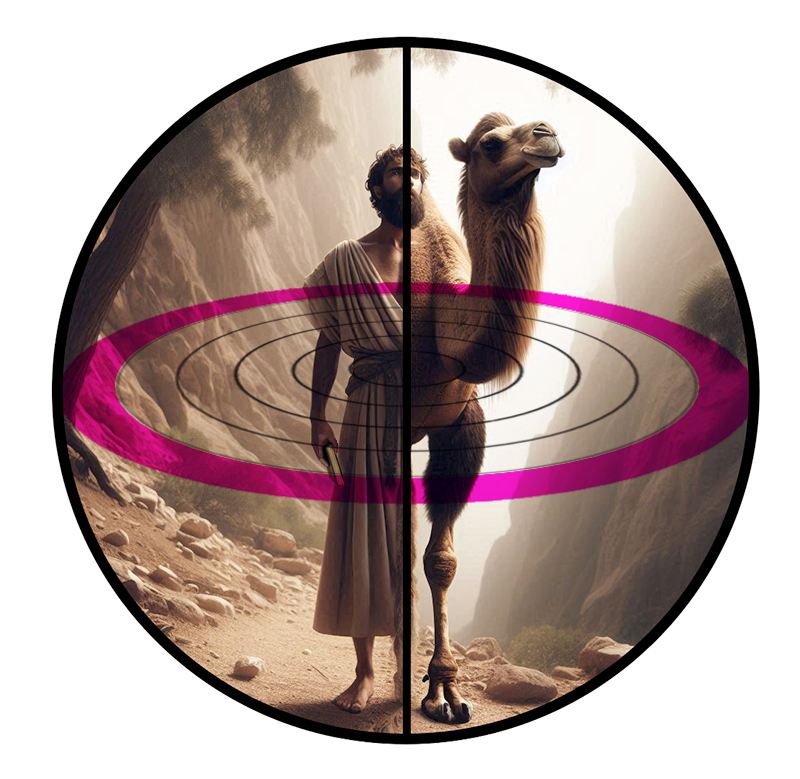
- The Hebrew word for "words" is דברים (d'varim), Strong's #1697. It is derived from the root דבר (dabar), #1696, meaning "ordered word." The term דברים is commonly used to denote spoken or written words.
- The Hebrew word for "bees" is דבוֹרים (d'vorim), Strong's #1682. It is derived from the same root דבר (dabar), which means "ordered/arranged word."
- The noun for bee, not surprisingly, is specifically constructed from the passive participle: דבוֹר which means, "he who is spoken." Bees = those who are spoken/arranged in order.
- But it does not end there. דבורה #1683 Deborah, the Judge, her name means, "Bee." But literally it is the feminine of the passive participle, "she who is arranged in order." The Writing is like the Outer Garment of the Word.
And this John had his garment from camel's hair, and a leather girdle about his loins, and his food was locusts and wild honey.
And John himself had his clothing from hairs of a camel, and a belt of leather about his loin. And his food was locusts and wild honey.
Footnotes
| 8e | Mat 3:4 Scripture as a Woman's Girdle vs a Noose ζώνη : girdle of a woman (see cut No. 48, also Nos. 44 and 61); then for waist, Il. 2.479, Il. 11.234. (Autenrieth Homer) ζώνη: A girdle worn by a goddess or a woman: ζώσατο ζώνῃ Il. 14.181. Cf. Od. 5.231 = Od. 10.544. Fig.: λῦσε παρθενίην ζώνην (her maiden girdle) Od. 11.245. The waist or loins of a man Il. 2.479, Il. 11.234. (Cunliffe Homer) ζώνη, ἡ, belt, girdle, waistband; at Hom. the lower belt that the women wore above the hips, which held the garment together, which hung down in folds (cf. ζωστήρ) (Pape) ζών-η, ἡ, (ζώννυμι) prop. the lower girdle worn by women just above the hips, περὶ δὲ ζώνην βάλετʼ ἰξυῖ Od. 5.231, 10.544, cf. Il. 14.181, Hdt. 1.51, etc. A manʼs belt is more freq. ζωστήρ ἡ ζώνη τοῦ Ὠρίωνος the girdle of Orion (the three stars) Aristotle, Meteorologica (343b24) (LSJ)
|