Light Giver 23
The Tragedy: Collective ("Gentiles") ≠ The People
And they began to bring accusation against himself, those who are saying, "We found this one, he who is distorting the Collective of Ourselves,84 and he who is preventing to give tributes to Dictator in Perpetuity ("Caesar"), and he who is speaking his own self to be an anointed one, a king!And the Man of the Spear questioned himself, he who is saying, "You, yourself are the King of the Casters?" And the one who has been separated to self was bringing to light, "You, yourself are speaking!"
And the Man of the Spear spoke toward the High Priests and the Multitude, "I am not finding anything responsible within the Man, this one!"
And they were strengthening fiercely, those who are saying that he is shaking up the People, he who is teaching throughout the Whole of the Caster ("Judean"), and he who has started away from the Circuit ("Galilee") as far as in here.
And Man of the Spear ("Pilate"), he who has heard, asked if the Man is a Circuiter ("Galilean").
To Send Upward
And he who has recognized that he is from out of the Authority of Heroic ("Herod"), he sent himself up toward Heroic, he who is being also himself within Foundations of Peace ("Jerusalems") within these ones, the Days.85Hearing about himself, instead of hearing himself
And the Heroic, he who has perceived the Salvation, rejoiced exceedingly, for he was being from out of multitudinous chronological-times, he who is wishing to perceive himself by reason of the Hearing About Himself, and he was hoping to perceive a certain sign under himself, that which is becoming.λόγοις ἱκανοῖς - sufficient, fitting, adequate words, beating himself up
And he kept interrogating himself within sufficient words, and he, himself answered nothing to himself.
And the High Priests and the Scholars had been standing by, those who are vigorously accusing himself.
στρατεύμασιν - The Entire Host Bringing Itself to Naught
And the Heroic, he who has brought Himself to nothing in sync together with the Army Hosts of Himself, and he who has mocked, he who cast around in bright radiant clothing, he sent himself up to the Man of the Spear ("Pilate").Beam removed from the eye
And they became friends, both the Heroic and the Man of the Spear, within herself the Day, in company with each other. For they were previously existing within an enmity, those who are being toward themselves.And Man of the Spear, he who summoned together the High Priests and the Rulers and the People,
he said toward themselves, "You brought to myself the Man, this one, as one who is turning back the People, and behold! I, Myself, he who has examined in the eye of yourselves, found nothing culpable/responsible within the Man, this one, of anything for which you are bringing accusation against himself!

"You brought the Man, this one"
But not even Heroic, for he sent himself up toward ourselves, and behold! there is nothing counterbalancing death which has been practiced to self!
παιδεύσας - Bring up, Rear a Child
Therefore, he who has trained up himself, I will release!86παμπληθεὶ - En Masse as One Man
And they shouted up, those who are saying unanimously, "Raise up this one, and release the Son of Father-Father ("Bar-ABBA") to ourselves!"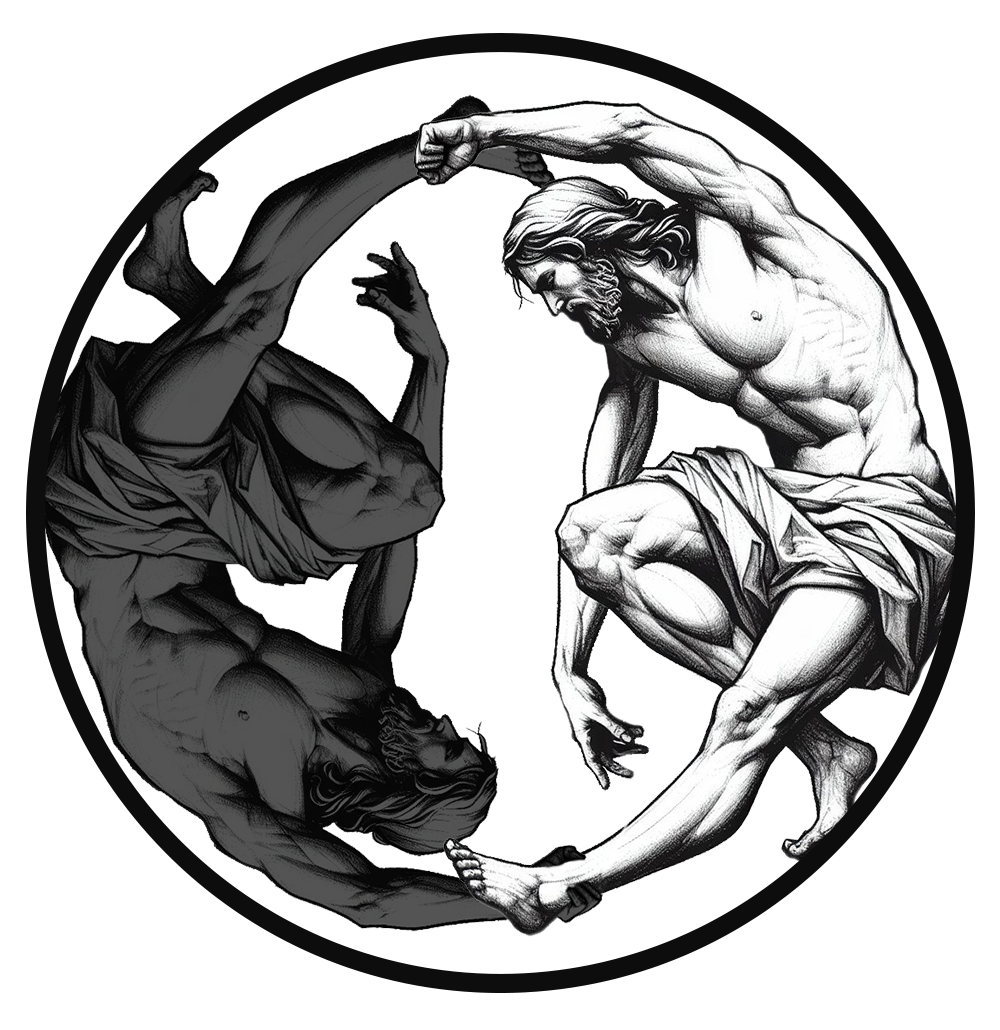
Lift him up, set him free
ABBA: Who is Son of Father-Father "Bar AB-bA"? Twins of a Contention
Anyone who was being on account of a certain factional strife, her who has become within the City, and a murder, him who has been thrown within the Watching.And the Man of the Spear spoke backwards to themselves, he who is desiring to release the Salvation.
And the ones were calling upon/invoking,87 those who are saying, "Stake Stakehimself!"
Not Denying Himself Three Times
And the one said for a third time toward themselves, "For what evil has he made, this one? I have found nothing culpable/responsible of death within himself! He who has trained up himself therefore, I will release!
I found nothing deserving of death!"
"Because you listened to the (wrong) voice...." (Gen. 3:17)
And the ones were pressing/laying upon with mega voices, those who are asking himself to be staked. And the Voices of themselves, they were overpowering.88And Man of the Spear decided to become the Demand of themselves.89
ויהוה חפץ דכאו - And He Is him who is pleased to crush Himself (Isa. 53:10)
And he released the one who has been cast into a watching on account of a factional strife and a murder, him whom they kept asking for, and he handed over the Salvation to the Will of Themselves.Captive to Kill Himself
And when they led himself away, those who have laid hold of Hearing, a certain one, a Cyrenian,90 he who is coming away from a field, they placed the Stake upon self to carry at the back of the Salvation.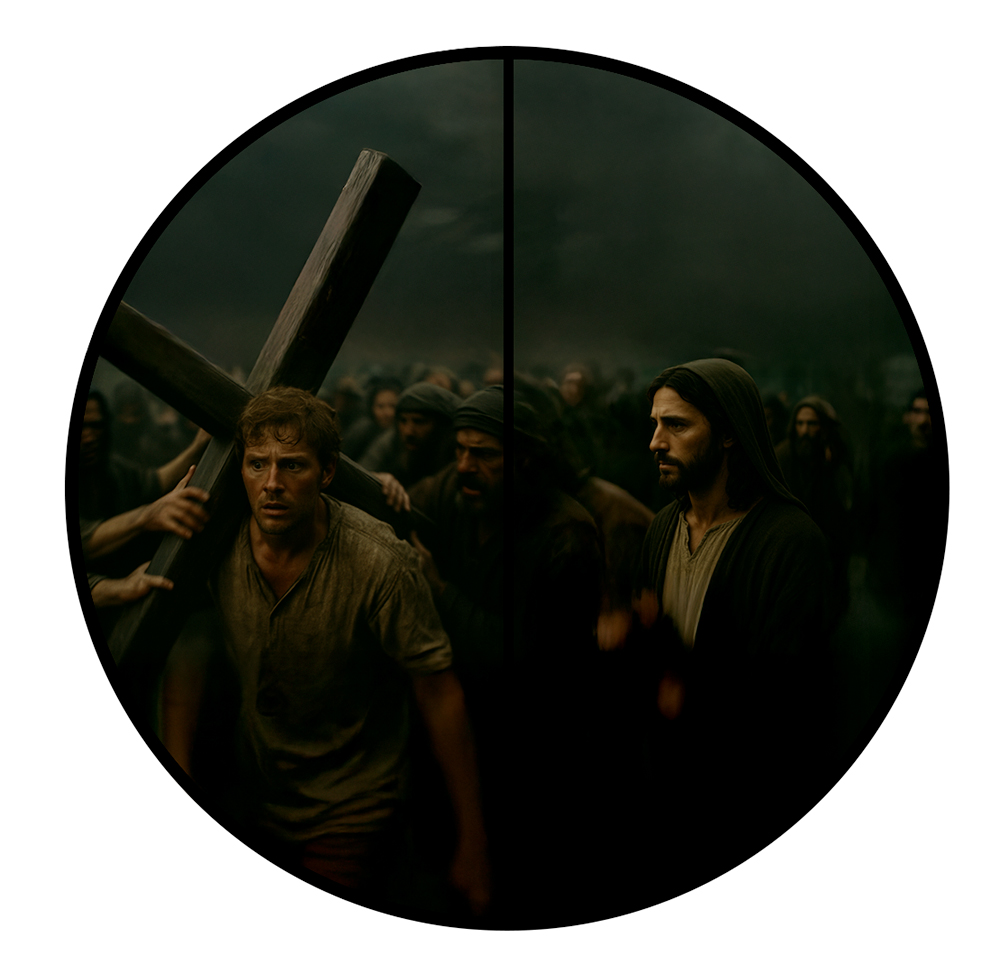
"Broad is the Road, she who is leading away into the Destruction, and they are multitudinous those who are entering across through herself."
(Matthew 7:13 RBT)θρηνέω - Singing dirges/laments
And they kept accompanying self, a multitudinous multitude of the People, and also women who kept cutting off and kept singing laments for Himself.And he who has twisted around toward themselves, Salvation, said, "Daughters of Foundation of Peace, do not weep over myself, except over your own selves weep, and over the Children of yourselves!
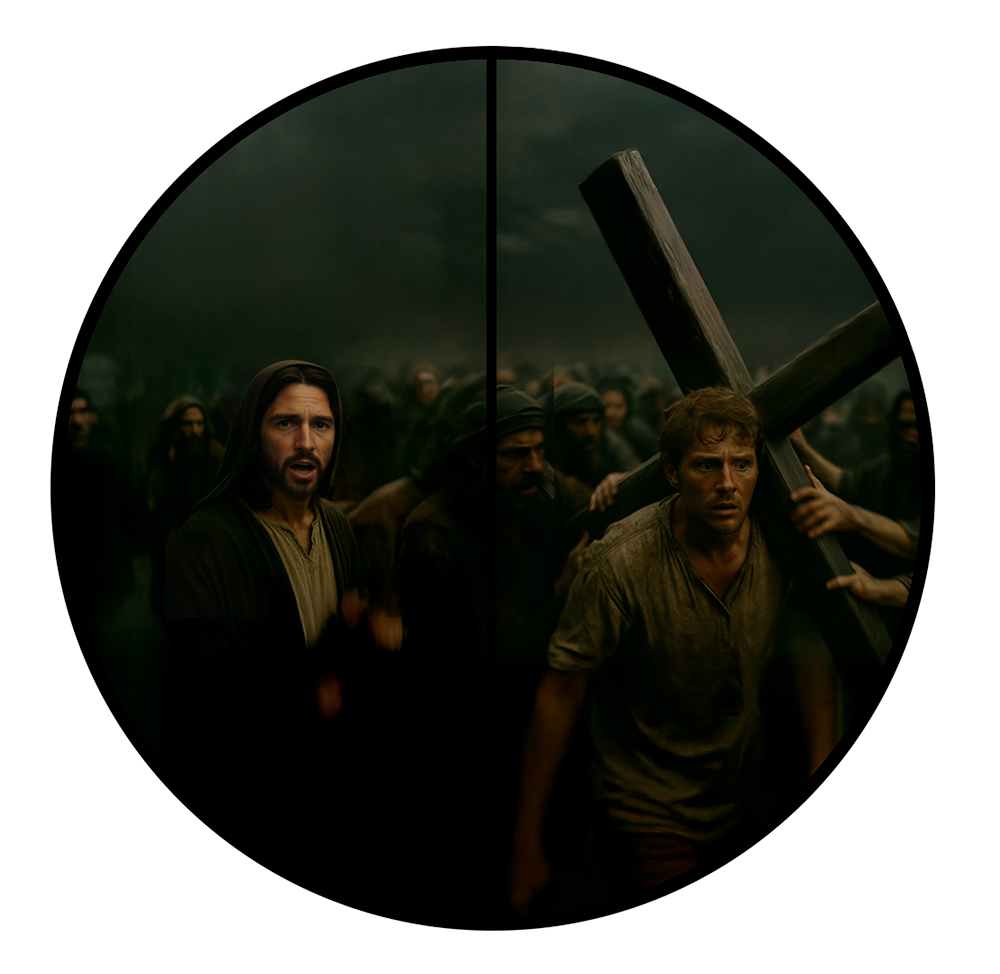
"Don't weep upon myself, weep upon your own selves!"
"A voice within the Height, he who is heard, a mourning song of weeping, bitter ones! Ewe, she who weeps over the sons of herself! She has refused to be consoled over the sons of herself for they are not!"
(Jeremiah 31:15 RBT)For behold! Days are coming within whom they will they recount, Blessed Ones are the Barren Ones and the Wombs which did not beget, and breasts which did not nurse!
At that time they will begin to speak to the Mountains, Fall upon ourselves, and to the Hills, Cover ourselves!
For if within the wet trees they are making these ones, what should become within the Dry?"
Ἤγοντο ἀναιρεθῆναι - Led to be Taken Up
And they also kept being led, other mischievous evil-doers, two united together with self, to be taken up.And when they came upon the Position, the one who is being summoned as a skull, in that place they staked himself, and the Evil Doers, him whom on the one hand is from the right sides, and whom on the other hand is from out of the left sides.91
They don't know what they are making
And the Salvation kept saying,92 "Father, remit themselves! For they have not known what they are making!" And those who are dividing up the Outer Garments of Himself, they cast lots/allotments.And the People stood ready, who is staring attentively. And also the Rulers were turning the nostril out, those who are saying, "He saved other ones, let him save his own self, if this one is the Anointed One of the God, the Selected One!"
ὄξος - poor cheap wine, the Roman soldier's drink
And also the Soldiers mocked self, those who are drawing near, those who are bearing poor wine to self.And those who are saying, "If you, yourself are the King of the Casters, save your own self!"
And there was also a title-inscription upon self, the King of the Casters, this one.
לבדו - To his own separation (Gen. 2:18)
And one of the Mischievious Evil Doers, of those who have been hanged up, he kept blaspheming himself, "Are you, yourself not the Anointed One? Save your own self and ourselves!"And he who has been separated, the Other One, he who is bestowing honor upon self, kept bringing to light, "Neither are you, yourself fearing the God, because you are within the Self Judgement!
ἄτοπος - Strange, Odd, Paradoxical, Out of Place
And ourselves indeed justly, for we are receiving back counterbalancing of the things we habitually practiced! But this one practiced nothing out of place/paradoxical!And he kept saying, "Salvation, remember myself when you come into the Queen of yourself!"
And he said to self, "Trustworthy One, to yourself I am speaking today, you will be in company with myself within the Enclosed Garden!"93
And she was already as if an hour, a sixth one, and a darkness became upon the Entire Earth until a ninth hour,
ἐκλείπω - leave off, abandon, fail
of the Sun, of him who left off/failed,94 and the middle of the Inner Veil of the Temple was split.And He breathed into his nostril the breath of life
And he who crowed with a mega voice, the Salvation, he said, "Father, into hands of yourself I am entrusting the Spirit of myself." And he who said this breathed forth.And the Captain of a Hundred ("Centurion"), he who perceived that which became, he kept glorifying the God, he who is saying, "Really, the Man, this one, was being just!"
συμπαραγενόμενοι - concurrent emergence (of Crops)
And all the Multitudes emerged concurrently upon the Viewing, this one—those who looked attentively at the things which have become, those who are beating the breasts, they were turning back.
συμπαραγενόμενοι: having arrived simultaneously; concurrently emerging, to be ready at the same time, of crops ripening, Hdt. 4.199.
(cf. LSJ)γνωστοὶ - Known Ones
And they had been standing by, all the Known Ones to self, away from afar off, and women— the ones who are following along together to self, away from the Circuit ("Galilee"), those who are perceiving these things.And behold! a man by a name of He Adds ("Joseph"), he who is pre-existing as a Council Member, a good man, and a just one.
Not investing in that
This one was not one who has jointly assented/deposited to the Project/Design or the Practice of themselves, away from Dual-Exalted Height ("Arimathea"),95 a city of the Casters, one who was welcoming the Queen of the God.Let my people go
This one, he who has drawn near to the Man of the Spear, demanded the Body of the Salvation.Into a Virgin
And he who has taken down, he wrapped self in a fine linen cloth and he placed Himself within a stone-hewn monument, in which no one yet was being him who is laid down.And she was being a day of Prepared One, and a cessation was beginning to dawn.
κατακολουθέω - follow after, comply, emulate (Memorial)
And those who have followed after, the Women, anyone who were being those who have come together from out of the Circuit to self, looked carefully at the Memorial, how the Body of Himself was placed.
μνημ-εῖον, Dor. μνᾱμεῖον, Ion. μνημήϊον, τό, memorial, remembrance, record of a person or thing
"And Adam is perceiving repeatedly the self eternal woman of himself, and she is begetting a son, and she is summoning the self eternal name of himself, Placed ("Seth"), for mighty ones have placed a seed back behind, underneath Vanity, for Spearhead has slain himself."
(Genesis 4:25 RBT)And those who have turned back around also made ready aromatic spices and perfume oils. And indeed, they made still the Cessation according to the Commandment.96
Footnotes
Company of People
The primary and literal meaning of ἀναπέμπω (anapempō) is “to send up”—originally in a spatial or directional sense, often from a lower to a higher place. The verb is compounded from:
-
ἀνά (ana) – “up,” “upward”
-
πέμπω (pempō) – “to send”
Core semantic range:
-
Literal spatial use – e.g., sending or moving someone or something upward:
-
to higher ground (Xen. Cyr. 7.5.34)
-
from the coast inland, or toward a metropolis like Rome (Plb. 1.7.12)
-
in military, physical, or geographic contexts
-
-
Institutional/jurisdictional metaphor – From this concrete idea of "sending upward," it developed a figurative legal-administrative use:
-
“remit,” “refer to a higher authority,” especially judicially or politically
-
E.g., Luke 23:7,15: “Pilate sent him up to Herod”, reflecting this juridical protocol of referral to someone of higher or equivalent rank
-
Frequently seen in papyrological texts from the Hellenistic and Roman periods (PHib., PTeb., BGU, etc.)
-
-
Extended metaphorical uses:
-
Transmit (e.g., ideas, impressions)
-
Ascribe (e.g., attributing something upwards or to a higher source)
-
Trace back (e.g., genealogy—“send [a lineage] up toward someone”)
-
(cf. LSJ ἀναπέμπω)
To Discipline as a Child
When a common classical Greek word appears to be used in an exclusive, even bizarre manner by the NT writers, the practice of scholars is to assign it a "special NT usage."
The verb παιδεύω, from which παιδεύσας derives (aorist active participle), is classically and overwhelmingly attested in the semantic field of education, cultivation, and training, not punishment. Rooted in παῖς (child), it designates the process of intellectual and moral formation, often in contrast to mere physical sustenance (τρέφειν). In authors from Sophocles to Plato and Xenophon, παιδεύειν refers to educating the youth (e.g., Pl. Rep. 430a), training in virtue (εἰς ἀρετήν, Pl. Gorg. 519e), and general cultural formation (οἱ πεπαιδευμένοι as “the educated,” Pl. Rep. 606e). Even metaphorical usages preserve the core idea of refinement: e.g., ὕβρις πεπαιδευμένη (Arist. Rh. 1389b11) as “chastened insolence,” not “punished,” but modulated into grace.
However, LSJ’s inclusion of a late and anomalous gloss under III.2—“chastise, punish”—signals the semantic deviation confined to Hellenistic and post-Hellenistic texts, notably the Septuagint (e.g., Hos. 7.12) and here in Luke 23.16. The very structure of the lexicon betrays this shift: rather than revising the primary definition, the editors cordon off this sense in a discreet subcategory, masking what is in fact a radical semantic innovation under the guise of a marginal extension (a.k.a "extended/tropical" definitions). Thus, a word once reserved for instruction and cultural elevation is presented, without sufficient philological justification, as also meaning scourge or punish—but only in contexts shaped by theological or translational agendas.
What?
This maneuver—whether conscious or not—amounts to lexical laundering: the repurposing of a culturally prestigious word for a concept it never bore in classical usage, while giving the impression of continuity. The result is that readers of the NT may receive a severe and punitive reading of παιδεύειν, unaware that such a usage is a stark departure from Greek linguistic norms, not an extension of them. The classical παιδεία "education"—so central to the Greek ideal of human flourishing—is thus quietly subordinated to a wholly foreign interpretive framework.
Why choose such a word in the first place?
In effect, readers are led to believe they are reading this:
μαστιγόω (verb) Strong's #3146
- Primary meaning: to whip, to scourge, flog
- Classical usage: employed for literal acts of whipping or flogging.
- NT usage: e.g., Matthew 20:19 – καὶ μαστιγώσουσιν αὐτόν (“and they will scourge him”).
Other interesting words to note:
κολάζω (verb) Strong's #2849
- Primary meaning: to punish, chastise, inflict corrective penalty
- Classical usage: Used in judicial, philosophical, and civic contexts to indicate corrective punishment—that is, punishment aimed at reform or deterrence, not vengeance. It appears frequently in Plato, Xenophon, and oratory (e.g., Lysias, Demosthenes). Plato (Gorg. 525b) distinguishes κολάζω from τιμωρέω, noting that κολάζειν aims to improve the offender rather than exact retribution.
ἐπεφώνουν does not primarily mean “shout” in the generic sense of loud yelling.
Its core meaning is more precise:
“to call upon,” “to invoke aloud,” or “to utter in directed speech.”
That can include shouting, if the context implies volume, but the verb itself does not inherently denote loudness or force.
Compare:
-
βοάω — “to shout,” “to cry out loudly” (focus on volume)
-
κράζω — “to scream,” “to shriek” (intensely vocal)
-
φωνέω / ἐπιφωνέω — “to speak,” “to call (upon)” (focus on direction, not volume)
So if a mob ἐπεφώνουν, they were likely vocally invoking or calling upon someone—perhaps loudly, but the verb itself does not mean “to shout” by default.
Primary meaning (according to Middle Liddell):
“to mention by name, tell of”
— e.g., Sophocles, where the sense is naming or referring to something aloud.
This directly reflects the literal sense of ἐπιφωνέω as “to voice upon” — that is, to direct speech toward something with specificity, such as naming it, calling it out, or designating it.
Secondary:
“to say upon or with respect to” — τινί (to someone), εἴς τι (with reference to something)
— Seen in Plutarch, and aligns with uses like applying a phrase or label to someone or something.
(cf. Middle Liddell ἐπιφωνέω)
The construction αἰτοῦσιν αὐτὸν σταυρωθῆναι should be understood as “they ask him to be staked/crucified”, with αὐτόν functioning as the person addressed (accusative of the person asked), and σταυρωθῆναι as the infinitive expressing the requested action.
This is a standard idiom in Greek: αἰτέω τινά τι ποιῆσαι, “to ask someone to do something.” It must be distinguished from “they ask for him to be crucified,” which would require a different construction—e.g., αἰτοῦσιν τὴν σταύρωσιν αὐτοῦ (“they ask for his crucifixion”) or αἰτοῦσιν ἵνα σταυρωθῇ (“they ask that he be crucified”). In the participial form, αἰτούμενοι αὐτὸν expects an infinitive complement to complete its sense.
Any time a pronoun follows this verb in the NT (him, father, me, etc.) it is refering to the person asked, not as an indirect object asked for.
Valley of Decision
The phrase ἐπέκρινε γενέσθαι τὸ αἴτημα αὐτῶν in its straight, unadulterated translation means "he decided to become their demand." This construction clearly portrays the subject's decision to undergo a transformation, becoming what the petition represents, i.e., a change of state in relation to the petition itself. However, many traditional translations of this passage, such as
"decided that their demand should be granted,"
"gave sentence that it should be as they required,"
"decided to have their demand carried out,"
or "sentenced their demand to be done,"
require significant grammatical alterations that depart from the original Greek.
To render these idiomatic translations, several grammatical changes must be made:
-
The aorist middle infinitive γενέσθαι ("to become") must be reinterpreted as an active construction, which it is not. This necessitates a shift from the middle voice (which implies a self-directed or reflective action) to an active one, such as ἐκρίθη ("was decided") or ἐξελέγη ("was chosen"), which would imply an external action or decision regarding the petition.
-
The noun αἴτημα ("petition") would need to be altered to a term that indicates an object of a legal decision or demand, such as αἴτημα ἐκπληρωθῆναι ("a petition to be fulfilled"), introducing an entirely new verbal form (like ἐκπληρόω "to fulfill") that does not appear in the original.
-
The phrase "to be done" or "granted," as seen in these retranslations, introduces verbs or passive constructions that are simply absent in the Greek, thus violating the syntactic structure of the original sentence.
In sum, these reworkings demand not only a semantic shift but also a substantial restructuring of the original grammar, transforming it into a form that aligns with conventional legal or procedural language rather than staying true to the original metaphorical and philosophical sense of γενέσθαι ("to become").
Does this process not reflect a profound distortion of the author's intended meaning, reducing the original depiction of a decision to undergo a transformation into a more conventional and legalistic interpretation of judgment?
Cyrene in Greek mythology is a huntress nymph known for her beauty and hunting skills, who was abducted by Apollo and taken to North Africa. The city of Cyrene, founded by Apollo in her honor, reflects her significance in Greek mythology and the cultural impact of her story.
"a champion in the leafy forest with lionslaying hands" (Nonnus, Dionysiaca 25. 180 ff)
The phrase ὃν μὲν ἐκ δεξιῶν, ὃν δὲ ἐξ ἀριστερῶν employs a classical μὲν...δέ construction, a common Greek syntactic device used to indicate contrast or parallelism. Literally translated as “whom on the one hand from the right, whom on the other hand from the left,” it typically introduces two groups or actions proceeding from opposite directions. Such phrasing often appears in historiographical, military, or descriptive narrative to denote bifurcated movement or attention.
The Greek verb ἔλεγεν is the imperfect active indicative of λέγω (“to say”), and properly conveys continuous or repeated action in the past.
While most English translations render it simply as “he said,” this corresponds more directly to the aorist form εἶπεν, which denotes a punctiliar or completed action. In contrast, the imperfect form ἔλεγεν should be translated as “he was saying,” “he kept saying,” or “he used to say,” preserving its imperfective aspect.
Rendering it as “he said,” covers up this meaning and is grammatically imprecise, as it fails to communicate the ongoing or habitual nature of the action encoded in the Greek tense. For rigorous exegetical or linguistic work, the imperfect sense must be maintained.
The term παράδεισος (also attested as παράδισος, e.g. SIG 463.8, Crete, 3rd century B.C.) originally denoted an “enclosed park” or “pleasure-ground,” an Oriental loanword first employed by Xenophon exclusively in reference to the parks of Persian kings and nobles (cf. Anab. 1.2.7; 2.4.14; Cyr. 1.3.14; Hellenica 4.1.15; see also Theophrastus Hist. Plant. 4.4.1; AJA 16.13 [Sardes, 300 B.C.]; LXX Nehemiah 2.8; Plutarch Art. 25). More generally, it came to mean “garden” or “orchard” (e.g., PRev.Laws 33.11; PCair.Zen. 33.3; OGI 90.15; LXX Canticum 4.13; Ecclesiastes 2.5; CIG 2694b; PFay. 55.7). The phrase “garden of Eden” appears in the Septuagint (Genesis 2.8).
Later, especially in the Christian tradition, παράδεισος came to signify “Paradise,” the "abode of the blessed" as an explanation of the μακάρων νῆσοι (“isles of the blessed,” Proclus ad Hesiod Op. 169).
LSJ notes its Persian origin in pairidaēza- (“enclosure”) and the word’s semantic shift from a physical royal garden to a religious and idealized paradise (cf. Pollux 9.13; Photios; Avesta).
— Liddell–Scott–Jones, s.v. παράδεισος.
The verb ἐκλείπω (ἐκ + λείπω) bears the core sense of “cease,” “fail,” or “disappear,” but in many contexts it specifically connotes “leaving off,” “quitting,” or “forsaking” an action or state. When used with a genitive, participle, or complement clause, it denotes the abandonment or cessation of that thing (e.g., ἐκλιπόντος τοῦ βίου, Soph. El. 1131, “departing from life”; ἐκλείπειν θεραπείας σώματος, Plut. Marc. 17, “to neglect bodily care”). While “quit” in modern English may suggest volitional cessation, ἐκλείπω need not always imply intent, though many uses (e.g., renouncing power or deserting a post) do. See LSJ, s.v. ἐκλείπω; Bailly, s.v. ἐκλείπω.
Strongs #G707. The term Ἁριμαθαίας (Harimathaias) in Greek is derived from the Hebrew ארמיתים (Arimathaim). The Hebrew name ארמיתים is believed to be a compound of:
- ארמי (armai) – meaning "high" or "exalted," from the Hebrew רמה (a height)
- תים (tayim) – the dual suffix indicating "two," suggesting a place with a dual or two-fold aspect.
The verb ἡσυχάζω (fut. -άσω; aor. ἡσύχᾰσα) primarily means "to keep quiet," "to be at rest," or "to be silent" (LSJ s.v. ἡσυχάζω). It is frequently used intransitively, e.g., οἱ πολέμιοι ἡσύχαζον ("the enemies were quiet," Xen. An. 5.4.16). However, LSJ also records a transitive (causative) usage meaning "to bring to rest," "impose silence," or "make quiet," e.g., ἡσυχάσας τῶ δύο εἴδη, τὸ τρίτον δὲ κινήσας (Plato, Republic 572a) and ἡσυχάζων in the sense of "impose silence" (D.C. 69.6). When ἡσύχασαν is followed by an accusative object, the causative sense ("they made [someone/something] quiet") is strongly implied, as the direct object indicates the entity affected by the action. Thus, context and presence of an accusative complement are key to distinguishing between "they were quiet" (intransitive) and "they made quiet" (causative).