Light Giver 17
Scandalous stones Made, Scandalous stones Take Back
And he said toward the Learners of Self, "The Not-Coming of the Scandals is inadmissible, except woe through whomever63 they are coming!Don't Miss
It is profitable/advantageous to himself if a stone belonging to a mill is encompassing around the Neck of himself and has been flung into the Sea than that he should scandalize one of the Little Ones of these.
Take heed to yourselves! If the Brother of yourself should miss, bestow honor to self, and if he should change the mind, send off to self!
And if he should miss the Day seven times into yourself, and he should wheel back around toward yourself seven times, he who is saying I am changing the mind, you will send away to self."
προστίθημι = Put to, Join to, Add
And the Messengers said to the Master, "Add to ourselves a trust!"And the Master said, "If you are holding a trust just like a kernel of mustard you would have said to the Sycamine Tree, this one, Be rooted out and be planted within the Sea, and she would have given ear/listened to yourselves!

And who from out of yourselves who is holding a born bondman, or one who is plowing, or one who is shepherding, who will say to self, to him who has come in from out of the Field, 'He who has passed by, lie back at once'?64
The Bread of Today, Tomorrow
But rather, will he not say to himself, Prepare what I will dine on! and he who has girded around, minister to myself until I should eat and drink and beyond these things you, yourself will eat and drink!
Is he not holding a grace for the Born-Bondman because he has made the ones which have been arranged in array?
In this way also when you, yourselves should have made all the things which have been arranged in array to yourselves, speak that, We are being useless born bondmen, what we were owing/indebted to make, we have made!"
And has become within the Leading Across into Foundation of Peace ("Jerusalem") and he, himself was passing straight across through the middle of Guard Tower ("Samaria") and Circuit ("Galilee").
Like a House of Mirrors
And while he, himself is entering into a certain one, an unwalled village, ten scaly men met, they who stood by from far off.65And they, themselves lifted up a voice, those who are saying, "Salvation, boss/one who stands over, have pity on ourselves!
And he who has perceived said to themselves, "Those who have led across, show your own selves to the Priests." And he became within the Bringing Under of themselves, they were cleansed.
And one from out of themselves, he who has perceived that he was healed, turned back in company with a mega voice, he who is glorifying the God.
And he fell upon a face close beside the Feet of himself, he who gave eucharist/thanks to self, and he was being a Watchman ("Samaritan").
And he who has been separated, the Salvation, said, "Were the Ten not cleansed? But where are the Nine?"
ἀλλογενὴς - Of Another Race
Were they not found, those who have turned back around, to give a glory to the God except the One of Another Race, this one?And he said to self, he who has stood up, "Traverse across! The Trust of yourself, she has saved yourself!"
And he who has been questioned underneath the Separatists as to when she is coming, the Queen of the God, he separated to themselves and said, "The Queen of the God is not coming in company with a close observation.
עצם מעצמי
Neither will they say, Behold in here!, or, there! For behold! the Queen of the God is in inside of yourselves!And he said toward the Learners, "They will come, days, when you will covet/long to perceive one of the Days of the Son of the Human, and you will not perceive.
And they will say to yourselves, Behold there! or, Behold in here! Do not go away, nor run after!
ביום ההוא - In the Day of Himself
For just as the Lightning, she who is flashing, is shining from out the one under the Heavenly One into the one under a heavenly one, in this way the Son of the Man will be within the Day of Himself.
Rejected By Her, He must be
But it is necessary for himself to first be afflicted multitudinous and to be rejected away from the Generation, this one.And according to how he became within the Days of Rest ("Noah") so also he will be within the Days of the Son of the Human.
They were eating, they were drinking, they were marrying, they were being given in marriage, until which day Rest ("Noah") entered into the Wooden Box and the Deluge came and he destroyed away everything.
Likewise just as he has become within the Days of Enwrapped ("Lot"), they were eating they were drinking, they were buying in the marketplace, they were selling, they were planting, they were house-building.
But on a day whom Enwrapped ("Lot") came out away from Scorched ("Sodom"), she rained fire and brimstone away from a heavenly one and destroyed away everything.
According to these same things she will be on a day to whom the Son of the Human is uncovered.
Within that one, the Day, whoever will be upon the Housetop, and the Vessels of himself within the House, let him not climb down to lift up these things, and the one within a field likewise let him not wheel around into the Behind Things.
Remember the Woman of Enwrapped ("Lot").
περιποιήσασθαι - To make/acquire all around
Whoever might seek to acquire all around the Soul Life of himself, will destroy herself. But whoever a will destroy away, will preserve alive herself.I am speaking to yourselves, the Night, this one, there will be two upon one bed; the one will be taken along, and the Other One will be sent away.
Upper and lower millstone
There will be two, those who are grinding against the Self, the First One will be taken along and the Other One will be hurled away.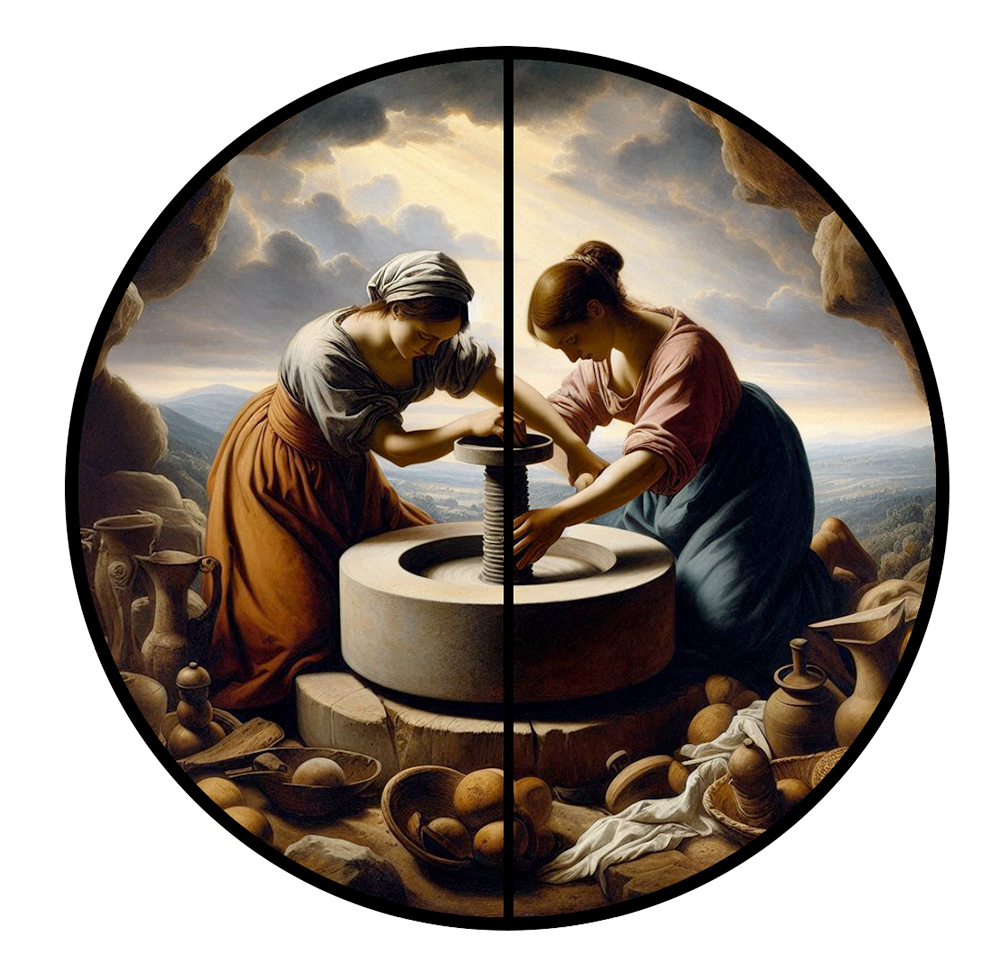
παραλαμβάνω - taken along, taken to oneself as a wife, ally, partner, adopted
(Herodotus, Plato, Aristotle)And those who have been separated are saying to self, "Where Master?" And the one said to themselves, "Where the Body is, there also the Eagles will be gathered in together."
Footnotes
The phrase τοῦ τὰ σκάνδαλα μὴ ἐλθεῖν employs a genitive articular infinitive, a construction common in classical and Koine Greek whereby an infinitive is substantivized through the definite article and declined. The genitive case here serves as the subject of the impersonal verb ἐστιν. Thus, the entire clause may be rendered literally as “the not-coming of the scandals,” functioning as the subject of Ἀνένδεκτόν ἐστιν (“it is inadmissable”). The presence of τοῦ marks this grammatical structure and should not be confused with a possessive or partitive genitive.
The phrase οὐαὶ δὲ δι' οὗ ἔρχεται can be translated as "Woe through whom they are coming." The word οὐαὶ is an interjection expressing lamentation or judgment, while δι' οὗ uses the genitive case (from the relative pronoun οὗ, "whom") to indicate the agent or means by which something occurs. This construction is not "woe to" (which would take the accusative or dative - cf. οὐαὶ woe and all its usages in the NT), but rather "woe through whom", identifying the individual responsible for bringing about the event. Therefore, the phrase expresses judgment on the one through whom the action takes place.
The phrase ὃς εἰσελθόντι is ungrammatical as it stands as it combines incompatible grammatical forms.
The unusual syntactics led some scholars to say that to make sense of the clause grammatically, you need to mentally insert or supply the verb ἐστί before the relative clause introduced by ὃς (cf. Meyers NT).
If we do not wish to add words, ὃς must be connected with ἐρεῖ; syntactically, as it functions as the subject of that verb.
Greek word order is flexible, but case and syntax are not. In this clause:
-
ὃς is nominative: only a subject (or predicate nominative, which this is not).
-
There is no other nominative noun or pronoun to serve as subject of ἐρεῖ.
-
Therefore, ὃς must be the subject of ἐρεῖ.
αὐτῷ him/himself (e.g. met him) does not exist in the early authoritative manuscripts.