Light Giver 13
Responsibility
And he who has been separated said to themselves, "Do you think that the Circuiters ("Galileans"), these ones, became missers close beside all of the Circuiters, because they have suffered these things?"No. I am speaking to yourselves, rather if you do not change the mind, you will all likewise be destroyed away/perish!
Or those ones, the Eighteen upon whom the Tower fell within the Sent ("Siloam"), and killed off themselves, do you think that they, themselves became debtors close beside all of the Humans, the ones who are inhabiting Foundation of Peace ("Jerusalem")?
No, I am speaking to yourselves, rather if you do not change the mind, you will all likewise be destroyed away!"
And he was speaking the Comparison, this one: A certain one held a fig tree, she who has been planted within the Vineyard of himself, and he came, he who is seeking after a fruit within herself, and he found not.
And he said toward the Vinedresser, "Behold! three cycles of time away from whom I am coming, he who is seeking after a fruit within the Fig Tree, this one, and not am finding! Therefore, chop down herself! Why should she also render the Earthly One inactive?
And the one who has been separated is speaking to self, "Master, send away herself, also the Year, this one, until whom I should dig around herself and cast dung heaps.
And if indeed she should make a fruit into the one who is destined, but if otherwise you will chop herself down."

"And they are cutting down a covenant, within Well of Seven, and My Father is a King is standing up, and Mouth of the All, a prince of the army of himself, and they are turning back toward an earth of Wallowers."
(Genesis 21:32 RBT)And he was him who is teaching within one of the Gatherings within the Cessations.
παντελές - all-accomplished, all-complete, absolute
And behold! a woman, she who is holding a spirit of a weak one eighteen cycles of time, and she was her who is bent over double, and not her who has power to lift up herself into the All-Complete.יקרא אשה - He is summoning, Woman - Genesis 2:23
And he who has perceived herself, the Salvation, he called to and said to herself, "Woman! You have been set free from the Weak One of yourself!"
"...for she has taken hold of this one from each man."
(Genesis 2:23 RBT)And he laid on herself the Hands, and immediately she was set upright and she began glorifying the God.
And he who has been separated, the Gathering Ruler, he who is indignant because the Salvation treated on the Cessation, was saying to the Multitude that there are six days within which one must labor. Be treated therefore within themselves, those who are coming, and not on the Day of the Cessation.
And the Master separated to self, and said, "Stage Actors! Do not each one of yourselves on the Cessation unloose the Ox of himself or the Donkey away from the Feeding Trough, and he who has led away give drink?
A Mega Chain
And this one, she who is being a daughter of Father of Multitude ("Abraham"), whosoever the Adversary has chained up, behold! ten and eight cycles of time was it not necessary for the Day of Cessation to be loosened away from the Band, this one?"ἀντικείμενοι antikeimai - Set Opposite, Correspond with
And while he, himself is speaking these things, they were ashamed everyone of those who are set opposite to self, and all of the Multitude were rejoicing upon all of the Glorious Things, the ones which are becoming under himself.And he was saying, "Who is she the same as, the Queen of the God? And who shall I make herself like?
To Me!
She is the same as a kernel of mustard, him whom a man, he who has taken hold, cast into a garden of his own self, and he increased and became into a tree, and the Winged Ones of the Heavenly One encamped within the Branches of Himself.And he said backward, "Who shall I compare the Queen of the God?
She is the same as leaven, her whom a woman, she who has taken hold, concealed into three measures of flour, until him whom was leavened entirely."
And he was passing through according to cities and unwalled villages, he who is teaching and he who is making a passage into Foundations of Peace ("Jerusalems").
And a certain one said to self, "Master, are the ones who are being saved small?" And the one said toward themselves,
"Fight to enter straight across through the Narrow Door, because multitudinous, I am speaking to yourselves, will seek to enter and will not be able.
In no way will you enter
Away from him whom the Household Despot should wake up,50 and should have shut off the Door,51 and you should begin to stand by outside and to strike the Door, those who are saying, Master open to ourselves! And he who has been separated will say to yourselves, I have not seen/known from where you, yourselves are!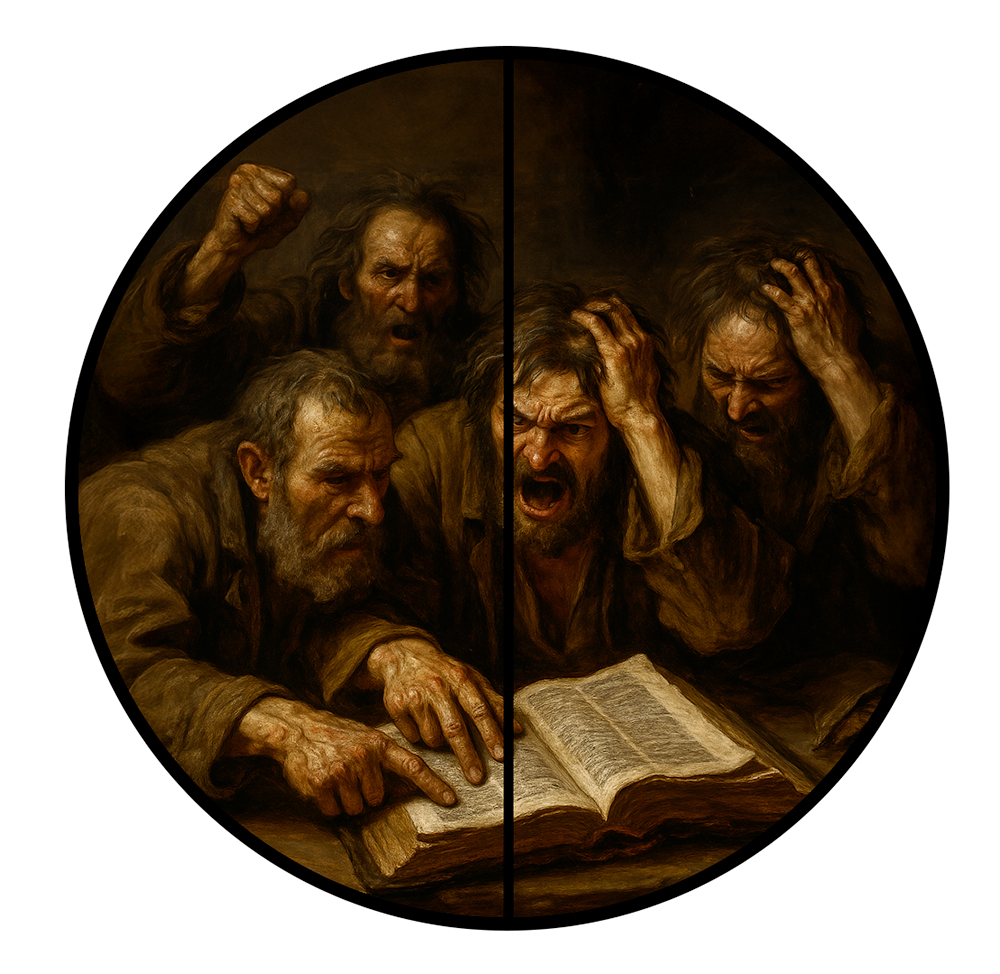
At that time will you begin to say, We ate in the eye of yourself, and drank, and you taught ourselves within the Broadways of ourselves.
And he will say, he who is speaking to yourselves, I have not seen from where you are! Stand back away from myself all you laborers of an injustice!
The Weeping One and the Gnashing One of the Teeth will be there when you should perceive Father of Multitude ("Abraham") and He Laughs ("Isaac") and Heel Chaser ("Jacob") and all of the Prophets within the Queen of the God, and you, yourselves those who are being cast outside!
And they will arrive away from rising ones and setting ones, and away from a north wind and a south wind, and they will lean back within the Queen of the God.
And behold! they are last ones, whichever ones will be first ones. And they are first ones, whichever ones will be last ones!"

Within herself, the Seasonal Time, certain Separatists drew near, those who are saying to self, "Come out and lead across from here, because Heroic ("Herod") is wanting to kill away yourself."
Today and Tomorrow
And he said to themselves, "Those who have led across, say to the Fox, this one, Behold! I am casting out demonic spirits and I am bringing to completion today and tomorrow healing ones, and on the Third One I am being completed!"The seed must die away (in the Beautiful Earth)
Except it is necessary for myself, today and tomorrow and on the one who is holding,52 to lead across because it is not permissible to destroy away a prophet outside of Foundation of Peace ("Jerusalem").53"Wings of a Stork"
Foundation of Peace, Foundation of Peace! The one who is killing off the Prophets and she who is stone-casting the ones who have been sent away toward herself! How often I desired to gather together the Children of yourself, in the way in which a bird a nest of young of her own self under the Wings, and you all were not willing!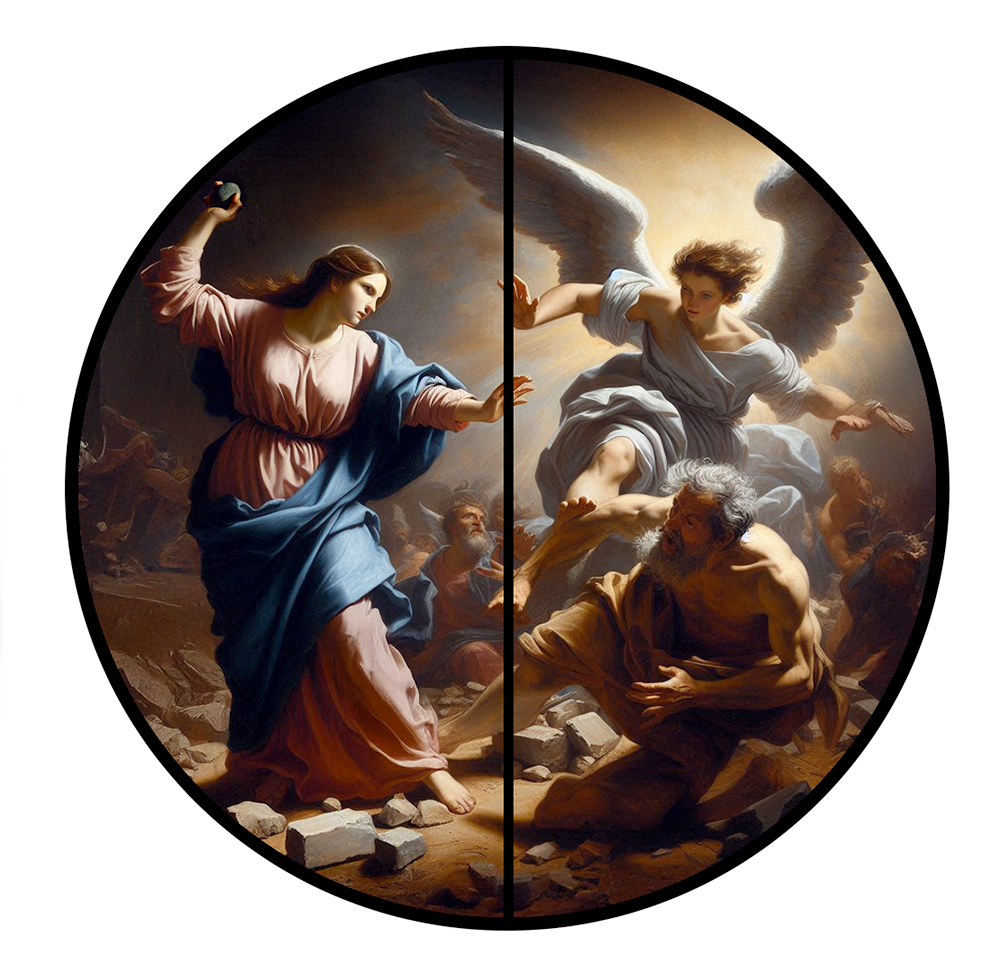
"And the King is saying to herself, 'What is to yourself?' And the Woman is saying, 'This one, she said to myself, Give the self eternal son of yourself, and we are eating himself Today, and the self eternal son of myself we are eating tomorrow! And we are boiling the self eternal son of myself and devouring himself!' And he said to herself within the Day, the Behind One, 'Give the self eternal son of yourself, and we are eating him.' And she is concealing the self eternal son of herself.'
(2 Kings 6:29 RBT)Behold! the Home of yourselves is sent away to yourselves, and I am speaking to yourselves you should never perceive myself until he will come when you should say, He who is blessed, the one who is coming within a name of Master!"
Footnotes
Waking up away from himself
The phrase ἀφ᾽ οὗ can function either as a temporal conjunction or as a relative pronoun phrase of origin, depending on context. When οὗ is used temporally, it is typically the genitive masculine or neuter singular of the relative pronoun, referring to an implied or explicit noun denoting time (e.g., ὁ χρόνος, τότε), and the phrase thus means "from (the time) which." In contrast, when οὗ refers to a person or agent, it remains genitive singular but takes on the gender of the antecedent, functioning as a personal relative pronoun: "from whom." Notably, the feminine equivalent would be ἀφ᾽ ἧς. Therefore, syntactic, semantic, and gender cues must be considered to distinguish these usages accurately.
Shutting off the Door
This word is used only once in the NT. When ἀποκλείω is followed by an accusative, it typically expresses the action of shutting someone or something out or excluding them. The accusative usually refers to the person or thing being excluded. For example:
-
ἀποκλείει τὸν ἐχθρόν — "He shuts out the enemy," where τὸν ἐχθρόν (the enemy) is the accusative object.
In contrast, the verb κλείω is the more general term for "to shut" or "to close" without the sense of exclusion. κλείω is typically used in neutral contexts for closing a door, gate, or container, without any implication of barring access or excluding someone from a place or state. For example:
-
κλείει τὴν θύραν — "He shuts the door," where τὴν θύραν (the door) is the accusative, but with no connotation of exclusion or separation.
-
κλείει τὰ βιβλία — "He shuts the books," where τὰ βιβλία (the books) is the accusative, indicating the simple action of closing, rather than exclusion.
Thus, ἀποκλείω involves a more forceful or exclusionary action, often with a person or thing being deliberately kept out of something, while κλείω is a more neutral and general term for simply closing or shutting something without such connotations of exclusion.
Quite a beating to the written word here in an effort to figure out the "expression":
Johann Albrecht Bengel (1687–1752), a German Lutheran theologian, biblical scholar, and commentator says:
Τῇ ἐχομένῃ, (on the following day) This expression has a wider meaning than τῇ τρίτῃ, on the third day (the day after to-morrow), which is included in τῇ ἐχομένῃ.
τῇ ἐχομένῃ (from ἔχω) is not typically used in the sense of "following" in the context of "following day" or similar meanings:
-
Etymology and Primary Meaning: The participle ἐχομένῃ comes from the verb ἔχω, meaning "to have" or "to hold." Therefore, its primary meaning is associated with possession or state of holding, not following. It doesn’t normally extend to the idea of following in a temporal sense.
-
Possible Figurative Use: In some contexts, Ancient Greek does employ metaphorical meanings or figurative uses, but these would be rare and usually involve something akin to "holding to" or "adhering to" a path, rather than the literal sense of "following." This would be quite distant from the more conventional usage of "following."
-
"Following Day": For the expression "the following day" or "the next day," Ancient Greek typically uses phrases like:
-
ἡ ἐπομένη ἡμέρα (hē epomenē hēmera) — "the following day."
-
ἡ ἑξῆς ἡμέρα (hē exēs hēmera) — another common way to refer to the next or following day.
-
-
Examples in Literature: The phrase ἐχομένῃ in classical texts almost always relates to someone who "has" or "holds" something, rather than following in a temporal or sequential sense.
While τῇ ἐχομένῃ could, in a very broad and figurative context, be interpreted as relating to something that follows (such as in "holding to" a sequence or event), this is not its typical or standard use. For "following" in the sense of time (like "following day"), expressions like ἡ ἐπομένη ἡμέρα are used instead.
Already, the phrase, "for it is not possible for a prophet to perish out of Jerusalem" makes little sense. But there are two ways to read this and the morphology of "οὐκ ἐνδέχεται προφήτην ἀπολέσθαι" is open to both interpretations:
-
"Not allowed to destroy a prophet":
-
οὐκ ἐνδέχεται is primarily understood as "it is not permitted" or "it is not allowed." The verb ἐνδέχεται can imply something that is allowable or permissible, and the negation οὐκ indicates that this permission is denied.
-
The infinitive ἀπολέσθαι conveys the idea of destruction or loss, and when paired with ἐνδέχεται, it can imply a prohibition or restriction on that action.
-
-
"A prophet cannot be destroyed" (passive sense):
-
οὐκ ἐνδέχεται can also mean "it is not possible" or "it is not likely" (when used with a negation). This interpretation focuses on the impossibility of the event. However, this is not the normal word used in the NT to express "impossibility" (cf. ἀδύνατος impossible).
-
In this case, ἀπολέσθαι in the middle voice (meaning "to perish" or "to be lost") could be understood as the passive sense of destruction and thus the phrase would mean "a prophet cannot be destroyed," suggesting that such an event is impossible or would not happen. This reading gave rise to all sorts of speculation and confusion as to why or how this was impossible and "exceptions" as Bengel admits of a particular and serious contradiction:
-
"This phrase admits of exceptions: for instance, John the Baptist was “a prophet” who “perished out of Jerusalem.”—ἀπολέσθαι, perish) by a public judicial procedure."
(Bengel's Gnomen on Luke 13:33)
-
-
Both interpretations are grammatically and morphologically valid based on the structure of the sentence. The key is choosing the reading that doesn't create serious contradictions.