Light Giver 18
ἐντρέπω - to invert, turn in
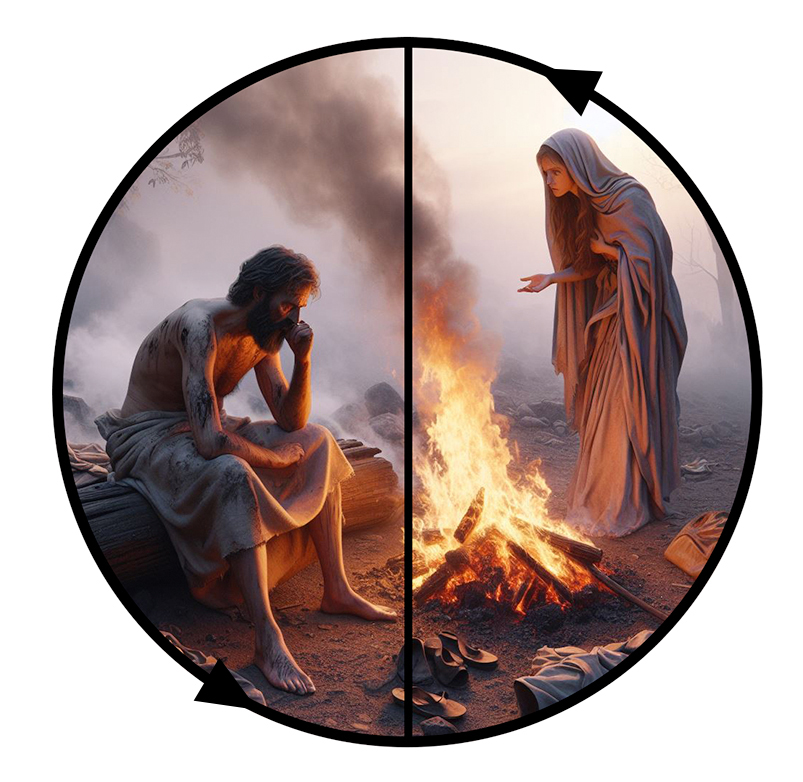
He who is saying, "A judge, a certain one, was within a city, a certain one, he who is not afraid of the God and he who is not inverted by man.And a widow was being within the City, that one, and she was coming toward himself, she who is saying, "Avenge myself away from the Adversary of myself!"
Passive
And he was not wanting upon a chronological time. But beyond these ones he said within his own self, Even if the God I am not fearing nor being inverted by a man,For this very reason of the Providing of toil/beating to myself by the Widow, this one, I will avenge herself so that she who is coming into end-aim does not strike myself under the eye.

Who is this one who darkens a counsel within chatterings without knowledge? Gird around, pray, like a warrior the dual loins of yourself, and I am inquiring of yourself and you are making myself know! Where have you become within the Founding of myself an earth? Make known if you have perceived an insight! Who set the measurement of herself so that she is perceiving? Or who stretched out against herself a measuring line?
(Job 38:10 RBT)And the Master said, Hear what the Judge of the Injustice is speaking!
And should the God never make the Vengeance of the Selected Ones of himself, of the ones who are shouting out to self of day and of night and he is being long-tempered of anger upon themselves?
I am speaking to yourselves that he will make the Vengeance of themselves within speed, yet nevertheless the Son of the Human, he who has come, will he really find the Trust upon the Earthly One?"
And he also spoke toward any of the ones who have been persuaded upon their own selves that they are being just ones, and those who are treating with contempt the Remnant, the Comparison, this one:
"Two men they climbed up into the Sacred Place to offer prayers. The one a Separatist, and the Other One, the Tax Farmer.
Praying to his own self: the Tax Farmer
The Separatist, he who has stood ready, these things toward his own self he was praying,66 'The God, I am giving eucharist/bestowing grace to yourself because I am not like the Remnant of the Humans, rapacious ones, unjust ones, adulterers, nor also like this one, the Tax Farmer!I fast twice of the Cessation ("Sabbath"), I give a tenth of all things, as much as I am acquiring.
"I strike myself below the eye"
And the Tax Farmer, he who has stood ready from far off, was not wanting to lift up even the eyes into the Heavenly One, but rather he was striking the Chest of himself, he who is saying, 'The God be reconciled to myself, the Misser!67I am speaking to yourselves, this one climbed down, he who has been acquitted, into the Home of Himself close beside that one!68 For everyone who is exalting high his own self will be humiliated, and the one who is humiliating his own self— he will be exalted high!"
Those who perceived
And they were offering to self the Infants, so that he might fasten to themselves. And those who perceived, the Learners, they were bestowing honor to themselves.The Queen, Myself
And the Salvation invited themselves, he who is saying, "Send off the Little Children, to come toward myself, and do not stop these ones, for of such is the Queen of the God!Mother of Life
Trustworthy One, I am speaking to yourselves, whosoever does not welcome the Queen of the God just like a little child should never enter into herself!And a certain one asked himself, a ruler who is saying, "Teacher, good one, he who has made what, will I inherit an eternal (aiōn) zoe-life?"
And the Salvation said to self, "Why are you calling myself good? No one is good if not one, the God.
You have seen the Commandments. Do not commit adultery, do not murder, do not you steal, do not testify falsely, honor the Father of yourself, and the Mother.
And the one said, "I have watched over all these ones from out of a youth.
And he who has heard, the Salvation, he said to self, "Still one thing is lacking to yourself. Sell everything, as much as you are holding on to, and hand across to beggars, and you will hold a treasure-storehouse within the Heavenly Ones, and come here, accompany myself!"
And the one who has heard these things became sorrowful all around, for he was an exceedingly rich one.
And he who has perceived himself, the Salvation, said, "How poorly docked are the ones holding the Riches going into the Queen of the God!69
Pierced
It is easier for a camel to enter straight across through a perforation of a needle than for a rich man to enter into the Queen of the God!"And the ones who have heard said, "And who is able to be saved?"
And the one said, "The powerless ones close beside men are mighty ones close beside the God!"

Behold! I have stood against the Door and I am knocking!
(Revelation 3:20 RBT)And the Small Stone said, "Behold! Ourselves, those who have hurled away their own, have accompanied yourself!"

And a river of fire light, he who goes in front, and going out from out of the front of himself, a thousand of thousands ministering to himself, and a myriad of myriads stood in front of himself, judgment sat down, and books have been opened.
(Daniel 7:10 RBT)πολλαπλασίων - Multiplicative
And the one said to themselves, "Trustworthy One, I am speaking to yourselves that there is no one who has sent away a house or woman or brothers or begetters or children for the sake of the Queen of the God,who should not receive multiple times more within the Opportune Time, this one, and within the Eternal (aiōn) One, the one who is coming, an eternal (aiōn) zoe-life!
And he who has taken in the Twelve said toward themselves, "Behold! we are climbing up into Foundation of Peace ("Jerusalem") and all that has been written/drawn will be completed across through the Prophets to the Son of the Man!"

"because within himself all the full measure of the Godhood [θεότης] is settling down bodily"
(Colossians 2:9 RBT)ἔθνεσιν ethnesin - To the Ethne, Swarms, Flocks
For he will be delivered over to the Herds ("Ethne"), and he will be mocked, and he will be treated outrageously, and he will be spat upon.And those who have scourged will kill off himself, and on the Day, the Third One, he will stand up."
And they, themselves understood nothing of these things. And the Saying, this one, was that which has been concealed away from themselves, and they were not recognizing the things that are being said.
ἐπαιτέω asking Besides, For More
And he became within the Drawing Himself Near into Fragrance of Himself ("Jericho"), a smoke-blind one who was sitting close beside the Road, he who is asking again and again.And he who heard a multitude of him who is passing through kept learning what this one might be.
And they announced to self that Salvation the Protector ("Nazareth") is passing beside.
And he cried aloud, he who is saying, "Salvation! Son of Beloved ("David")!! Have mercy on myself!!"
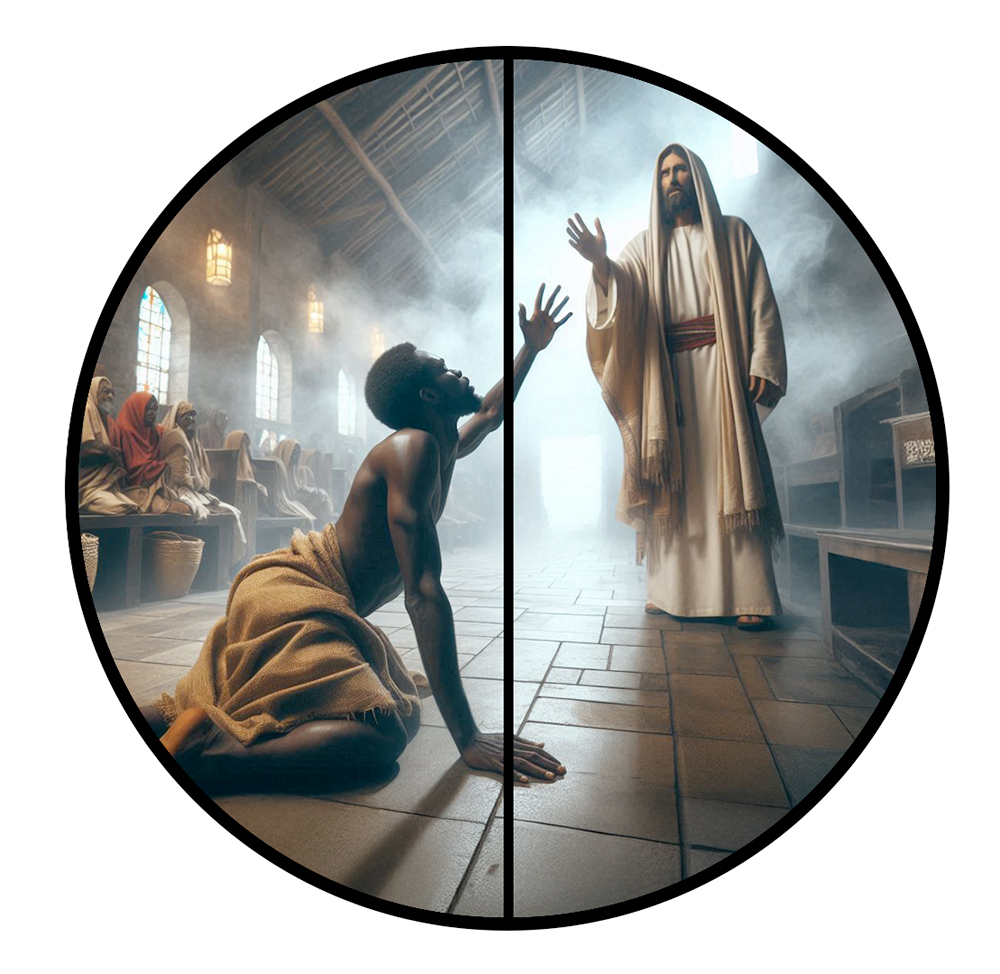
Son of Beloved One!!
BE MERCIFUL TO MYSELF!!
And he who has stood ready, the Salvation, ordered himself to be led toward himself, and of him who has drawn near of himself, he asked himself,
"Who do you desire I make to yourself?" And the one said, "Master! so that I might look up!"
Look up and Count the Stars
And the Salvation said to self, "Look up! The Trust of yourself, she has saved yourself!"αἶνος = story, tale
And immediately he looked up and he was accompanying self, he who is glorifying the God. And all the People, he who has perceived, gave a story to the God.Footnotes
The phrase ταῦτα πρὸς ἑαυτὸν προσηύχετο (“he prayed these things to his own self”) from the Nestle 1904 and Westcott and Hort 1881 editions suggests a reflective prayer, emphasizing the Separatist's inward focus. The preposition πρὸς (“to”) combined with ἑαυτὸν (“himself”) underscores that he is addressing his prayer to his own self, but it is going nowhere.
However, the textual variant σταθεὶς πρὸς ἑαυτὸν ταῦτα προσηύχετο (found in editions like the RP Byzantine Majority Text 2005 and Greek Orthodox Church) shifts the sense subtly to avoid this meaning.
The change in syntax and punctuation across manuscripts — particularly the placement of "πρὸς ἑαυτὸν" — crafts a significant shift.
The common translation of ἱλάσθητί as "be merciful" is misleading, undertranslated at best. The term derives from ἱλάσκομαι, meaning “to make propitiation” or “to appease wrath,” and is used in contexts of atonement, not mere compassion. It more properly conveys a plea for divine reconciliation or expiation of guilt, akin to the Hebrew כפר (kipper).
παρ' with the accusative, according to LSJ, Bailly, Thayer's, etc. primarily indicates proximity or direction, often denoting physical movement towards or along something (e.g., "near," "alongside"). This usage is seen in expressions like "towards the ships" or "alongside the coast."
However, παρ' can also extend metaphorically, especially when used to convey a sense of comparison, origin, or relation (e.g., "in relation to," "from the side of"). In such cases, the accusative would be used not to mark physical direction, but a figurative or relational reference.
The problem with this lies in the ambiguity and the use of a past tense "he descended rather than" which is simply not a coherent saying. Also, the word "rather" was added in. The fact that translations such as the KJV place "rather" in italics reflects their translators' awareness that the word is not present in the Greek text but is supplied interpretively to reflect what they believe to be the intended sense:
"this man went down to his house justified rather than the other:"
(KJV)
Furthermore, the variant readings of later manuscripts bear witness to the awkwardness — κατέβη οὗτος δεδικαιωμένος εἰς τὸν οἶκον αὐτοῦ ἢ γὰρ ἐκεῖνος — attested in some later manuscripts, shows that early copyists and readers perceived παρ’ ἐκεῖνον as ambiguous or problematic. Problematic enough to change it. This change introduces ἢ γὰρ ("for rather" or "for than"), a construction that makes the contrast unambiguously comparative, likely motivated by the desire to clarify what they assumed the original seemed to imply but did not state overtly.
Textually, the presence of such a gloss reveals that the original reading — while syntactically sound — lacked sufficient clarity for later audiences, prompting them to "correct" it. This in turn provides indirect but strong support for the conclusion that the παρ’ ἐκεῖνον construction was not the most natural or expected way to express a comparative contrast.
To express unambiguously in Greek the sense “this man went down justified and not the other,” the clearest classical or Koine formulation would be:
οὗτος ἔβη δεδικαιωμένος εἰς τὸν οἶκον αὐτοῦ, οὐχ ὁ ἕτερος.
This one went down to his house justified, not the other.
Alternatively, if one wants to be explicit with syntactic clarity, one would write:
οὗτος ἔβη δεδικαιωμένος εἰς τὸν οἶκον αὐτοῦ ἀντὶ ἐκείνου.
This one went down to his house justified instead of that one.
This second version introduces the explicit ἀντὶ ἐκείνου — “instead of that one”, a construction well-attested for expressing substitution, exchange, comparison, etc. (cf. LSJ. ἀντί, A.III). This would eliminate ambiguity for both ancient and modern readers.
(cf. Thayer's entry on παρά, and Bailly's treatment of the preposition).
Unfavorably Docked
"δυσ-κόλος"
A compound of δυσ- (bad/poorly) and κόλος. The adjective κόλος, -ος, -ον is primarily used to describe something that is "truncated" or "cut short", "having a part lopped off", "reduced to a stump" with specific applications that extend this meaning to particular objects or features. Here's a detailed explanation of the two primary senses:
General Meaning: "Truncated" or "Cut Short"
- This is the primary and broadest sense of κόλος, used to indicate that something is shortened, incomplete, or lacking part of its original form.
- Example:
- Homer, Iliad 16.117:
Ἕκτωρ Αἴαντος δόρυ μείλινον ἄγχι παραστὰς πλῆξ᾽ ἄορι μεγάλῳ αἰχμῆς παρὰ καυλὸν ὄπισθεν, ἀντικρὺ δ᾽ ἀπάραξε: τὸ μὲν Τελαμώνιος Αἴας πῆλ᾽ αὔτως ἐν χειρὶ κόλον δόρυ, τῆλε δ᾽ ἀπ᾽ αὐτοῦ αἰχμὴ χαλκείη χαμάδις βόμβησε πεσοῦσα.
“Hector, standing near Ajax’s ashen spear, struck it with a great sword near the socket behind the spearhead, and completely sheared it off. Telamonian Ajax was left holding the truncated [κόλον] spear in his hand as it was, while the bronze spearhead fell far from him, clanging to the ground as it fell.”
In this passage from Homer’s Iliad (Book 16.114–125), the word κόλος is used to describe the truncated spear of Ajax (“κόλον δόρυ”). Hector strikes Ajax’s spear near its shaft with a great sword, severing the bronze tip and rendering the weapon ineffective. The term κόλον, meaning “truncated” or “mutilated,” vividly illustrates the destruction of the spear and signifies Ajax’s sudden disadvantage in battle.
- Homer, Iliad 16.117:
This is not derived from κόλον meaning the large intestine or colon in anatomy or a clause (in rhetoric), a part of a sentence. Related is the word δυσκολός which used of persons literally means hard to satisfy with food (cf. Ath. 6.262a), and from this are various idiomatic uses such as "unpleasant," "hard to please" or "troublesome." Thus the rendering of "how difficult to enter" is quite inaccurate on the grounds that the proper Greek word for such an expression is χαλεπός, (difficult, hard, grievious, and hardly, with difficulty) which is not used.
(Cf. LSJ, Bailly, A. (2024), Pape, Cunliffe, Autenrieth, Middle Liddell)