Light Giver 16
διαβάλλω diaballó - Throw across/over
And he was also saying toward the Learners, "There was a man, anyone who was being rich who was holding a home-steward, and this one was thrown over to self as him who is scattering abroad the things which are pre-existing of himself.Who are You to Me?
And he who crowed to self said to self, Who is this one I am hearing of around yourself? Give back the Logos Ratio of the Home Management of yourself, for you are not yet able to house-manage!And the Household-Steward said within his own self, Who will I make, for the Master of myself is taking the Household-Management away from myself? I am not strong enough to dig! I am ashamed to beg!
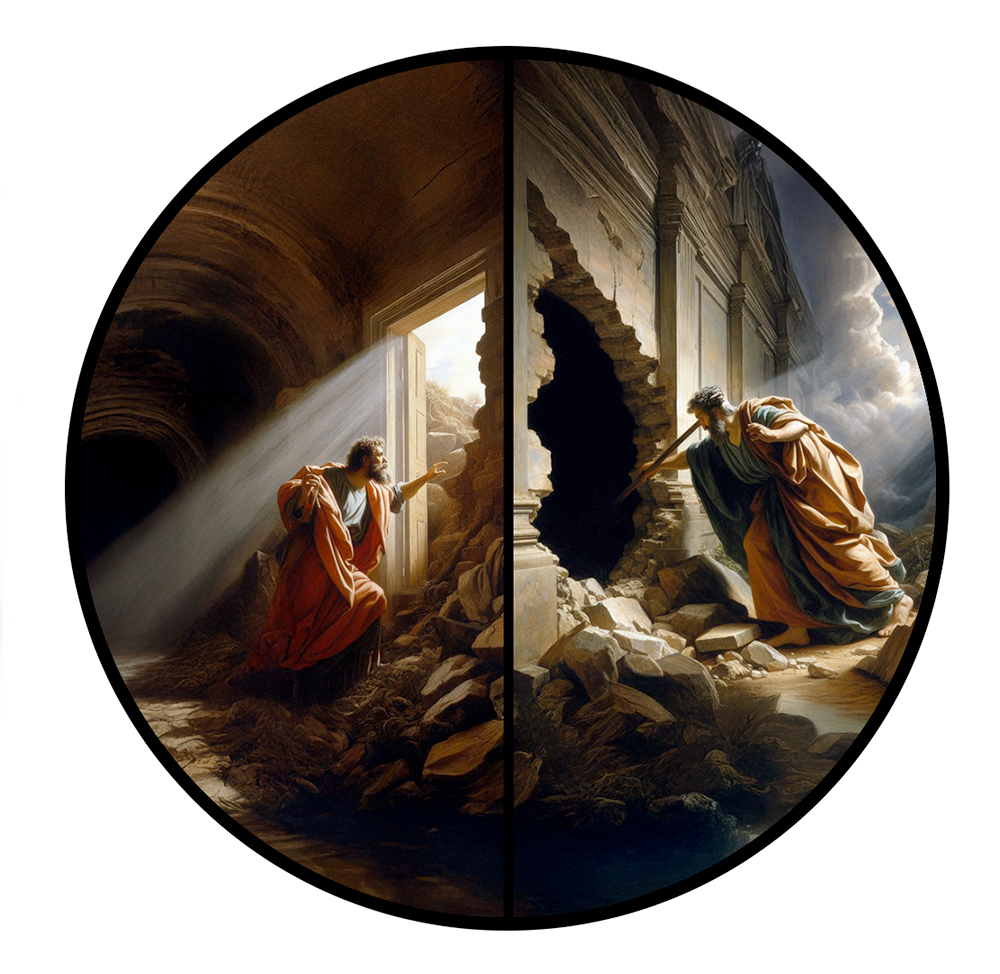
And he is saying toward myself, "Come and see the self-eternal abominations, evil ones which they, themselves make in here!"
(Ezekiel 8:8-9 RBT)μετασταθῶ - Be changed, displaced, transferred
I recognized who I will make, so that when I should be displaced/removed from out the Management they might receive myself into the Households of their own selves.And he who has summoned in one each of the Debtors of the Master of his own self, he was saying to the First One, How much are you indebted to the Master of myself?
Reconcile quickly with the Adversary of Yourself
And the one said, A hundred baths of olive oil. And the one said to self, Take the Drawings of yourself, and he who sat down, quickly draw fifty!59Then to another one he said, And how much are you, yourself indebted? And the one said, "A hundred kors of wheat. He is saying to self, Take the Drawings of yourself and write/draw eighty.
Sons of the Aion (the Eternal)
And the Master praised the Household-Steward of the Unjust One, because he made prudently. For the Sons of the Eternal One, this one, are being more prudent beyond the Sons of the Luminary into the Generation, the one of their own selves.
The Greek noun φάος (also φῶς, φόως), though primarily denoting light, especially sunlight or daylight, is also used to refer to moonlight and starlight, as seen in expressions like φαέεσσι σελήνης ("with the beams of the moon," Hes. fr. 142.4) and in Pindar's use of the term in celestial contexts (Pyth. 3.75). See LSJ, s.v. φάος, especially under usages in Homer, Hesiod, and later lyric poets.
And I, myself am saying to yourselves, Make friends from out the Mammona of the Unjust One, so that when he should fail/suffer eclipse, they might receive yourselves into the Eternal Tents.60
The trustworthy one within the smallest one is also a trustworthy one within many, and the unjust one within the smallest one is also an unjust one within many.
μαμωνᾷ mamōna = that which is trusted
If therefore within the Unjust Mammona you have not become trustworthy ones, who will entrust the True One to yourselves?And if within the one belonging to another you did not become trustworthy ones, who will give the one belonging to you to yourselves?
No household-servant is able to serve two masters, for he will either hate the One, and the Other One he will agape-love, or he will hold against one, and the Other One he will look down upon. You are not able to serve a god and that which is trusted in ("mammona").
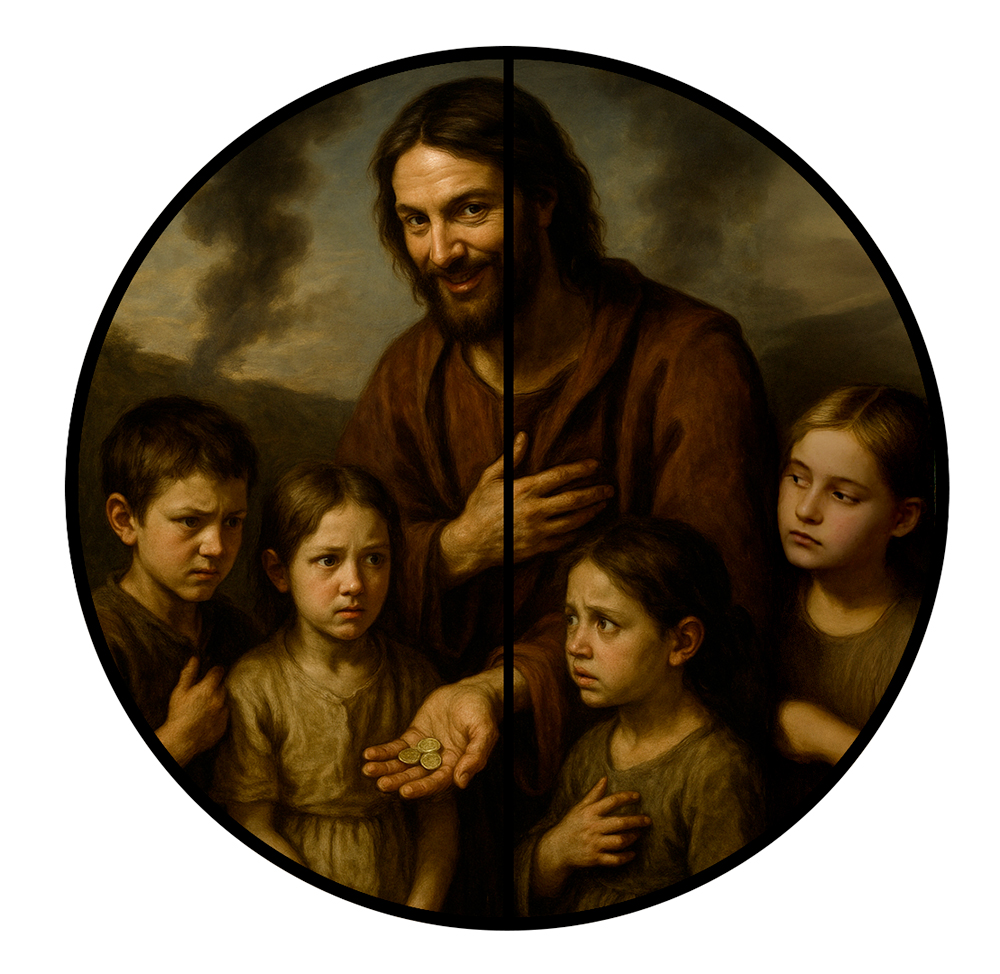
Of such a kind is the kingdom..."
φιλάργυροι - fond of silver
And they were hearing these things, all the Separatists, those who are pre-existing philo-lovers of silver, and they were turning the nostril out at himself.And he said to themselves, "You, yourselves are the ones who are acquitting your own selves in the eye of the Humans, but the God is recognizing the Hearts of yourselves, because the High One within men is an abomination in the eye of the God!
βιάζω - Suffering Forceful Violence
The Usage and the Prophets are as far as Favored ("John"). Away from that time the Queen of the God is being gospelized, and everyone is forcing his way into herself.61And it is easier for the Heavenly One and the Earthly One to pass by than for one little horn of the Usage to fall down.
Everyone who is setting free the Woman of himself and he who is marrying another one is committing adultery, and the one who is marrying her who has been set free away from a man is committing adultery.
A King
And a man, a certain one, was rich and he was putting on purple and fine linen, he who is making merry according to a day brightly.Even the Dogs Eat the Crumbs
And a certain cowering one, with a name of Helpless ("Lazarus") had been thrown toward the Gateway of himself, he who has been wounded,and he who is longing to be fed away from the ones that are falling away from the Table of the Rich One, but the Dogs also, those who are coming, were licking away the Festering Wounds of himself.
ἀποφέρω - Carried Off
And the Cowering One became to die and to be carried off of himself below the Angels into the Fold of Father of Multitude ("Abraham"), and the Rich One also died and was given funeral rites.62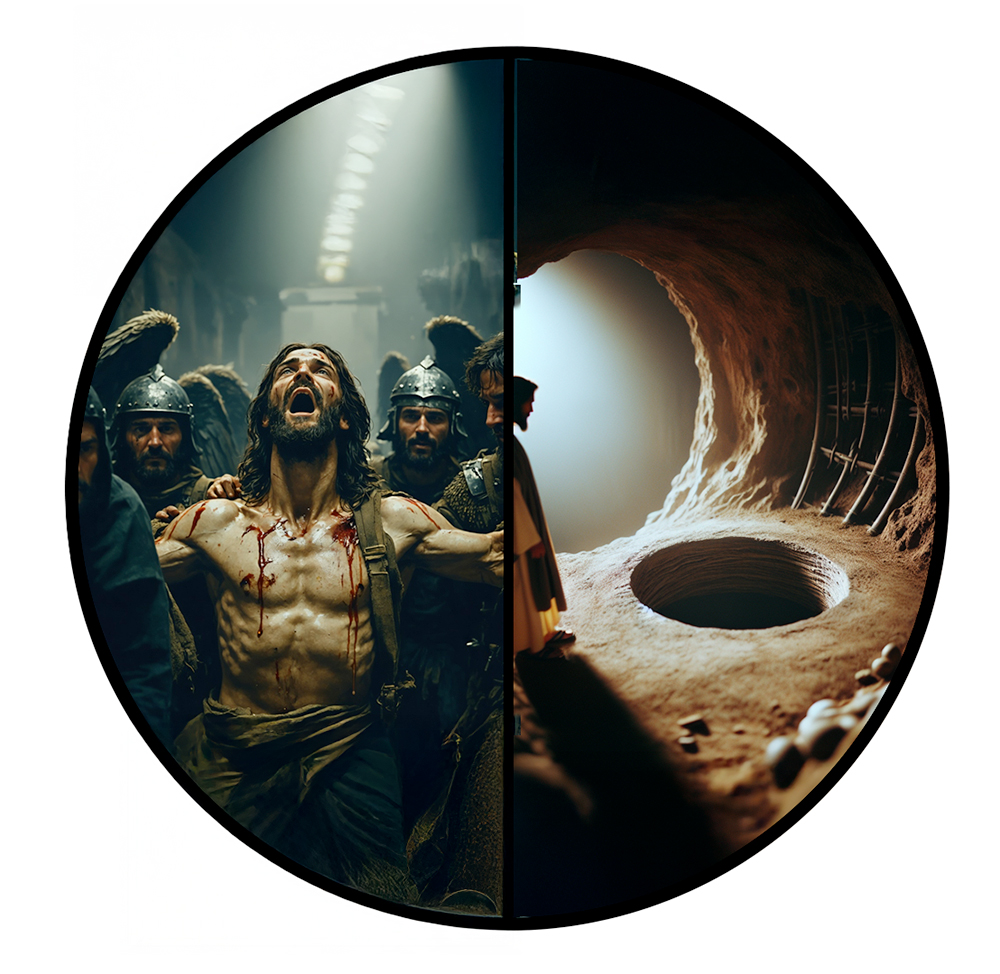
κόλπος a hollow - denotes a variety of meanings centering on the concept of an enfolding or enclosing space. In its primary physical sense, it refers to the bosom of a mother or nurse (Il. 6.400, 467), or more broadly, the belly or entrails, especially in the plural (Eur. Hel. 1159; Call. Jov. 15).
It also commonly designates the fold of a garment, where items might be held (Il. 22.80; Od. 15.468). By extension, it may describe natural hollows such as the trough between sea waves, the bosom of the sea, or the interior of the earth, including references to the underworld (Il. 18.140; Opp. C. 3.11; Ar. Av. 694).
βασάνοις = Touchstones of Testing/Torture
And within the Underworld ("Hades"), he who has raised up the Eyes of himself, he who pre-existing within touchstone-tortures, is perceiving Father of Multitude from far away and Helpless ("Lazarus") within the Fold/Gulf of himself.And he who has crowed, he said, "Father, Father of Multitude ("Abraham"), have mercy on myself and send Helpless ("Lazarus") so that he might dip the Peak of the Finger of himself in water, and cool down the Tongue of myself, for I am suffering pain within the Flame, this one!
And Father of Multitude ("Abraham") said, "Child, remember that you took away the Good Things of yourself within the Zoe-Life of Yourself, and Helpless ("Lazarus") similarly the Evil Things! And , in here he is being summoned alongside, and you, yourself are suffering in pain!
χάσμα chasma - Gulf, gaping opening
And within all of these things, in between ourselves and yourselves a mega gulf has been firmly fixed in such a manner that the ones who are desiring to cross over in here toward yourselves are not able, neither from that side toward ourselves, can they cross over!
And he said, "I implore yourself therefore, father, so that you would send forth himself into the Home of the Father of myself,
for I am holding five brothers in such a manner that he might solemnly protest to themselves so that they, themselves should not also come into the Place, this one, of the Touchstones!"
And Father of Multitude is saying, "They are holding Drawn Out ("Moses") and the Prophets, let them hear themselves!"
And the one said, "No father, Father of Multitude, but rather if anyone should lead over away from dead ones toward themselves, they will change the mind!"
And he said to self, "If they are not hearing Drawn Out ("Moses") and the Prophets, not even if a certain one should stand up from out of dead ones, will they be persuaded!"
Footnotes
Abbott-Smith NT Greek Lexicon:
1. that which is traced or drawn, a picture.
2. that which is written;
The LSJ Lexicon provides a detailed explanation of the verb γράφω and its various forms, usages, and meanings. Here's a breakdown of the key points:
Primary Meaning: "To Draw"
-
The verb γράφω (with various forms such as ἔγραψα, γράφω, ἐγραψάμην, ἐγράφην, etc.) primarily means "to draw" in the sense of marking, scratching, or inscribing, derived from the action of making marks on a surface.
-
In Homer, it is used to mean "scratch" or "graze," as seen in Iliad 17.599, where the word describes a point made by a spear ("αἰχμὴ γράψεν οἱ ὀστέον ἄχρις").
Meaning of "To Represent by Lines"
-
The verb γράφω also means to represent by lines (i.e., to draw or depict visually), which later evolved into meanings related to painting or art. This sense appears in later works:
-
Herodotus (2.41) uses the term in the sense of drawing.
-
Plato, in the Republic (377e), uses it for creating depictions such as in maps or drawings.
-
Drawing Maps or Creating Visual Representations
-
Drawing maps is one of the later senses, as in Herodotus 4.36, where it refers to drawing a map of the earth's boundaries.
-
Similarly, it is used for creating images such as a statue or figure: "ἀνδριάντα γ.," which means to sculpt a statue, found in Plato, Republic 420c.
In the Context of Art
-
ζῷα γ. means to draw or paint animals (i.e., creating artistic depictions), which is synonymous with the later Greek term ζωγραφεῖν (to paint or to create pictures).
-
Passively, it could also refer to a painting or image being created: "εἰκὼν γεγραμμένη," meaning "a painted image" (Aristophanes, Ran. 537).
Mathematical and Scientific Uses
-
In the context of geometry, γράφω means "to describe" a figure, as in Euclid's "Postulates" and Archimedes' "On the Sphere and Cylinder." This is a more technical use where it signifies creating geometric shapes or curves.
-
Generating a figure is another use, as in Aristotle (Mechanics) where a point or line in motion "generates" a geometric figure.
Passives and Middle Forms
-
The verb γράφω is used in various middle and passive forms to convey the action of being drawn or written:
-
Future passive: γράφησομαι (e.g., Hippocrates, Acut. 26) or γεγράφησομαι (e.g., Sophocles, Oedipus Tyrannus 411).
-
Aorist passive: ἐγράφην (e.g., Herodotus 4.91, Plato, Protagoras 128c).
-
The verb also appears in a middle form with reflexive meaning, as in γεγράφαται (e.g., in Oppian's "Cynic").
-
Metaphorical Uses
-
In memory: A metaphorical use appears in Pindar (O. 10(11).3), where it refers to something written in the "leaf of memory" or as a mental inscription, symbolizing the idea of memory as a form of written record.
Writing and Inscribing Texts
-
The verb γράφω also has the meaning of writing texts, whether they are documents, letters, or contracts. For example:
-
Writing a will: "γ. διαθήκην," as in Plato, Laws 923c.
-
Writing on materials such as wax, gold, or papyrus (Plato, Phaedrus 276c).
-
Writing in water or ash, referring to temporary or symbolic writing.
-
Branding or Marking
-
γράφω can also mean to brand or mark something, such as branding cattle or marking objects in a distinguishable way, as in Oppian's "Cynegetica" (1.326).
In summary, γράφω in its primary sense means to draw or inscribe, initially in a literal sense (scratching or marking), but later evolving to encompass artistic and mathematical uses, such as drawing pictures or creating geometric figures. It also extends metaphorically to the idea of writing and marking in both physical and abstract contexts.
(cf. Logeion γράφω)
Lord Mammon
The Greek term μαμωνᾶς (mamōnas), found in the New Testament, is often translated as "wealth" or "riches" and is personified as a master that competes with God for loyalty. The etymology of "μαμωνᾶς" provides deeper insight into its meaning. It is derived from the Chaldean term מאמונא (mamona), which is associated with trust and reliance, being derived from the Hebrew אמן aman meaning to trust, believe, support. This led to certain interpretations of "money" or "wealth" as a common thing people trust in (according to Gesenius is contracted from the Hebrew word מטמון (matmon Strongs #4301), meaning "hidden treasure" or "buried treasure.").
The Hebrew term אמונה (amunah) means "faith/trust/confidence"
The Hebrew word מאמונה (ma'amunā) comes from the root אמנ (’mn), which is related to ideas of faith, trust, and reliability (as seen in אמונה (emunah), meaning faith or trustworthiness). However, מאמונה has a distinct meaning, usually related to concepts of trust, reliability, or faithfulness in a more practical or functional sense.
The term μαμωνᾶς (mammon) derives from the Aramaic מאמוֹנא, itself apparently from the root אמן, meaning "to trust." Scholars such as Buxtorf and those cited in Thayer’s Lexicon understand the word as signifying “that which is trusted”, reflecting not merely wealth, but literally the object of trust or reliance, especially in a moral or religious context.
מאמונה Someone who is trusted:
-
Trust / Faithfulness – In Aramaic, מאמונה refers to the concept of being entrusted or reliable, often indicating someone who is trusted or someone appointed to a role of responsibility.
-
Appointed Overseer or Guardian – It can also refer to someone who is appointed to a position of responsibility, such as a steward, warden, or guardian. This is often the sense in Jewish Aramaic literature, particularly in the Talmud, where מַאֲמוּנָה might describe a guardian of something or someone entrusted with a task or responsibility.
Etymology and Morphology:
-
Root: The root א־מ־נ (’mn) is connected to trust and faith, as seen in the related words אֱמוּנָה (emunah, faith) and מָמוֹנָא (māmōnā, wealth).
-
Pattern: The word מאמונה would be a passive participle in Aramaic, derived from the root, and denotes something or someone that is entrusted, faithful, or reliable. Is it riches? Or, a person?
The key meaning here lies in the personification. Mammon is also personifed as a master or lord, and thus one representing the power of אמונה "faith", placed in a person of trust. As a master or lord, Mammon would thus be one demanding trust, devotion, faith.
------
The verb ἐκλείπω (ekleípō), from ἐκ ("out of") and λείπω ("to leave"), broadly means "to fail," "cease," or "abandon." Its uses span both literal and metaphorical contexts in classical and post-classical Greek. In a transitive sense, it can mean to omit, leave out, or forsake (cf. Herodotus, Aeschylus); intransitively, it often connotes failing or ceasing to function, especially of natural or divine phenomena.
Of particular note is its astronomical usage, where ἐκλείπειν refers to the eclipse of a celestial body, especially the sun or moon. This application appears in authors such as Thucydides and Herodotus—e.g., ὁ ἥλιος ἐκλιπὼν τὴν ἐκ τοῦ οὐρανοῦ ἕδρην (“the sun departed from its seat in the sky,” Hdt. 7.37), describing the temporary darkening during an eclipse. The noun ἔκλειψις, later standardized in astronomical terminology, is derived directly from this verbal root and retains this specialized sense.
By extension, ἐκλείπω can also refer to death (as in ἐκλείπειν βίον, Sophocles), highlighting the metaphor of life being extinguished like a light. Its semantic field therefore encompasses absence, cessation, and disappearance, whether applied to light, presence, strength, or life itself.
As the translation of "the Queen" was completely out of the question for these men, the ensuing two thousand years of utter confusion and nonsensical attempts at creating a coherent interpretation of a "kingdom suffering violence" needs no explanation. There was never a solution to the saying, because the saying is completely bogus. Rightly did the prophets speak.
The phrase καὶ πᾶς εἰς αὐτὴν βιάζεται can be literally translated as "and everyone is forcing himself into her."
The verb βιάζεται comes from βιάζομαι, which means "to force, constrain, or overpower." In ancient Greek, βιάζω is often used for physical force (e.g., Od. 12.297, where it means "you are forcing me") or metaphorical compulsion (e.g., Thuc. 8.53, "to do violence to the laws").
In its middle/passive form, it indicates being forced or constrained, either physically (e.g., Il. 11.589, "he is hard pressed by missiles") or mentally (e.g., Thuc. 7.67, "being compelled by the present difficulty"). The verb also expresses intense effort or persistence, such as in Lys. 9.16, "making every effort to harm."
The phrase Ἐγένετο ἀποθανεῖν καὶ ἀπενεχθῆναι αὐτόν (Luke 16:22) may be analyzed in two ways. Grammatically, it consists of the aorist middle indicative ἐγένετο ("it/he came to be") governing two aorist infinitives, ἀποθανεῖν ("to die") and ἀπενεχθῆναι ("to be carried away"), with αὐτόν ("him") as the accusative subject of both infinitives. It has been interpreted as idiom, or what is called, a periphrastic infinitive construction with γίγνομαι + infinitive(s). It is unusual, but was considered to be meant for the narration of events in a formal, almost liturgical style, i.e. "And it came to pass...." Such a phrase would not be used in normal dialogue—periphrasis refers to the use of more words to express a concept that could be conveyed more simply with a single word. But was that the point? In the very same verse, the simple word is used of the rich man, "and he also died."
A strictly formal rendering would be: "It came to be to die and to be carried off by him."
Carried Up or Carried Off?
ἀπενεχθῆναι αὐτὸν does not mean "carried by him." It means "to be carried away by him" or "to be carried off", with the emphasis on the subject being the one who is carried away. The word αὐτὸν seems to be skipped over/deleted by other translations.
The verb ἀποφέρω (and its derived forms) generally means "to carry away," "to bring back," or "to take away." While its basic meaning is neutral, it carries numerous negative connotations depending on the context. In some uses, it describes the act of carrying off spoils or losses (e.g., ἀπένεικαν τεύχεα –
"They carried off the armor," Odyssey 16.360),
or the dissipation of something, as in ἀπενεχθέντες ἐς Λιβύην –
"Having been carried off to Libya," Thucydides 7.50).
These suggest negative outcomes, such as loss or theft. Additionally, the verb is used metaphorically to indicate paying back or returning something, often in contexts of debt or punishment as in ἀπήνεγκε παρανόμων –
"He handed in an accusation," Demosthenes),
which can carry the weight of unpleasant repayment. Lastly, it can describe the returning of individuals, such as a sick person being carried home, again often implying a tragic or unwelcome return (e.g., ἀπηνέχθη εἰς . . ἔτι ζῶν – "He was carried back while still alive").
(See Logeion ἀποφέρω)
Thus, ἀποφέρω is simply not the right word to express "carried by angels" in a positive sense. Instead, ἀναφέρω or ἐπαναφέρω would be more appropriate, as both verbs have meanings related to raising up, lifting, or carrying in a more neutral or positive sense, and can be used in contexts involving divine or heavenly beings.
-
ἀναφέρω (to carry up, to bring to) can convey the idea of being lifted or raised up, which aligns more closely with the notion of being carried by (good) angels.
-
ἐπαναφέρω (to carry back or to restore) is also a possible alternative in certain contexts, though ἀναφέρω would be a better fit for something like "carried by angels".
For example, if you want to say "carried by angels," a better translation would be ἀναφέρεται ὑπὸ τῶν ἀγγέλων or ἀναφέρεται ὑπὸ τῶν ἀγγέλων depending on the tense and nuance.