Light Giver 22
Feast of the Unspoilt Bread of Essence
And she was drawing near, the Feast Day of the Unleavened, the one who is being called, Pass Over ("Pascha").ἀνέλωσιν - Appropriate, take him in, adopt, take to themselves
And the High Priests and the Scholars were searching for the Way which they might take up himself, for they were afraid of the People.74bAnd the Adversary entered into Caster ("Judas"), the one who is being summoned Man of Cities ("Iscariot") who is being from out of the Number of the Two and Ten.
And he who has gone away jointly uttered with the Arch Priests and generals of the Way how he might hand over himself to themselves.
And they rejoiced and they constructively put together to give to self silver.
And he fully acknowledged and he was searching for a fitting opportunity of the Handing Over of himself to themselves without a crowd.
And she came, the Day of the Unleavened, within her whom it was necessary for the Pass Over ("Pascha") to be sacrificed.
And he sent away Small Stone and Favored, he who has said, "Those who have led across, prepare for ourselves the Pass Over so that we might eat."
And the ones said to self, "Where do you desire we should prepare?"
And the one said to themselves, "Behold! As you, yourselves entered into the City, a man will encounter yourselves, he who is bearing a earthen jar of water. Accompany himself into the House, into whosoever he is entering.
And you will say to the Home Master of the House, The Teacher is speaking to yourself, Where is the Untying Place/Inn where I may eat the Pass Over in company with the Learners of myself?
And that one also will expose to yourselves a mega Above Earth Chamber which has been spread out, prepare in that place!
And those who have gone away discovered just as he had spoken to themselves, and they prepared the Pass Over.
And when she became, the Seasonal Time, he reclined back, also the Messengers in sync with himself.
"Over myself is the Longing Desire of Himself!" - Songs 7:11
And he said toward themselves, "With a passionate longing I longed for this, the Pass Over, to eat in company with yourselves in front of the Suffering of Myself!For I am speaking to yourselves that I should never at all eat of self until him whom might be made full within the Queen of the God!"
And he who has taken hold of a cup, he who gave eucharist/thanks, he said, "Take hold of this one, and part/distribute into your own selves.
For I am speaking to yourselves that I should never drink away from the , away from the Offspring of the Vine until him of whom the Queen of the God should come!"
ἀνάμνησιν - recalling to mind, Memory
And he who has taken hold of a bread loaf, he who gave eucharist/thanks, he deflected and gave to themselves, he who is saying, "This one is the Body of Myself, the one which is being given beyond yourselves, make this into My Own Memory!""This one is my body"
The Greek verb κλάω originally denotes “to break, fracture, or snap” (e.g., wood, spears, vine shoots: Od. 6.128; Il. 11.584; Thphr. CP 1.15.1). It wasn't fitting, nor used in the sense of tearing off a piece of anything. In technical and metaphorical contexts the meaning shifts from literal breakage to deviation or bending, giving rise to the senses “deflect,” “inflect,” or “follow a non-straight course”.
(κλάω – Deflect)בדם הוא - in the Blood of Himself
And the Cup in the same way, beyond the Dining, he who is saying, "This Cup, the New Testament within the Blood of Myself, the Beyond One of yourselves which is being poured forth."Nevertheless, behold the Hand of the one who is handing over myself, upon the Table in company with myself!
For indeed the Son of the Human is leading over according to that which has been marked off, except woe to the Man, that one, through whom he is being handed over!"
πράσσω - Practice, Perform Repeatedly
And they, themselves began to examine together toward their own selves, who then from out of themselves might be the one who is destined to practice this thing.Nikolaitans
And she became also a love of winning within themselves, the "who of themselves seems to be greater."
φίλος (phílos) — “loving,” “fond of”
νίκη (níkē) — “victory,” in contests or disputes
εὐεργέτης - patron, donor, doers of good, public benefactor
And the one said to themselves, "The Kings of the Herds are exercising lordship over themselves, and the ones who are exercising authority over themselves are being summoned as workers of good.But yourselves, not thus! But instead let the More Mega One within yourselves become just like the Younger One, and the one who is leading just like the one who is ministering!
For who is more mega, the one who is dedicated, or the one who is ministering? Is it not the one who is dedicated? And I, myself am within the middle of yourselves, just like the one who is ministering!
But you, yourselves are the ones who have persisted through in company with myself, within the Trials of myself!
I, myself also am systematically arranging to yourselves, according as the Father of myself systematically arranged to myself a queen.
So that you may eat and drink on the Table of myself within the Queen of myself, and you will sit down on thrones, those who are separating the Two and Ten Tribes/Branches of the God Contends ("the Israel").
Sown by the Adversary
But I, myself was in want around to yourself, so that she might not fail, the Trust of yourself. And yourself, when he who has wheeled back around, firmly fix/steady the Brothers of Yourself!"
And the one said to self, "Master in company with yourself I am prepared also to lead across into a watch, and into death."
To Not Know
And the one said, "I am speaking to yourself, Small Stone, a rooster will not will crow , until you should reject myself three times, to not see/know."76And he said to themselves, "When I sent away yourselves without a money-purse and a leather pouch and sandals, did you fall short of something?" And they said, "Of Nothing."
The Dagger of the New Testament
And he said to themselves, "But rather , the one who is holding, let him lift up a money-purse, and likewise a leather pouch, and the one who is not holding, let him exchange the Outer Garment of himself and buy a dagger!77For I am saying to yourselves that this one, the one which has been written/drawn, must be completed within myself: The one was counted also in company with lawless ones, for the one around to myself is also holding an end-aim.

Holding around/toward the aim
And the ones said, "Master, Look! two daggers in here!" And the one said to themselves, "She is competent/enough!"

And I am lifting up eyes, and I am seeing, and behold! twofold women—those who are going out! And the Spirit is within the dual wings of themselves! And these ones have dual wings like the wings of the Kind Bird/Stork, and they are lifting up the self eternal Ephah between the Earthly One and between the Dual Heavenly Ones!
(Zechariah 5:9 RBT)And he who has gone out, he traversed across according to the Habit, into the Mountain the Olive Trees, and he accompanied self and the Learners.
And he who became upon the Position said to themselves, "Offer prayers, to not enter into a trial!"
And he, himself tore away from themselves as though a shot of a stone, and he who placed the Knees was offering prayers.
It's not mine, but yours
He who is saying, "Father, if you are willing, bring along this one, the Cup, away from myself, save not the Pleasure of myself but rather the one of yourself, let it become!"And an angel was perceived to self, away from the Heavenly One, he who is reinforcing himself.78
"And the Sons are crushing themselves within her inner person..." Gen. 25:22
And he who has become within a struggle for victory kept offering prayers more eagerly, and the Sweat of himself became as if clots/lumps of blood, those who are disembarking/stepping down upon the Earthly One.79And he who has risen up away from the Prayer, he who has come toward the Learners, he found themselves, those who are sleeping away from the Pain of Sorrow.
And he said to themselves, "Why are you sleeping? Those who have stood up, offer prayers so that you might not enter into a trial!"
While he, himself is still chatting, behold! a multitude, and the one who is being called Caster ("Judas"), one of the Two and Ten, he was going ahead of themselves, and he drew near to the Salvation, to philo-love/kiss himself.80
And Salvation said to self, "Caster ("Judas")! Are you handing over the Son of the Human by a kiss?"
And the ones who have perceived around himself that which will be, they said, "Master, will we strike within a dagger?"
And one, a certain one from out of themselves, struck the Born-Bondman of the High Priest, and took away the Ear of himself, the Right Side.
until this ear
And he who has been separated, the Salvation, said, "Allow it until this one." And he who has fastened to the Ear, healed himself.81And Salvation said toward the ones who have become close against himself, arch priests and generals of the Sacred Place and Elder Ones, "Just like against a plunderer you went out in company with daggers and wood!"
According to a day, while him who is being of myself in company with yourselves within the Sacred Place, you did not stretch out the Hands upon myself, but rather she, herself is the Seasonal Time of Yourselves, and the Authority of the Darkness!"
And those who have collected together himself led, and they led into the House of the High Priest, and the Small Stone was accompanying from afar.

συλλαμβάνω - collect, gather together, esp. rally scattered troops, lay hands on, seize
She stretched him out in the abundance of her persuasion, within a portion of the dual shores/lips of herself, she is expelling him out. For multitudes of pierced ones, she has caused to fall, and a mighty throng are all the slain of herself! The roads of Sheol in the house of herself are descending steps toward the inner chambers of death!
(Proverbs 7:21,26-27 RBT)And a certain young maiden, she who has perceived himself, he who is sitting down toward the Luminary, she who also gazed earnestly at himself said, "And this one was being together with himself!"

And the one and denied/disowned, he who is saying, "I do not see himself, woman!"
And so you have spoken!
And beyond a little, another, he who has perceived himself was bringing to light, "You, yourself are also from out of themselves!" And the Small Stone was bringing to light, "Man, I am not!The Hour of Himself Stands Apart from Himself
And while she, herself stood apart, as though a seasonal time of one, another certain one was confidently affirming, he who is saying, "Upon a true one, this one was also being in company with himself, for he is also a Circuiter ("Galilean")!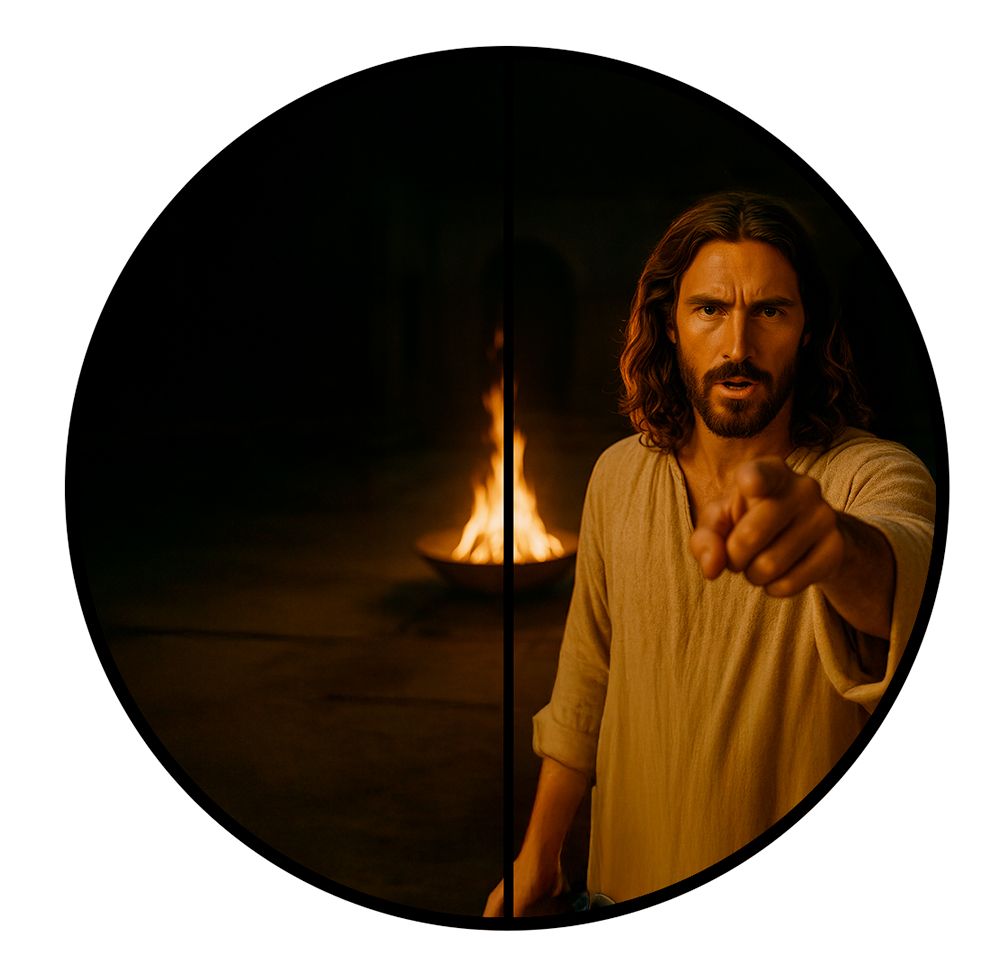
Son of the Man, lift up your eyes!
And the Small Stone said, "Man, I do not see what you are speaking!" And immediately while still him who is chatting of himself, a rooster crowed.And he who has been turned around, the Master, looked at the Small Stone, and the Small Stone remembered the Logos Ratio of the Master just as he spoke to self, that before a rooster crowing, today you will reject myself three times.
And he who has gone out outside, he wept bitterly.
And the Males, the ones who are holding together himself, began mocking to self, those who are flaying.
Enveloped in Darkness
And the ones who have enveloped all around himself, they were questioning, those who are saying, "Prophesy, who is he, the one who struck yourself?"And also multitudinous other things, those who are blaspheming, were speaking into himself.
συνέδριον - A Joint sitting body, governing body
And as she became a day, the Council of Elder Ones of the People were led together, and both arch priests and scholars. And they led himself away into the Joint Sitting Council of Themselves, those who are saying,
"We caught her..."
συνέδριον - joint sitting/session
ἔνοχος - "one who is held in anything, so that he cannot escape" (Thayer)
εἰπὸν ἡμῖν - "O Lord, Speak to Us!"
"If you, yourself are the Anointed One, speak to ourselves!" And he said to themselves, "If I should speak to yourselves, you would never trust!And if I should ask, you would never separate!
But away from the the Son of the Human will be him who is seated from out of the right sides of the Powerful One of the God!"
And they all said, "Therefore you, yourself are the Son of the God!" And the one was bringing to light toward themselves, "You, yourselves are speaking that I, myself am!"
And they said, "What need do we still hold of a testimony? For we, ourselves heard away from the Mouth of himself!"
Footnotes
Take up, Adopt
Translating ἀναιρέω in the New Testament merely as “kill” or “put to death” reflects a significant "covering up" of its true semantic range that is neither lexically nor contextually justified. The New Testament already employs a wide array of terms for lethal action, such as ἀποκτείνω (“to kill”), θανατόω (“to put to death”), φονεύω (“to murder”), and διαφθείρω (“to destroy”), which are used without euphemism throughout the corpus. The verb ἀναιρέω, by contrast, has a broader and more interesting semantic profile in classical and Hellenistic usage, which includes many positive senses. According to LSJ, these include:
-
to take up (physically or symbolically), e.g., a child (παῖδα, Pind. Pyth. 9.61), bones (τὰ ὀστᾶ, Thuc. 1.126), or prizes (ἀέθλια, Il. 23.736);
-
to raise up from the ground, e.g., a sacrificial victim (ἀνελόντες ἀπὸ χθονός, Od. 3.453);
-
to undertake or assume responsibility, e.g., burdens (πόνους, Hdt. 6.108), warfare (πόλεμον, Hdt. 5.36), or public service (δημόσιον ἔργον, Pl. Lg. 921d);
-
to receive, as in taking up a child to claim paternity or fosterage (Plut. Ant. 36; Men. Sam. 159);
-
to adopt a view or opinion (γνώμην, Hdt. 7.16);
-
to exact or collect, e.g., vengeance (ποινὴν, Hdt. 2.134), or tribute;
-
to take up into one’s care, e.g., wounded persons or shipwrecked survivors (Xen. HG 1.7.4);
-
to carry off, including in the sense of rescue or preservation;
-
to contract a lease, undertake a task, or withdraw funds;
-
to accept or entertain (emotion or thought), e.g., a thought (ἐπιφροσύνας, Od. 19.22) or a sense of good fortune (εὐδαιμονίαν, Pi. Nem. 7.56);
-
to confute, in philosophical or rhetorical contexts (Arist. SE 176b36), or to annul and rescind formal declarations (νόμον, Aeschin. 3.39);
-
to appoint or ordain, especially in reference to divine oracles (Pl. Lg. 865d; Hdt. 1.13).
This wide semantic field reflects a verb deeply embedded in religious, civic, juridical, and domestic contexts, often connoting not destruction but appropriation, assumption, or enactment of formal responsibility. When ἀναιρέω is used in the New Testament—e.g., Acts 7:21 (where Pharaoh’s daughter “took up” Moses), or Acts 23:15 (in a plot to “remove” Paul)—its meaning should be examined with sensitivity to these broader classical uses. Resorting to a reductive translation such as “kill” risks not only lexical imprecision but also theological and narratological distortion. A context-sensitive rendering, informed by both diachronic semantics and classical usage, is required to preserve the nuanced rhetorical and legal overtones that may be active in the New Testament text.
TL;DR
-
ἐξῃτήσατο means “demanded” or “asked for.”
-
σινιάσαι is the infinitive form of σινιάζω, which is derived from σινίον. LSJ glosses it as equivalent to σήθω, meaning “to sift”, only found in Luke 22:31.
-
The verb σινιάζω more literally means “to signal” or “to mark” (post-classical Greek), while the “sifting” meaning likely comes from later Christian interpretation due to the wheat analogy.
-
The phrase ὡς τὸν σῖτον (“as the wheat”) suggests a simile, comparing the act of marking the disciples to handling wheat, not necessarily to sifting it.
What?
ἐξῃτήσατο ὑμᾶς τοῦ σινιάσαι ὡς τὸν σῖτον — This translation follows the Greek morphology and syntactic structure closely, refraining from interpretive metaphor. The verb ἐξῃτήσατο is the 3rd person singular aorist middle of ἐξαιτέομαι, meaning “to demand for oneself” or “to request intensely.” The object ὑμᾶς is accusative plural, indicating the group being requested. The construction τοῦ σινιάσαι is a genitive articular infinitive, common in Hellenistic Greek to indicate purpose or intended result. The infinitive σινιάσαι is the aorist active infinitive of the verb σινιάζω, a post-classical (not Attic or early Koine) verb that appears to derive from Latin signare, “to mark,” “to seal,” or “to signal.”
Just not true.
Though widely interpreted in ecclesiastical tradition as metaphorical “sifting” (a reading driven by the comparative clause ὡς τὸν σῖτον, "as the wheat"), there is no evidence in classical or Koine Greek that σινιάζω ever meant “to sift” in a literal or idiomatic sense.
It is important to understand that the standard Greek verbs for "sift" or "winnow" would be λικμίζω (to winnow) or ἀνέμω (to toss grain). The meaning "sift" thus represents a contextual reinterpretation influenced by the wheat metaphor, not the semantic core of σινιάζω. Luke's choice of (rare) wording here is not inconsequential. With such a rare and unusual choice of wording, what leads a man to think it should be changed to a commonplace word?
Theological Bias.
The phrase ὡς τὸν σῖτον serves as a simile marking the manner or model of the intended action — “as the wheat”, i.e., just as wheat is marked (in threshing? gathering? ownership?), not sifted per se. Without imposing theological inference, the construction supports a literal reading:
“He demanded you, with the intention to mark you, as the wheat.”
This raises the possibility that the verse originally depicted a claim of dominion or possession, or perhaps a symbolic identification process, rather than a trial or purification (as "sifting" would suggest). After all, the Adversary sowed darnel/weeds, and is after domination, not merely testing, right? Sifting is a purification process— what is he doing sifting wheat, and not what he sowed?
On the derivation of σινιάζω, see Georgacas, D.J. The Influence of Latin on Byzantine and Modern Greek, Byzantinische Zeitschrift, Vol. 45 (1952), pp. 337–344. See also Trapp, E. Lexikon zur byzantinischen Gräzität (LBG), where σινιάζω is attested only in later and vernacular sources with the meaning to signal or indicate, from Latin signare. The aorist infinitive σινιάσαι is regularly formed.
Liddell-Scott-Jones (LSJ), A Greek-English Lexicon (9th ed.), s.v. σινιάζω: Glossed as equivalent to σήθω (to sift, winnow), attested in Luke 22:31 and later sources, including Hesychius, Photius, and various Byzantine glossaries. LSJ reflects the later semantic shift, where σινιάζω becomes associated with the verb for sifting grain due to the wheat metaphor used in the Gospel passage.
The verb σινιάζω is attested in post-classical and Byzantine Greek, where it retains meanings such as “to signal” or “to mark,” in contrast to the more literal "sift" associated with σήθω and λικμίζω in earlier Greek. See Georgacas, D.J., The Influence of Latin on Byzantine and Modern Greek, Byzantinische Zeitschrift, Vol. 45 (1952), pp. 337–344, and Trapp, E., Lexikon zur byzantinischen Gräzität (LBG).
The comparison of ὡς τὸν σῖτον ("as the wheat") in Luke 22:31 should be understood as a simile of identification rather than a description of a literal sifting process. The action of marking or signaling aligns with the idea of choosing or identifying wheat in a symbolic rather than a process-driven sense.
Textual Embellishments
The phrase μὴ εἰδέναι in Luke 22:34 is attested in early and critical editions (e.g., Westcott & Hort 1881, Nestle 1904) without the object pronoun με (“me”), contrasting with later Byzantine and Textus Receptus traditions which added με. The shorter reading is text-critically favored (lectio brevior potior), especially when the longer reading is easily explained as a "scribal/scholar clarification."
The syntactic construction μὴ εἰδέναι—without an object—intensifies the abstraction of the denial, potentially implying not just disavowal of a person, but a categorical refusal of recognition or understanding.
Abraham's Knife
The term μάχαιρα, though often broadly translated as sword, more precisely refers to a large knife or dagger, particularly in Classical and Hellenistic usage. The LSJ defines μάχαιρα as "a large knife or dirk," with early attestations in Homer (e.g., Il. 11.844) describing it as a weapon distinct from the longer, straight ξίφος (sword). The term frequently denotes a short-bladed weapon, suitable for close combat or assassination—hence its identification as "an assassin’s weapon" (Antiphon 5.69). While the word later encompasses curved or sabre-like cavalry blades (μ. ἱππική, IG XI.2.161), it remains consistently distinct from ξίφος, which denotes a longer, straighter blade. In philosophical and legal texts, μάχαιρα is even contrasted with ξίφος in contexts that stress this morphological and functional difference (e.g., Xen. Eq. 12.11). Therefore, in many literary and historical settings, μάχαιρα is best rendered as dagger or dirk, not merely sword.
In transitive constructions, ἐνισχύω governs a direct accusative, meaning “to strengthen” or “to reinforce,” whether applied to abstract qualities (e.g., τὴν βουλὴν σου in LXX Ezek. 27.9) or persons (ἄγγελος ἐνισχύων αὐτόν, Luke 22.43). Its semantic scope includes both physical reinforcement and emotional or moral encouragement. See Hippocrates Lexicon 2.26; Aristotle, P.A. 2.7.17; Thucydides, Hist. 5.9.3; Diodorus Siculus 5.57.
The Greek noun ἀγωνία (from ἀγών, “contest, struggle”) originally denoted a physical struggle or contest, especially in athletic or martial contexts such as wrestling (Xen. Cyr. 2.3.15; Plat. Men. 94b). Over time, its usage broadened to include any form of exertion or effort, both physical and mental, and in later authors it came to signify mental anguish, anxiety, or distress (Arist. Probl. 2.26; Dem. 236.19). Thus, depending on context, ἀγωνία may indicate either a literal contest or a metaphorical struggle, preserving its core semantic value of intense effort and conflict.
The Greek verb καταβαίνω does not mean "falling." It primarily denotes descent in physical space, as in coming down from a mountain (Il. 13.17), dismounting from a horse (Xen. Cyr. 5.5.6), stepping down from a public platform (Dem. 375.20), descend a ladder Odyssey 1.330, κλίμακα κατεβήσετο ("he descended the ladder") or to disembark on land, Pind. N. 4, 63; figuratively, to reach the goal, to attain the objective, Pind. N. 3, 73.
The verb regularly takes a genitive when indicating the point of origin (e.g., ἀπὸ τοῦ βήματος) and an accusative for the goal of the descent (e.g., εἰς πεδίον). In rhetorical or figurative contexts, it can describe descending into a contest (e.g., “descending into the arena”) or transitioning to a new phase in discourse (e.g., Hdt. 1.116). In later Greek, the verb also takes on extended metaphorical senses, such as yielding position, ceasing a speech, or even reaching a terminus.
Φιλῆσαι (from φιλέω) primarily means "to love" or "to show affection" in classical Greek. While it could be used in contexts that could imply a kiss, it does not directly mean "to kiss." The more specific verbs for "to kiss" would be κατεφίλησα (katephílēsa) or the noiun φιλεῖν (phileîn) used in the next verse. Therefore, φιλῆσαι generally conveys a broader sense of affection or love, which could include kissing, but it does not exclusively refer to the act of kissing.
The Ear is a neuter noun, and τούτου is neuter "this one."