Unveiling 2
Cain's Complaint
I have seen the Works of yourself, and the Striking one, and the Enduring One of yourself, and that you have no power to carry evil ones, and you have tested the ones who are calling themselves 'sent away ones' and they are not, and you have discovered themselves, false ones,And you are holding an enduring one and you have carried because of the Name of myself, and you have not worn out.
You Abandoned Her, Abraham!
But I am holding down from yourself because you have sent away the Agape-love of yourself, the First one.Therefore remember where you have fallen down from! And change your mind! And make the First Works, otherwise I am coming to yourself, and I will move the Lampstand of yourself from out of the Place of herself, unless you should change the mind!
But you are holding this one, because you hate the Works of the Conquering the People ("Nicolaitans"), whatsoever even I, myself am hating.
The one who is holding an ear, let him hear what the Spirit is speaking to the Summoned Assemblies. To the one who is conquering, I will give to self to eat from out of the Wood of the Zoe-Life which is within the Enclosed Garden of the God.
And write to the Angel of the Summoned Assembly within Myrhh: The First One and the End One who became a dead one and lived, he is speaking these things here,
I see the Pressing of yourself, and the Beggary/Destitution, but you are wealthy/opulent, and the Blasphemy from out of the ones who are calling their own selves to be Casters, and they are not, but are rather a gathering of the Adversary!
φυλακή - a watching or guarding, esp. by night
Fear nothing, whatever you are destined to undergo! Behold! the Accuser from out of yourselves is destined to cast into a watch so that you might be tested, and you will hold a pressing-together of ten days. Become a trustworthy one until death, and I will give to yourself the Wreath of the Zoe-Life!
Used in various contexts by ancient authors: Strabo (Geography 1.3.6) uses θλῖψις to describe opposing forces or resistances, likely in relation to geographical or tectonic processes. Galen (as cited in De Pulsu, 7.306) applies θλῖψις to describe physiological pressure, specifically related to the pulse. Oribasius (as cited in Medical Collections 8.24.61) mentions θλῖψις στομάχου ("pressure of the stomach") in medical contexts, referring to gastric pressure.
Additionally, Soranus (in Gynecology) uses the term ὑστερικαὶ θλῖψις to describe "hysterical pressures," referring to symptoms related to the uterus, which was historically associated with psychological conditions.
The one who is holding an ear, let him hear what the Spirit is speaking to the Summoned Assemblies, the one who is conquering will never suffer injustice from out of the Death of the Second one.
And write to the Angel within the Summoned Assembly of Pergamum, he is speaking these things here, the one who is holding the Sharp Double-Mouthed Rhomphaia!
The Revolving Throne of Self
I have seen where you are living, in the place where the Throne of the Adversary is, and you are seizing control/hold of the Name of myself, and you have not denied the Trust of myself, and within the Days of Anti-Father ("Antipas"), the Witness of myself, the Trustworthy one of myself, whosoever has been killed away close beside yourselves, in the place where the Adversary is living.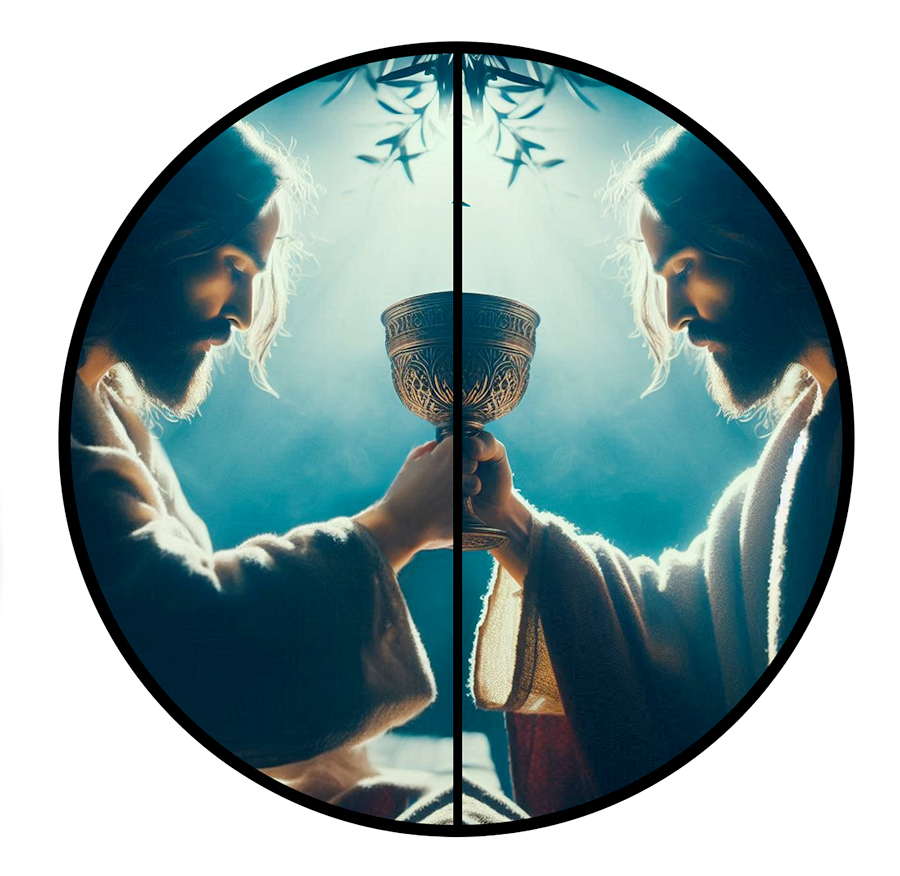
"The Trustworthy Witness of myself whom was killed off, right next to your own self..."
עגל agol - to rotate/revolve
The Throne in the Summoned Assembly of Pergamum, "hill of the rolling skull."
"And the King is making a mega throne of a tooth, and he is overlaying himself with pure gold. The Throne has six stairs/ladders. And the Throne has a revolving [עגל] head, from behind himself, and hands from this side, and from this side, and a double/pair of lionesses, those who are standing ready beside the Hands."
(1 Kings 10:19 RBT)The Caster "Judah" Turned Aside to A Prostitute...
But I am holding little ones down from yourself because you are holding in that place those who are taking control of the Teaching of Swallower of the People ("Balaam") who was teaching the Devastator ("Balak") to cast a scandal in the eye of the Sons of God Contends, to eat image-sacrifices, and to engage in prostitution.A Two Handed Hold of A Very Bad Doctrine
In this way you are holding, also yourself, those who take control of the Teaching of the Conquerors of People ("Nicolaitans") in the same manner!Therefore change the mind! Otherwise I am coming to yourself swiftly, and I will wage war in company with5 themselves within the Rhomphaia of the Mouth of myself!
The Food A Woman Hid in Three Measures
The one who is holding an ear, let him hear what the Spirit is speaking to the Summoned Assemblies! To the one who is conquering, I will give to himself the "What is it Food?" ("Manna"), the one which has been hidden, and I will give to himself a bright white small stone, and upon the Small Stone a new name, that which has been written/drawn which nobody has seen except the one who is taking hold.
A Pearl of Great Price
“Into the Fold the Small Stone is cast, but every decision from HE IS.” (Proverbs 16:33 RBT)
And write to the Angel within the Summoned Assembly of Daughter of Stars ("Thyateira"), he is speaking these things here, the Son of the God the one who is holding the Eyes of himself just like a flame of fire, and the Feet of himself the same as a bronze-frankincense one.
I have seen the Works of yourself, and the Agape-love and the Trust and the Dust-kicker/service and the Enduring One of yourself, and the End Works of yourself are much greater than the First ones!
But I am holding down from yourself because you are sending away the Woman, Not-Inhabiting ("Jezebel"), the one who is calling herself a prophetess, and she is teaching, and she is causing my own Slaves to wander, to engage in prostitution, and to eat image sacrifices!
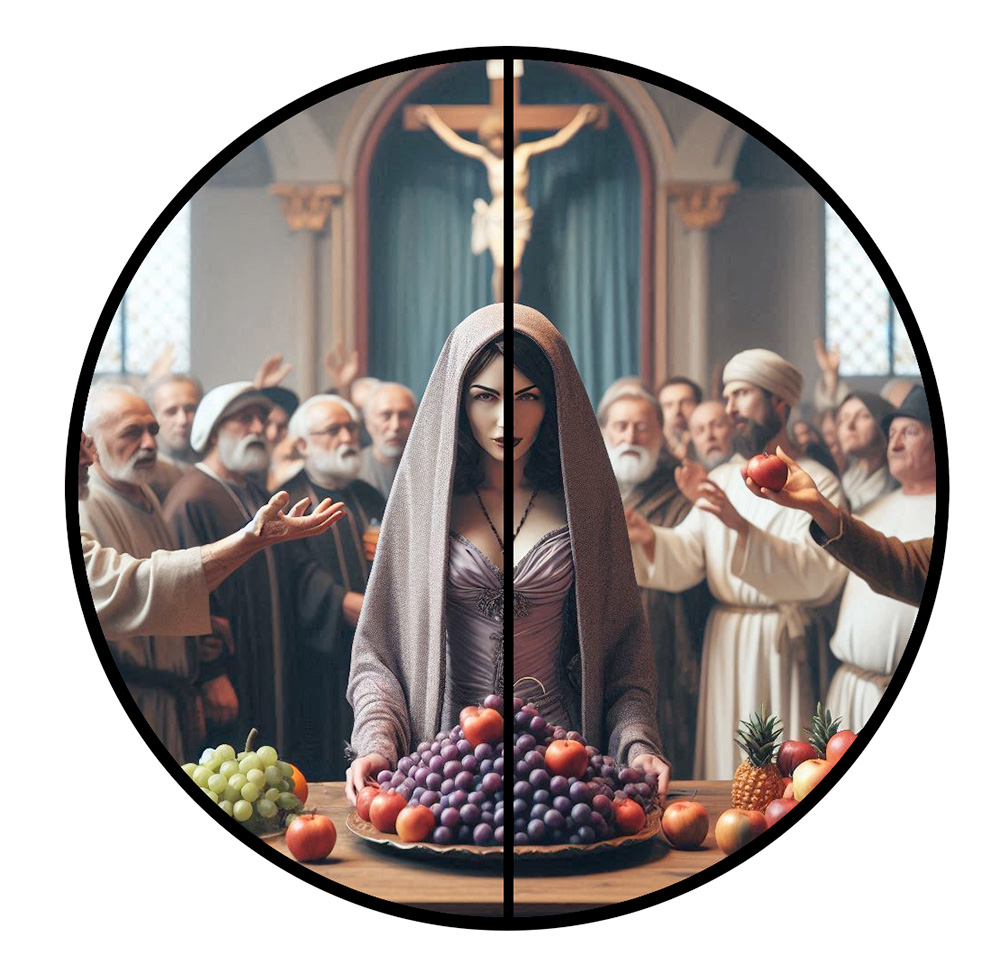
Eating food of image-sacrifice.
"Would you like some grapes? How about some strong wine, my dear? My Man is gone on a journey, come to the wine vat, we have plenty to last us through the night..."
"Upon the bed of myself, within the Nights, I searched for the self-eternal one who has loved her, the soul of myself. I searched for himself, and I did not find him!"
(Song of Songs 3:1 RBT)"Precious is the Marriage within everyone, and the Marriage Bed undefiled, for the male-prostitutes and the adulterers, the God will separate."
(Hebrews 13:4 RBT)Stubborn, Hard-Headed
And I have given to herself chronos time, so that she might change the mind, and she is not wanting to change the mind from out of the Prostitution of herself!Behold! I am casting herself into a bed! And also the ones who are committing adultery in company with herself into a mega pressing, unless they change the mind from out of the Works of herself!
And I will kill off the Children of herself within death, and all the Summoned Assemblies will recognize that I am Myself, the one who is searching for balls/kidneys6 and hearts, and I will give to each one of yourselves down to the Works of yourselves.
And to yourselves I am speaking, to the Remaining ones within Daughter of Stars ("Thyateira"), as many as are not holding the Teaching of this one, anyone who has not recognized the Deep ones of the Adversary, just like they are speaking, I am not casting upon yourselves another weight.
Whosoever if "I" will come
Nevertheless, take control of whatever you are holding, until whosoever if I will come.7ἔθνος ethnos - Company/Host, Swarm of Bees, Flock of Birds, Nation
And the one who is conquering, and the one who is watching over the Works of Myself until an end-aim, I will give to self an authority on the Herds.An Iron Stave/Verse
And I will shepherd themselves within an iron wand,8 just like the Ceramic Tools are crushed to pieces! Also myself, I have taken hold close beside the Father of myself!And I will give to himself the Morning Star!

The one who is holding an ear, let him hear what the Spirit is speaking to the Summoned Assemblies!
Footnotes
Μετά τινος (metá tinos) and σύν τινι (sýn tini) both denote relationships of cooperation or alliances in warfare.
Specifically, μετά τινος means "with" or "alongside someone," indicating a partnership or joint effort in conflict, as seen in Xenophon’s works (e.g., Hellenica 7.1.27) and other contexts. Similarly, σύν τινι means "with" or "together with," describing collaborative military actions or alliances (e.g., Anabasis 2.6.5). In contrast, περὶ τῆς ἀρχῆς π. (perì tēs archēs p.), meaning "about the control of," refers to wars fought over the control or rule of territories or authority, as illustrated in Herodotus (e.g., 6.98). These phrases capture the nuances of military cooperation and conflicts over political control in ancient Greek contexts. (cf. Logeion πολεμήσω)
Interpreters of the NT took the word mετά (with/after) for "against", perhaps thinking that our modern usage of the verb (i.e. "at war with") is a justifiable means of interpreting the ancient usage of "to wage war."
Νεφρός primarily refers to the kidneys, typically used in the plural (Diog. Apoll. 6, Hp. Aph. 4.78, Pl. Ti. 91a). It is occasionally found in the singular (Ar. Lys. 962) and the dual (Ar. Ra. 475). The term is sometimes used euphemistically for testicles (Philippid. 5.4) and metaphorically in the Septuagint to signify inner thoughts or emotions (LXX Ps. 15(16).7). The word shares etymological ties with Old High German "nioro" and Latin "nefrones" or "nebrundines," reflecting a broader cultural link between kidneys and emotional states.
When in Doubt, Leave it Out!
The phrase "ἄχρις οὗ ἂν ἥξω" is an interesting construction and is a mysterious blend of standard and non-standard elements in Ancient Greek. It has stumped scholars who thought it must refer somehow to an unknown (indefinite) date or time of coming, rather than a conditionality of the coming.
"The Greek for "till I come" is remarkable - ἄχρις οῦ ἂν ἥξω; where the ἂν conveys a touch of indefiniteness as to the date specified - until the time whensoever I shall come. We have a similar construction in 1 Corinthians 15:25. Revelation 2:25"
Pulpit Commentary (1889)
However, there is no "time" indicated in this text, only "until." Until what? Here's a breakdown of the components and their typical uses:
-
"ἄχρις": This means "until" or "up to the point when..." It introduces a temporal clause that indicates a limit or endpoint in time.
- "οὗ": This means "who/which/what." It is a genitive masculine singular of ὅς, the relative pronoun.
-
"ἂν": This particle is used with the subjunctive mood to express conditions, potentiality, or hypothetical situations. It is not typically combined with the future indicative.
-
"ἥξω": This is the future indicative form of the verb "ἥκω," meaning "I will come."
In standard Ancient Greek, a more conventional way to express "until I come" (which would indicate that there is a time) would be:
- "ἄχρις ἥξω" (correct in classical usage), meaning "until I come" or "up to the point when I will come."
However the use of "οὗ" and "ἂν" in this context throws this meaning off. It might be unconventional but since it was intentional, it should be interpreted/exposed and not put out of view.
whosoever might. The scholars themselves teach the proper use of ὅς when combined with the particle ἂν. Brown-Driver-Briggs (BDB) the widely respected Hebrew-English lexicon for biblical studies and a standard reference work for students and scholars of Biblical Hebrew and Aramaic makes it plain:

Whenever or Whoever?
If someone were unfamiliar with the word ὅταν, meaning "when," they might not realize that Classical Greek already has a clear and proper way to express "when/whenever." The standard and conventional method to convey "whenever" or a conditional temporal relationship is the construction ὅτε + ἄν, which contracts to form ὅταν—not ὅς ἄν. While ὅς ἄν is used for general or conditional relative clauses ("whoever," "whichever"), ὅταν is specifically designed to indicate temporal generality.
A conditionality of who, with a definite "I will come." The writer is attempting to convey a conditional aspect of "who." Though it's non-standard, the writer is using "ἂν" to introduce a hypothetical or uncertain condition, perhaps to emphasize the uncertainty or conditionality of who will arrive...
"When in doubt, leave it out!"
A rendering of "when" in this respect would be false, and basically assume that the writer mixed up his Greek. Thus, most translations disregard completely the "ὅς ἄν" and leave it out. The KJV added the word already in italics. The Berean Literal Bible, in effort to give the literal, came close and rendered "until which." But in order to keep the reader from wondering "which what?" they apparently couldn't resist adding the word in italics "until which time" which is no different than rendering as though it were ὅταν, which it is not.
Strong's #G4464 ῥάβδος rhabdos. This means rod, wand, or stick. It is something shorter than a typical walking staff. In the context of Ancient Greek poetry and literature, the term ῥάβδος refers to a line or verse of poetry. This is a more specialized or technical usage of the word.
Ancient Greek texts, including poetry and drama, were often analyzed and discussed in terms of their formal structure. Scholars and commentators would use specific terminology to describe parts of these texts. ῥάβδος (rhabdos) in this literary or scholarly sense refers to a line or verse within a poem or a piece of verse. This use reflects the idea of a "stave" or "line" of written text, analogous to how we use "line" to describe a single row of text in modern poetry.
Pindar the Poet
This usage of ῥάβδος is found in the scholia (commentary) on Pindar's Odes (Pindar's work, Book I, line 4.63). Scholarly annotations and commentaries on classical texts often used specific terms to describe textual elements and their analysis.
Considering the presence of the preposition ἐν "in/within a rod" which was ignored by interpreters, it makes more grammatical sense to take this meaning.
(cf. Logeion ῥάβδῳ)