Unveiling 1
The Head Laid Bare
An unveiled one of Salvation, of an anointed one, her whom the God gave to self to show to the Born-Bondmen of himself, those ones who must become in a swift one. And he gave a sign/signaled, he who sent away straight across through the Angel of himself, to the Born-Bondman of himself, Favored.Him whom he bore witness to, the Logos Ratio of the God, and the Testimony of Salvation of Anointed One, as many things as he perceived.
γράφω graphó - to scratch, carve, paint, draw lines, write
Blessed is the one who is recognizing, and the ones who are hearing the Words of the Prophecy and those who are watching over the ones within herself, those who have been written/drawn,1a for the Opportune Time is near at hand!
"Behold! How large are the drawings [gramma] I have drawn [grapho] to yourselves with my own hand!" (Galatians 6:11 RBT)
In Aristotle's Mechanica, the principles of motion are discussed, i.e. how lines or curves are generated by the movement of points. The verb γράφω here describes the act of "tracing" or "drawing" such figures, illustrating the geometrical understanding of motion, where a moving point leaves behind a visible path, such as a circle traced by the end of a rotating arm.
cf. Aristotle's Mechanica (848b10)τῇ Ἀσίᾳ "The Titaness"
Favored, to the Seven Summoned Assemblies, the ones within the Titaness ("the Asia")1b A grace to yourselves, and a peace, away from the one who is, and the one he was, and the one who is coming, and away from the Seven Spirits which are face to face with the Throne Seat of Himself.And away from Salvation, Anointed One, the Witness, the Trustworthy, the First-born of the Dead Ones, and the Chief of the Kings of the Earthly One, the one who is agape-loving ourselves and he who has set free ourselves from out of the Misses of ourselves within the Blood of himself.
And he has made ourselves a queen, priests to the God and a father of himself. To self the Glory and the Might into the Eternal (aiōn) Ones of the Eternal (aiōn) Ones, Trustworthy One ("Amen")!
φῡλή Branch/Tribe: Offshoot of a "Tree"
Behold! he is coming in company with the Clouds and every eye will perceive himself, and anyone who has stung out/through himself, and all the Tribes/Branches of the Earth will chop upon himself. Yes, Trustworthy One!
κόπτω kopto - to strike/smite/chop off/fell a tree
ἐκκεντέω ekkenteó: ek "out" and kentron "sting/goad"
"Where is the Victory of yourself, O Death? Where is the Sting [kentron] of yourself, O Death?"
(1 Corinthians 15:55 RBT)Alpha and Ω
I, Myself am the Alpha and the Ω. He is speaking, a master, the God, the one who is being, and the one who was being, and the one who is coming, the All-mighty.
Alpha and Ω.
I am enjoined to yourself
Myself, Favored, the Brother of yourselves, and joint-companion, within the Pressing-Together and a queen, and Patient one within Salvation. I became within the Island, she who is being summoned Fatherland ("Patmos"),1c across the other side to the Logos Ratio of the God and to the Testimony of Salvation."I Heard Behind Me"
I became within a spirit, within The Master's Day, and I heard behind myself a mega voice just like a war-trumpet,she who is saying, "Draw/write what you are looking at into a book, and send it forth to the Seven Summoned Assemblies: into City of the Bee1d ("Ephesus"), and into Myrrh ("Smyrna") and into Fortified Citadel ("Pergamum") and into Daughter of Stars2 ("Thyateira"), and into Precious Stones3 ("Sardis"), and into Love of Brothers ("Philadelphia") and into People's Justice ("Laodicea")!"
380 BCE
"And I turned back to look at the Voice"
This silver tetradrachm (a four-drachma coin) is stamped on the front with a bee within a dotted circular border. The reverse depicts the foreparts of a stag kneeling in right profile, looking back towards a palm tree. The bee, stag, and palm tree are all emblems of Ephesos, the Greek city on the west coast of Turkey. The bee, originally a symbol of an early Anatolian goddess later identified with Artemis, was so integral to this association that the priestesses of Artemis were called "honey bees."
The Greek letters Ε and Φ are an abbreviation for Ephesos, while the palm tree alludes to Artemis' birth beneath a palm on Delos. The stag, sacred to Artemis, symbolizes her role as protector of wild animals...
She hath hewn out her pillars, seven
And I wheeled back around to look at the Voice, anyone who was chatting in company with myself, and he who has wheeled back around, I perceived seven golden lampstands.Not even Solomon was cast around/enrobed as one of these ones - Matt. 6:29
And within the Middle of the Lampstands, likened to a son of a man, he who has put in/clothed to the Feet, and he who has been girded all around toward the Breasts with a golden belt.
Within the Head, Mighty Ones...
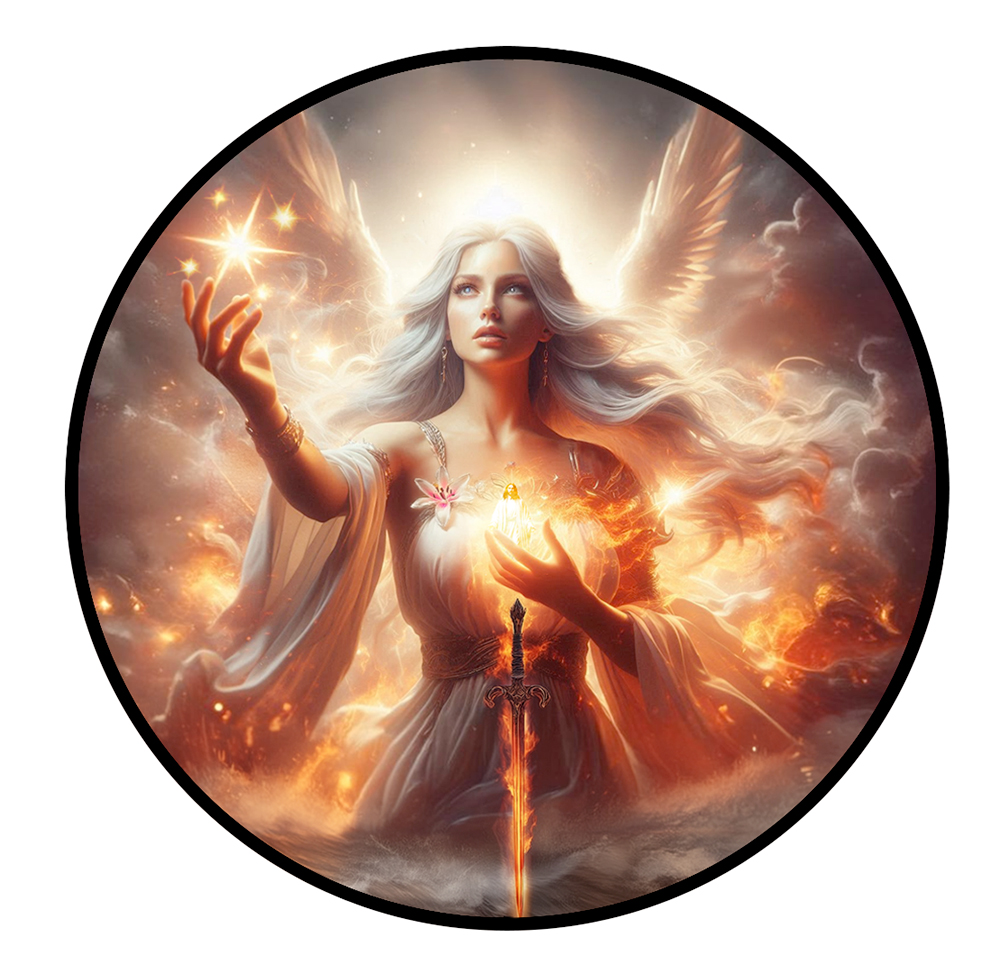
And the Head of himself, and the Hairs, bright white ones, just like bright white wool, just like bright white snow, and the Eyes of himself just like a flame of fire.And the Feet of himself compared to a bronze-frankincense one, just like her who has been set on fire within a oven, and the Voice of himself just like a voice of multitudinous waters.
And he who is holding within the Right Hand of himself seven stars, and a rhomphaia sword4 from out of the Mouth of himself, double mouthed, sharp, she who is leading out; and the Face of himself, just like the Sun, she is bringing to light within the Powerful One of himself.
...the Hairs of Himself
...the Face of Himself
...the Voice of Himself
...the Right Hand of Himself
...the Double-Mouthed Dagger of Himself
A large sword with a curved or hooking blade used by the Thracians, often described as a heavy and formidable weapon. It was characterized by its substantial size and width, and a curved blade. Examples of its use include its depiction in historical accounts, such as in Plutarch's Aemilius (18) and Phylarchus' fragments (57 J.), where it is described as a "heavy, iron sword" wielded with both hands.
And at which time I perceived himself I fell down toward the Feet of himself, just like a dead one, and he laid the Right Side of himself upon myself, he who is saying, "Do not fear! I am myself, the First one, and the End one,
and the one who is living! And I was a dead one, and behold! he who is living, I am, into the Eternal ones of the Eternal ones! And I am holding the Keys of the Death and of the Underworld!
Therefore write the ones which you have perceived and the ones which are being, and the ones which are destined to become in company with these ones!
The mystery of the seven stars, the ones which you perceived upon the Right Side of myself, and also the Seven Golden Lampstands. The Seven Stars are angels of the Seven Summoned Assemblies, and the Seven Lampstands, they are the Seven Summoned Assemblies."
Footnotes
"A circle traced by the end of a rotating arm."
The term γράφω graphó evolved from the original meaning of "scratch" or "mark" (Il. 6.169) to represent creating lines, drawings, and figures, including maps (Hdt. 4.36), geometric shapes (Euc. Post. 3; Archim. Sph.Cyl. 1.23), and curves generated by motion (Arist. Mech. 848b10; Archim. Sph.Cyl. 1). Its mathematical and artistic applications highlight its role in depicting forms and diagrams. This is the word from which we get "graphics."
Aristotle's Mechanica (848b10) and Archimedes' On the Sphere and Cylinder (Book 1) pertain to the use of the verb γράφω in the context of geometry and mechanics, emphasizing its role in generating or describing mathematical figures and motion.
-
Aristotle's Mechanica (848b10):
In Mechanica, Aristotle discusses the principles of motion, including how lines or curves are generated by the movement of points. The verb γράφω here describes the act of "tracing" or "drawing" such figures, illustrating the geometrical understanding of motion, where a moving point leaves behind a visible path, such as a circle traced by the end of a rotating arm. -
Archimedes' On the Sphere and Cylinder (Book 1):
Archimedes frequently uses γράφω to describe the process of generating geometric figures through motion. For example, in On the Sphere and Cylinder, he examines how a point moving in specific ways can describe a curve or a surface, such as a sphere or a helix. The term underscores the dynamic creation of figures in the study of geometry and mechanics, linking abstract motion to visible forms.
These usages highlight the transition of γράφω from its basic meaning of "scratch" or "mark" to a sophisticated technical term in Greek mathematics and mechanics. It conveys the idea of "drawing by motion," foundational in describing geometric constructions and the relationship between algebraic and visual representations.
The Asia
Would anyone have thought that these words needed interpretation, especially considering the core theme of Revelation is symbolic imagery and prophetic concealment? No one did, and perhaps this is because of certain deeply embedded inclinations against the feminine paradigm? It goes without saying that the elevation of the feminine is one of the most taboo and sacriligious things in all the world's major religions, and this is as deeply embedded as the sacred texts of said religions are fortified toward the masculine. When it comes to Babylon "the Great Harlot" the scholars are quick to accept the symbology without question. Why? Because she's bad. But when it comes to such symbology as "the Asia Titaness" it scarcely even crosses their minds—minds which have already decided that the feminine is basically "responsible for the fall of mankind." And perhaps the feminine is responsible for the fall of mankind, considering the Great Harlot who "sits over many waters." But if so, perhaps equally, the feminine is also responsible for mankind's rebirth?
The Book of Revelation opens with the address:
“John to the seven assemblies that are in the Asia” (Rev. 1:4)
Greek: Ἰωάννης ταῖς ἑπτὰ ἐκκλησίαις ταῖς ἐν τῇ Ἀσίᾳ
This is traditionally taken as a geographical reference to the Roman province of Asia (modern western Turkey), where the seven churches—Ephesus, Smyrna, Pergamum, etc.—were located. However Revelation is overtly symbolic and allegorical throughout. The reader is explicitly told (1:1) that the content is conveyed "in signs" (ἐσήμανεν).
In Greek mythology, Ἀσία (Asia) is not just a place but a Titaness, a female divine personification, often regarded as the eponymous matron of the region.
She is:
-
Daughter of Oceanus and Tethys (a sea-born lineage),
-
Sister to other personified elements (Doris, Europa, Thrace, etc.),
-
Sometimes wife of Iapetus, mother of Prometheus and Atlas—thus a matriarchal figure at the root of civilizational myth.
This is crucial: to say “Asia” in the 1st century CE is not only to invoke a province—it is to invoke a name freighted with mythic, matriarchal, and symbolic possibilities.
Romans 16:5
Notably, the phrase “firstfruit of the Asia” (ἀπαρχὴ τῆς Ἀσίας) carries quite a semantic weight favoring a divine referent over a mere geographic sense, particularly in literary or religious contexts where ritual offerings or symbolic “first fruits” hold significant meaning.
-
ἀπαρχή (firstfruit, first sacrificial offering):
This term inherently invokes ritual or sacrificial connotations, typically directed towards a deity or divine figure rather than a land or political entity. When one speaks of “firstfruits,” it is usually understood as an offering made to a god or goddess. (cf. LSJ ἀπαρχή) -
Implications of “Firstfruit of the Asia”:
To say “firstfruit of the Asia” can symbolically signify:-
The initial or premier offering to the Titaness Asia, acknowledging her divine role and patronage over the land and its produce or people.
-
The origin or primordial essence deriving from the Titaness, possibly referencing her offspring or the beginnings of peoples or gifts associated with her domain.
-
The translation of ἀπαρχή (aparchē) as “convert” in Romans 16:5—as commonly rendered in modern English Bibles (“first convert in Asia to Christ,” etc.)—is not even remotely accurate. It's a boldfaced change rather than a faithful rendering of the actual Greek:
"a first convert in Asia to Christ"
vs.
"a firstfruit offering of the Asia into Christ" (the real verse)
When I don't understand something enigmatic, and decide instead to hack up small elements of a verse, am I really showing myself trustworthy? If one cannot be trusted with the small, can he be trusted with the great?
(cf. LSJ, DGE, Bailley, Wikipedia Asia Oceanid)
Πάτμος (Patmos) is one of the islands in the Aegean Sea, specifically part of the group known as the Sporades. The term "Sporades" (σποράδες) comes from the Greek word meaning "scattered" or "distant," reflecting the islands' dispersed locations. The Sporades include notable islands such as Skiathos, Skopelos, Alonissos, and Skyros. Patmos, a key island in this group, is historically significant and is mentioned by ancient Greek historians like Thucydides.
Many Aegean toponyms come from pre-Greek languages, and Πάτμος could have originally had a non-Greek etymology that was later reinterpreted or phonetically adapted within Greek. Absent of any attested etymology, we can only rely on its components to derive any intended/encoded meaning:
- In many Greek words the segment "πατ" is a reduced form of πατήρ, meaning “father.” Classical Greek compounds such as πατριάρχης (patriarch), πατρίς (fatherland), and πατρῐκός (of one's father), clearly display this derivation, reflecting an Indo-European root that connotes ancestry or origin. Other words show a derivation from πατεω (to tread) such as πατ-ησμός (treading on), or πατ-ητής (one who treads grapes).
- The ending -μος in Ancient Greek commonly appears both in adjectives and in nouns derived from verbs, serving distinct but related functions. In adjectives, -μος frequently marks third-declension forms, often describing qualities or states, such as ἄφιμος ("strong") or κράσιμος ("well-mixed, temperate"). These adjectives function descriptively, modifying nouns to indicate inherent properties. In contrast, when -μος appears in noun formations, it typically derives from verbs and denotes an action, result, or state associated with the verb’s meaning. Examples include δεσμός ("bond, fetter") from δέω ("to bind"), νόμος ("law, custom, usage") from νέμω ("to distribute"), and τρόμος ("trembling") from τρέμω ("to tremble"). These noun formations often capture either the process or the outcome of an action, distinguishing them from adjectives, which primarily function as descriptors. While the -μος ending is not as systematically productive as others like -σις (which often forms action nouns), it remains a significant morphological feature, contributing to a range of common Greek terms that persist in later linguistic developments.
Added to this is the NT attestation of the feminine πατρίς patris (fatherland) Strong's Greek #3968. This may also explain why the Ancient Hebrew for the plural "fathers" is in the feminine אבוֹת abot.
The association of Ephesus with a "bee" or a "city of the Mother Goddess" is rooted in the city's ancient religious traditions, particularly its connection with the worship of the goddess Artemis, who was later syncretized with earlier Anatolian mother goddess figures. Here is a more detailed exploration of these concepts:
1. The Bee Symbolism:
- The Bee as a Sacred Symbol: In Ephesus, the bee was a significant symbol, often associated with the goddess Artemis. Artemis of Ephesus was distinct from the more widely known Greek Artemis as a virgin huntress. In Ephesus, she was worshipped as a fertility goddess, reflecting earlier Anatolian mother goddess traditions. The priestesses of Artemis were sometimes referred to as "Melissae," which means "bees" in Greek.
- The "Melissae": The term "Melissae" not only referred to the priestesses but also had a symbolic connection with the bees, which were seen as sacred creatures in many ancient cultures, including those of the Aegean and Anatolia. The bee was emblematic of industry, community, and the nurturing aspects of the goddess.
- Archaeological Evidence: The connection between Ephesus and the bee is supported by archaeological finds, including coins from the city that depict bees, often alongside images of the goddess Artemis. These coins date back to as early as the 6th century BCE.
2. City of the Mother Goddess:
- Artemis of Ephesus: The worship of Artemis at Ephesus is well-documented, and her cult was one of the most significant in the ancient Mediterranean world. The Ephesian Artemis was depicted differently from the Greek Artemis; she was often shown with multiple breasts or with symbolic elements like beehives, indicating her role as a mother and fertility goddess. This iconography is thought to be a continuation of earlier Anatolian mother goddess worship, which was prevalent in the region before the arrival of the Greeks.
- The Connection to Cybele: Some scholars suggest that Artemis of Ephesus may have absorbed attributes from Cybele, the Phrygian mother goddess who was also worshipped in Anatolia. Cybele was often associated with fertility, nature, and wild animals, much like Artemis, but her worship was more directly tied to earth and fertility, which may have influenced the depiction of Artemis in Ephesus as a nurturing, motherly figure.
The term Θυάτειρα (Thyáteira) does not have a clear etymology. However, breaking it down, there are possibilities:
- Θυά (Thyá) could be a contraction of Θυγάτηρ (Thygátir), which means "daughter."
- θύα (thýā), a feminine noun, refers to a type of plant related to θύον (thýon), which is identified as thyme in Theophrastus' Histories of Plants (HP 5.3.7).
- Θύρα (Thýra) means "door" or "gate."
- θυάς (thyás) a form of attack or charge, also sacrifice/victim
- τειρα (teira) could be a nominative form of τείρεα (térea), which refers to "stars" or "constellations." It is a plural noun used to denote celestial bodies or groups of stars.
The term τείρεα is used in ancient Greek literature to describe heavenly signs or constellations. For instance, in Homer’s Iliad, it refers to stars or constellations that are visible in the sky. (cf. Logeion τείρεα)
Explanation of Θυά (Thyá)
Θυά (Thyá) is a rare term and does not have a standard, clear definition in classical Greek literature. However, it can be found in contexts related to Greek mythology and religion:
Virgo Constellation (The Maiden)
Mythological Background
Virgo is often linked with Artemis, the Greek goddess of the hunt, or Diana in Roman mythology. Artemis, known for her role as a huntress, symbolizes the wilderness and hunting. Virgo’s association with Artemis reflects her dominion over nature and the hunt, though the constellation itself does not directly represent a huntress.
Throughout various mythologies, Virgo has been connected to goddesses associated with agriculture, fertility, and hunting. While the constellation's association with Artemis is thematic, it highlights the goddess's broader role in nature rather than a specific representation.
In astrology and mythology, Virgo is associated with purity and virginity, attributes shared with Artemis. Although the constellation itself is not depicted as a huntress, its symbolic connection to Artemis is established through these shared qualities.
Σάρδεις (Sardis) is a plural form used for the ancient city, while "σάρδης" (sardēs) refers to a type of stone, specifically carnelian. The connection between the city name and the stone suggests that the name of the city could be related to the local significance of carnelian or to the city's trade in gemstones. The term "σάρδης" highlights the city's association with the gemstone industry in antiquity.
The ῥομφαία rhomphaia was originally a "spear" and later a long, curved "sword."
Historical accounts and linguistic sources show that it originally functioned as polearm. Rich’s Dictionary of Antiquities describes it as having a wooden shaft of the same dimensions as the iron head, similar to the Roman pilum (javelin).
Hesychius lists ῥομφαία as μάχαιρα, ξίφος, ἤ ἀκόντιον μακρόν, indicating it could be a sword, long blade, or even a javelin-like weapon. Additionally, the Dacian falx, a similar weapon, had long-handled variants used with two hands, further supporting the idea that some ῥομφαίαι were polearm-like.
Roman military adaptations against Thracian and Dacian warriors—such as reinforcing helmets—suggest that these weapons had enough length and impact force to be effective in breaking shields and armor, a characteristic of polearms and long two-handed weapons.