RBT Paraphrase
She Speaks: Queen of Earth (Harlot) Overthrown
1 And mighty ones is putting in order the self eternal whole of
the Words of
the Mighty One, to speak:
2 Myself,
He Is, mighty ones of yourself, those whom I have removed from
the Earth of
Dual-Siege ("
Egypt"), from out of the house of slaves.
3 The Mighty Ones is not behind yourself upon the faces of myself.
4 She is not making to yourself a carved image, or any embodiment/form which is within the Dual Heavenly ones from above or which is within
the Earth from below or which is within the Dual Waters from below
the Earth.
Visiting the Orphan, Rachel Jealous
5 She is not bowing herself down to themselves and she is not serving themselves, for
Myself,
He Is, mighty ones of yourself, is a mighty one of jealousy. He has visited/looked after the
bent over one of the fathers, upon the sons upon thirty, and upon forty, to those who hate me.
Her Daughters
6 And he made
a kind one into
a thousand for my love and for those who keep watch over
the commandments of mine.
Carrying
7 She is not carrying the self eternal Name,
He Is, mighty ones of yourself, in vain. Because
He Is is not clearing of guilt the self eternal one whom is carrying the self eternal name of himself, in vain.
8 Remember the self eternal day of the Still One, to make holy himself.
9 You are working
six of the days, then you have made the whole angelic task of yourself.
10 And the day the Seventh one is a
still one for
He is, mighty ones of yourself. She is not making the whole angelic-mission of your eternal self,
and son/builder of yourself, and daughter/built one of yourself, and servant of yourself, and maidservant of yourself, and beast of yourself, and traveler of yourself, who are within the gates of yourself.
11 For
six of the
days,
He Is has made the self eternal dual-Heavenly ones and the self eternal Earth and the self eternal Sea and every self eternal one who are within themselves, and he is resting within the Day of the Seventh one. Upon
a stand He Is has blessed the self eternal
manifestation of
the Still One and he is making holy Himself.
12 He has honored the self eternal father of yourself and self eternal mother of yourself just as
He Is, mighty ones of yourself has commanded yourself, in order that the days of yourself are inwardly slowing upon
the Ground of Adam ("Adamah") whom
He Is, mighty ones of yourself has given to yourself.
13 She is not murdering/dashing to pieces.
14 She is not committing adultery.
15 She is not thieving.
16 She is not eyeing within
the evil one of yourself a witness of falsehood.
17 She is not delighting in the house of the
evil one of yourself, she is not delighting in the woman of the
evil one of yourself, or the slave of himself, or the maidservant of himself, or the traveler ("bull") of himself, or the foaming one ("he-ass") of himself, or anything which is to the
evil one of yourself.
In the Land of Wandering
18 And the whole of the Gathered People are seeing ones of
the self eternal Voices, and the self eternal Torches and the self eternal voice of the Horn, and the self eternal Mount of Smoke. And the Gathered People is seeing, and they are moving back and forth, and they are standing in place from a remote place/time.
19 And they are speaking toward Drawn Out ("Moses"), "He has ordered words of your eternal self in company with ourselves, and she is being heard but let mighty ones not order words in company with ourselves, lest we die!"
20 And Drawn Out ("Moses") is saying toward the Gathered People, "Don't fear, for within the beyond one, he who tests your eternal selves, the Mighty Ones came. And within the beyond one she is becoming a fear of himself upon the faces of yourselves, in order that you all are not missing."
21 And the Gathered People is standing firm from a remote time/place and Drawn Out drew near toward the Drooping Gloom which there is the Mighty Ones.
Wisdom Cries Out
22 And
He Is is saying toward Drawn Out ("Moses"), "In this way she is speaking toward the son of myself:
"Your eternal selves are God Contends ("Israel")! You all have seen that from out the Dual-Heavenly ones I have ordered-words in company with yourselves!23 Your inner selves are not making my eternal self! You all are not making for yourselves mighty ones of silver and mighty ones of gold!24 She is making myself, the Ground of Adam ("Adamah"), a place of slaughter! You are slaughtering upon himself the self eternal ladder/stairs of yourself, and the self eternal peaceful ones of yourself of the self eternal flock of yourself, and the self eternal seeker of yourself within every Standing Place, whom I am causing to remember the self eternal name of myself. I am coming toward yourself and I have blessed yourself!Neqevah - Female - "Pierced One"
25 And if she is making to myself a place of slaughter out of stones, you are not building their eternal selves out of shaped stones, for you are swinging the sword of yourself against herself and you are piercing her!26 And she is not climbing up within the stairway upon the place of slaughter of myself, which she is not uncovering the nakedness of yourself upon himself."
RBT Hebrew Literal
1 and he is ordering words mighty ones את-self eternal all the Alignments the Mighty One/Goddess to say
2 my self
He Is gods of yourself who/which I caused yourself to go out from the earth of Dual-Siege from the house slaves
3 not he is becoming to yourself/walk mighty ones behind ones upon/against/yoke faces
4 not she/yourself is making to yourself/walk carved image and every/all embodiment/form who/which spices/in the dual heavenly ones from above and whom/straightly in the Earthly One from below and whom/straightly in the dual waters from below to the earth
5 not you/she are bowing yourself down to themselves and not you/she are working them for my self
He Is gods of yourself toward jealousy/be envious he has visited bent over one/perversity fathers upon/against/yoke builders/sons upon/against/yoke thirty and upon forty for those who are hated
6 and he made a kind one to a thousand for my loved one and to those who keep watch my commandments
7 not she/yourself is lifting up את-self eternal there/name/he set
He Is gods of yourself for nothing for not he is being purged
He Is את-self eternal who/which he is lifting up את-self eternal his name for nothing
8 he who is remembered את-self eternal manifestation/day The Still One to make him holy
9 six manifestations/days you are working and you have made all angelic-mission of yourself
10 and a day the Seventh One still one/resting one to
He is gods of yourself not she/yourself is making all angelic-mission he who comes and son/builder of yourself and daughter/built one of yourself is serving yourself and maid of yourself and beast of yourself and traveler of yourself who/which within the gates of yourself
11 for six manifestations/days he has made
He Is את-self eternal the Dual-Heavenly Ones and אֵת-self eternal the Earthly One את-self eternal the Sea and אֵת-self eternal all who/which within themselves and he is resting within the Manifestation/Day the Seventh One upon/against/yoke an upright one/stand/thus he has blessed/kneeled
He Is את-self eternal manifestation/day The Still One and he is making him holy
12 make heavy/honor את-self eternal father of yourself and אֵת-self eternal mother of yourself in order that
they are inwardly slowing days of yourself upon/against/yoke the Ground of Adam who/which
He Is gods of yourself he has given to yourself
13 not yourself is dashing to pieces
14 not yourself is going astray
15 not she/you is stealing
16 not she/you are eyeing in the evil one of yourself until/perpetually/witness false
17 not she/you are delighting in house evil of yourself not she/you are delighting in woman evil of yourself slave of himself maidservant of himself traveler/bull foaming one/he-ass of himself and every/all who/which to the evil of yourself
18 and every/all the People seeing ones את-self eternal the Voices and אֵת-self eternal Torches and אֵת-self eternal voice the Horn and אֵת-self eternal the Mountain smoke and he is perceiving the People and they are moving back and forth and they are standing firm from a remote time/place
19 and they are speaking toward Drawn Out ("Moses") has aligned/alignment he who comes in company with ourselves and she is being heard and toward/do not he is ordering words in company with ourselves mighty ones a corner/lest we are dying
20 and he is saying Drawn Out ("Moses") toward the People not you are fearing for to within the crossed one he who tests/tries your eternal selves he has come the Gods and within the crossed one she is becoming the fear of himself upon/against/yoke the faces of yourselves in order that not you all are missing
21 And he is standing by the People from a remote time/place and Drawn Out/Moses has drawn near/driven hard toward the Drooping Gloom who/which there/name/he set the Mighty Ones
22 and he is saying
He Is toward Drawn Out ("Moses") like this you/she is speaking toward sons/my son God-Contends your/their eternal selves you all have seen for from out of the Dual-Heavenly Ones I have ordered words in company with yourselves
23 not your inner selves are making my eternal self mighty ones silver and gods/my goddess gold not you are making to yourselves
24 place of slaughter/sacrifice ground of adam she/yourself is making to myself yourself has slaughtered upon himself את-self eternal stairs of yourself and אֵת-self eternal peaceful ones of yourself את-self eternal flock of yourself and אֵת-self eternal the inquirer of yourself within the whole the Position/Standing Place who/which I am reminding את-self eternal my name I am coming toward yourself and I have blessed yourself
25 and if place of slaughter/sacrifice building stones she/yourself is making to myself not yourself is building their eternal selves shaped stones for the sword of yourself you are swinging upon herself and you are piercing her
26 and not she/you are ascending/ascending channel within the stairway upon/against/yoke the place of slaughter of myself who/which not she/yourself is uncovering the naked one of yourself upon himself
Notes
| Exo. 20:1 | Exo. 20:1
Hebrew האלה ha-elah feminine. the mighty lofty one, the oak tree, the curse, or "the these"?
The etymological root meaning of “אל” (el) in Hebrew is known to be associated with concepts of strength, power, or authority. This root is evident in various contexts. But the same word can have a variety of meanings completely unrelated.
See the study אלה/אל el/elah Strength, Power, Authority, Might |
| Exo. 20:2 | Exo. 20:2 Hebrew anoki myself. Is this an emphatic of an emphatic myself? The scholars have said it is a special emphatic, or an archaic emphatic. They see no reason for the differentiation in use between and . Both carry the meaning myself, me, I. But obviously they are not the same. Perhaps is a "myself the second" or "myself the other"?
is a phrase that has been interpreted as "I am God" or "I am the Lord" but this is incorrect and leaves out a lot of information. Firstly, is not "I am" as it is not a verb but a very specific pronoun. It was just spoken in chapter 3 of this same book, "I am [] who I am []" using the verb. This is not the same. The phrase "I am Yahweh" or literally "I am he is," is not found in the Hebrew anywhere. The phrase does not exist. should not be translated as "I am." |
| Exo. 20:3 | Exo. 20:3 Hebrew אלהים אחרים elohim acharim. this phrase occurs about 63 times. Acharim in these instances is given a "collateral sense" of different. And from this it has been translated as "other." In other words, they change its meaning. The idea of "different" has nothing to do with the concept of the back, behind, afterward.
|
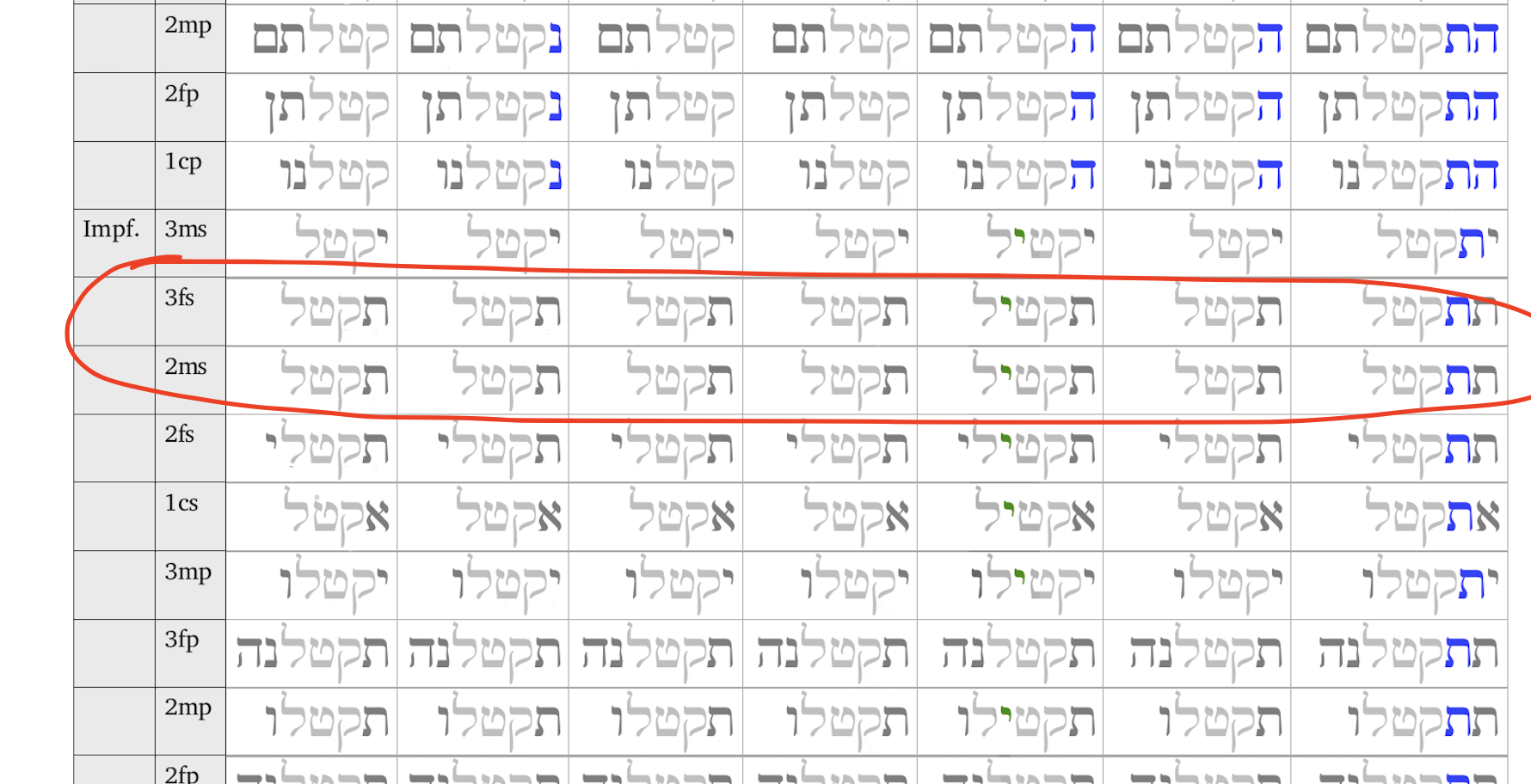
| Exo. 20:4 | Exo. 20:4 Hebrew תעשה. You are making/she is making. The second person masculine and third person feminine are identical in the imperfect/incomplete form. The real question that apparently was never asked is, why would these commands be to only one person (in the second person singular) and not to the whole in the plural if that is the correct interpretation?
|
| Exo. 20:4 | Exo. 20:4 Hebrew temunah. This sort of "embodiment, form, likeness" carries a positive connotation. As in something good:
>ותמנת יהוה יביט
And he is gazing intently on the embodiment/form [temunat] of He Is ("Yahweh")...
Numbers 12:8 RBT
|
| Exo. 20:6 | Exo. 20:6 In Biblical Hebrew, the form is the masculine perfect form ("and he did" or "and he made"). Vowel points () were put upon it to dictate it as a masculine participle "he who makes" which is also spelled the same (). The vowelization, which was not written until created by the Masoretes in 7th to 10th centuries CE, distinguishes the forms. For the masculine perfect, it is vocalized as (ʿasah), while for the masculine active participle it is vocalized as (ʿoseh). |
| Exo. 20:8 | Exo. 20:8 Strongs #7676 . The Still One/Sabbath.
Scholars seem to have trouble with the gender of this noun. The Masoretes had trouble as well and warped the masculine noun into the fake feminine pronoun הִוא. Is it masculine or feminine? But being representative of the origin in the middle, the Man and His Woman as one in Heart, this is to be expected. But plenty of evidence is there for the feminine. Numerous verbs take the feminine suffix with the Sabbath as the object.
...those who profane/spoil her []... (Exodus 31:14 RBT)
But this doesn't mean the Man has no place in the center of rest. On the contrary, is a masculine noun meaning sabbath/still one (Strongs #7677). Does it mean "the little still one"? Perhaps akin to "the little man of the eye" or "apple of the eye"? Maybe the "apple" which "she" eats" underneath his tree? Maybe the "hidden man of her heart" (1 Pet. 3:4)?
It is taken from the phrase shabbat of shabbaton which seems redundant if both are interpreted as the same word. But they aren't. שבת is also a noun form from the verb yashab, to sit/dwell. It can mean seat, or sitting (one). According to Exodus 16:23 where it first appears there is some rich meaning to be found:
"And he is speaking toward themselves, 'He Is ("Yahweh") has spoken Himself straightly. The still/sitting one of a still one is holy to He Is ("Yahweh"), tomorrow." |
| Exo. 20:9 | Exo. 20:9 Believed to be a masculine construct because of its pairing with the masculine 'days' but would be unnecessary as is already masculine (vs. the feminine ששה) |
| Exo. 20:9 | Exo. 20:9
Strongs #4399 deputyship, ministry, task (of messengers/angels)
The words (mal'akh) and (melakht) are related etymologically, stemming from the same root letters: . This root carries the core meaning of "sending" or "dispatching," implying a sense of carrying out a task or delivering a message.
-
(Mal'akh - Angel/Messenger) #4397:
- "מלאך" (mal'akh) refers to an angel or a messenger in Hebrew. It is derived from the root , meaning "one who is sent" or "one who delivers a message." In biblical and traditional Hebrew contexts, angels are seen as divine messengers, intermediaries between God and humans, tasked with delivering messages, carrying out missions, or performing specific duties.
-
(Melakht - Work/Task/Mission) #4399:
- "מלאכת" (melakht) refers to work, task, or labor in Hebrew. It also derives from the same root , but in this case, the emphasis is on the action of carrying out tasks or fulfilling duties. This word is often used to describe various forms of labor or work assignments, both in everyday contexts and in religious or spiritual contexts. It conveys the sense of purposeful action or activity, akin to the duties assigned to a messenger or an agent.
Both "מלאך" (mal'akh) and "מלאכת" (melakht) are rooted in the concept of "sending" or "dispatching," but they emphasize different aspects of this idea: "מַלְאָךְ" (mal'akh) focuses on the messenger or agent who carries out tasks or delivers messages, while "מְלַאכְתְּ" (melakht) emphasizes the tasks or duties themselves, regardless of who performs them. |
| Exo. 20:10 | Exo. 20:10 Hebrew the conjugation is identical for second person masculine singular and third person feminine singular. Choosing the right one depends on grammatical context. The Shabbat is a feminine noun, and not representing merely an empty seat or place, but her who sits on it i.e. "the place found for her, the dove, to settle in rest...." (cf Note on verse 8) |
| Exo. 20:13 | Exo. 20:13 Hebrew רצח, not simply "kill" or "murder," but rather "to dash to pieces". Compare the context of Deuteronomy 22:6, " נפשׁ" and he is breaking the soul/breath to pieces..." Psalm 62:3, "" "you are all being dashed to pieces like a wall..." and Psalm 42:10, "י" within the breaking down of the bones of myself..."
Often "blood" is found in the context of this verb "dashing to pieces". But "blood" itself is not merely blood of the flesh but quite a bit more:
"only flesh with the soul/breath of himself, the blood of himself..." (Genesis 9:3 RBT)
"For the soul/breath of the Flesh is within the Blood of Himself..." (Leviticus 17:11 RBT)
Thus this word seems to have more to do with "killing the soul" or "murdering the soul" as it were, a concept discussed by Jesus in the New Testament. |
| Exo. 20:15 | Exo. 20:15 Strongs #1589 גנב ganab. to carry off, kidnap, deceive. "Stealing" is the "extended" meaning of this verb. But out of forty occurrences, the context of its usage is clear. It is used of carrying off animals, teraphim (Gen. 31:19), people, men, gods/goddess, beast, oxen, countrymen, sons, and the heart.
In 2 Samuel 19:3 a reflexive Hithpael is used, "The Gathered People are kidnapping themselves...."
Considering all the other commandments are related to people, it makes sense that this commandment would as well. |
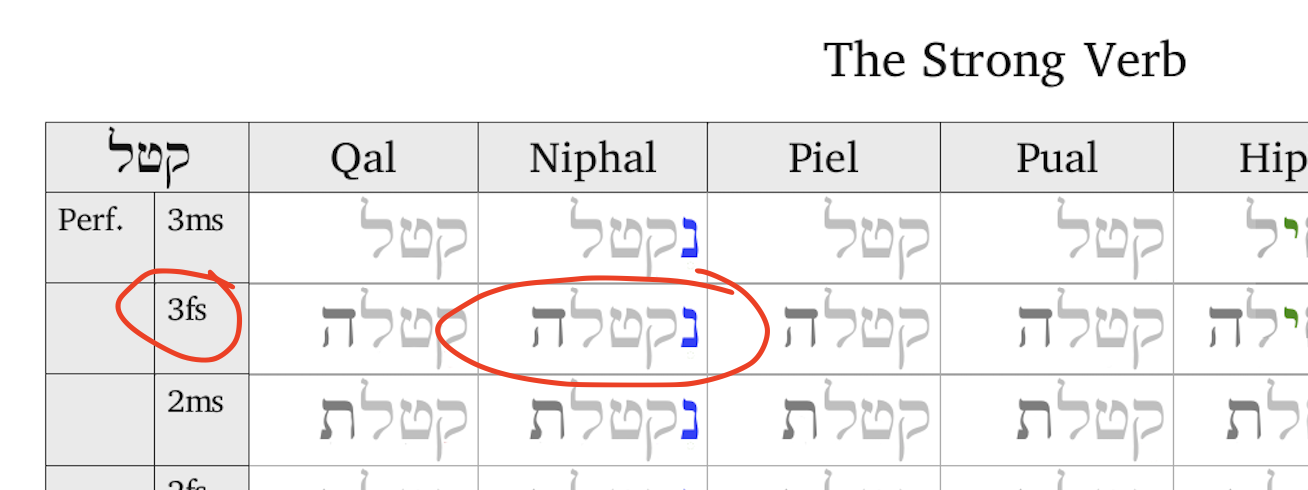
| Exo. 20:19 | Exo. 20:19 Hebrew is a third person feminine singular Niphal passive form of the verb to hear/listen. It is not first person plural. It means she is being heard/listened to.
|
| Exo. 20:25 | Exo. 20:25 Strong's #2490 to bore/pierce. |