People of the Land of Milk 2
Bearing News to David
And I climbed up, according to an unveiling, and I laid on themselves the Good News which I am proclaiming within the Herds, and according to my own, to the ones who are reputed, lest somehow I should run into emptiness/vanity, or did run.But not even Avenged, the one united with myself, he who is being a Greek, was forced to be cut around.
And because of the ones were smuggled in, false brothers, anyone who came in close beside to spy down on the Freedom of ourselves, her whom we are holding within Anointed One Salvation, so that they will bring ourselves into bondage.
to whom, not even toward a seasonal time, did we yield to the Subjection, so that the True One of the Good News should remain permanently toward yourselves.
And away from the ones who are esteemed to be something, whatever kind they once were, nobody is carrying through. The God does not take hold of a face of a man. For the ones who seemed influential added nothing to myself.
ἀκροβυστία acro-bystia - "Top Plug"
But on the other hand, those who have perceived that I have been entrusted with the Good News of the Acro-Plug,3 just as Small Stone of the Cutting Around.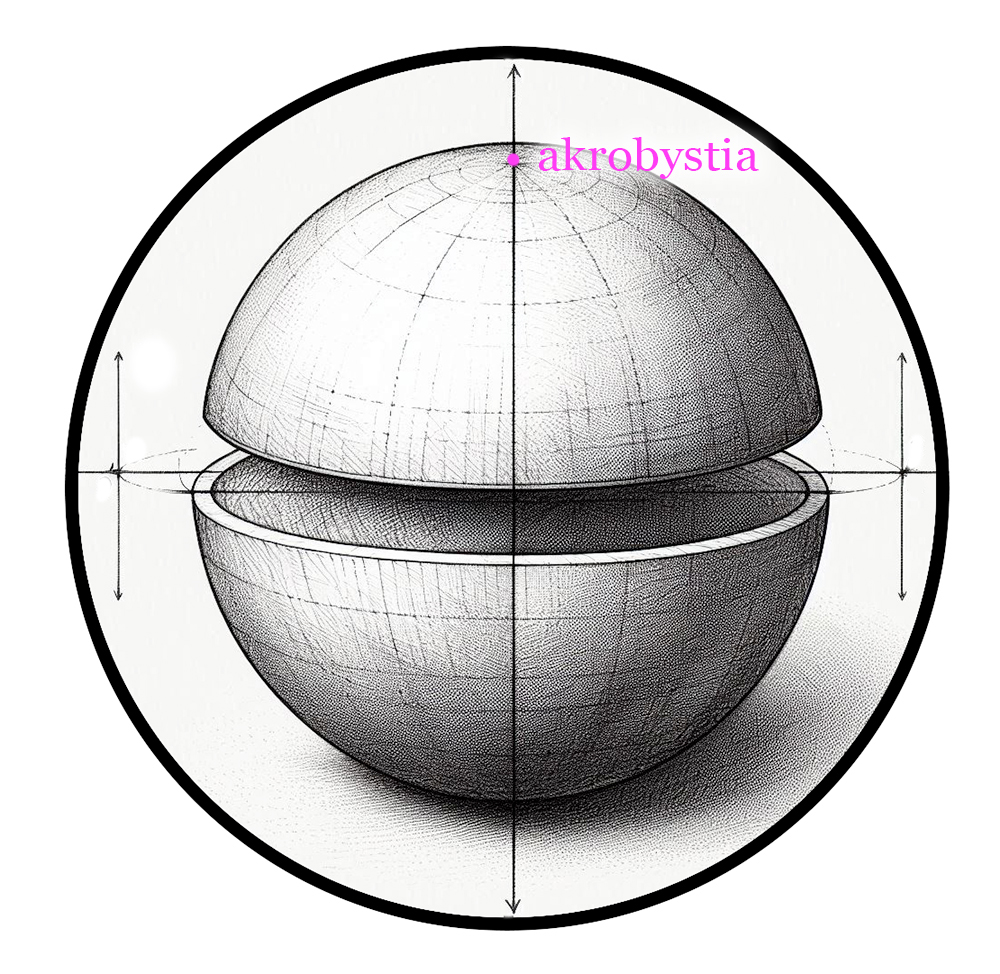
A fitting term to describe plugging the center of one's being, so that it is...not a drain. In this way what was an "abyss" or "bottomless pit well" now becomes a highest point yielding "sons of the highest."
For the one who acted for Small Stone into a sending off/discharge of the Cut Around one, acted also for myself, into the Herds.
Only so that we should be mindful of the Beggars, which also I was eager to make this self.
And when Rock ("Kephas") came into Holding Opposite ("Antioch"), I stood opposite to self, down against a face, because he was him who has been condemned.
Like Esau, Castrating himself
For in front of the Coming, he was eating anything in company with the Bands of People away from Heel Chaser, but when I came he was shrinking back, and was marking off his own self, he who is afraid of the ones from out of the Cut Around One.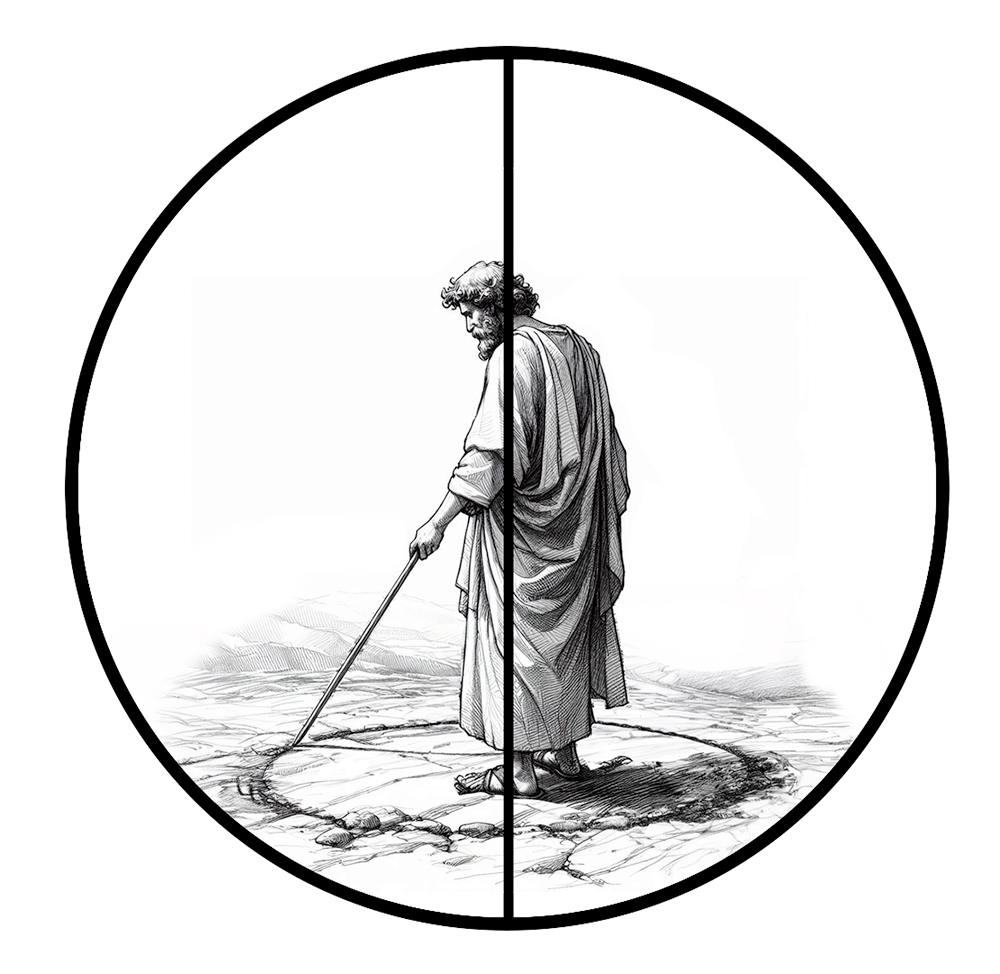
Marking off the self
"Bridegroom of bloody ones."
And also the Left Behind Casters pretended to agree with self, so that even Son of Prophecy was carried off together with the Stage Play of themselves.
But when I perceived that they were not treading straight footed toward the Truth of the Good News, I said to Peter in front of everyone, If you yourself, a Caster, are beginning below nationally, and you are not living casting-ly, how do you force the Herds to Cast-ize?
Ourselves, Casters by natural origin, and not missers from out of the herds of people,
and those who have seen that no man is made just from out of works of a usage, unless across from Trust of Anointed One Salvation. And we ourselves have trusted into Anointed One Salvation so that we might be made just from out of Trust of Anointed One, and not from out of works of a usage, because from out of works of a usage, no flesh at all will be made just.
And if, we were found, those who are seeking to be made just within an Anointed One, even ourselves, missers, then may an anointed one not become an agent of a miss!
For if the things that I have overthrown, these ones I build back, I stand together my own self with a side-stepper.
For myself straight across through a usage, died away to a usage, so that to God I might zoe-live!
I have been jointly staked with an anointed one, and I, myself am no longer living, but he is living within myself, an anointed one, and that which I am living within a flesh, I am living within a trust, the one of the Son of the God, the one who agape-loved myself, and he who handed over his own self beyond myself.
δωρεάν as Adv., as a free gift, freely
I am not setting aside the Grace of the God, for if straight across through a usage is a just one, then an anointed one died away as a free gift.3bFootnotes
Strong's #G5103 Τίτος Titus
τίτος (títos) referes to a concept related to retribution in ancient Greek. The adjective τίτος is derived from the verb τίνω (tínō), meaning "paid for" or "avenged." In Homer’s Iliad, τίτος describes actions or deeds that have been repaid or avenged (Il. 24.213). The phrase τίτα ἔργα translates to "works of vengeance" or "deeds of retribution," highlighting the theme of justice and revenge.
τιτός Consisting in paying back or requital : τότʼ ἂν τιτὰ ἔργα γένοιτο Il. 24.213 (for v.l. see ἄντιτος).
The Acro-Plug
Strong's #G203 ἀκροβυστία akro-bystia. "head depth, peak depth, deep point" This is a word thought to be modified from the normal Classical Greek ἀκροποσθία akro-posthia (tip of foreskin) because posthia/peos (ποσθία/πέος) referred to the male penis and/or foreskin. The first part ἀκρο "akro" means "end, farthest point, tip, limb, extremity, rim, crest." It also can mean "citadel built on a steep rock overhanging a town."
- headland, cape, Il. 4.425, 14.36, Od. 9.285, S. Tr. 788, Pl. Criti. 111a: metaph., ἄκρην πενίης οὐχ ὑπερεδράμομεν Thgn. 619, cf. A. Eu. 562; κάμπτειν Men. 4.
- hill-top, height, Od. 8.508, Hymn.Is. 72 (pl.).
- a mountain-top, summit: used by Hom. only in the phrase κατʼ ἄκρης from top to bottom, i. e. utterly, πόλιν αἱρέειν κατʼ ἄκρης Hdt.; so in Attic, κατʼ ἄκρας utterly, Trag., Plat.
- the citadel of a city, Lat. arx, Xen.
Absent any signification in this compound for the male "membrum virile" we are left with βυστία bystia. What is this? No one seems to know, and the assumption was that it came from a different pronunciation of "posthia."
The prefix βύσ- in Greek is often associated with depth or something deep.
The Diccionario Griego-Español (DGE) provides a brief and uncertain meaning of the word βύστος (bystos), suggesting that it might mean "submerged in the depths" and notes its association with the term "καμπτός" (bent, curved) and its heavy-sounding nature, as explained in the context of the name "Ἥφαιστος" (Hephaestus) (cf. DGE βύστος).
Gemini Pro 3 AI tells us the following:
While βυστία (bystia) is not the most common form found in standard dictionaries (the standard singular noun is usually βύσμα or βύστρα), it is entirely valid as a derivation meaning "plug," "stuffing," or "bung."
Here is the linguistic breakdown of why it means "plug" and how it connects to the text of Hephaestus:
The core of all these words is the verb (or sometimes βυνέω), which means:
-
- To stuff full.
- To plug up.
- To cram into.
From this verb, Ancient Greek creates several nouns regarding things that "plug" or "stuff":
-
- Τὸ βύσμα (To bysma): A plug, a bung, or a cork (something stuffed into an opening).
- Ἡ βύστρα (Hē bystra): A plug (specifically often used for ear-plugs or muzzles).
- Τὸ βύστος (To bystos): This is the word from your previous text. It represents the action of plugging or the state of being stuffed/deep.
βυστία would function as the plural of a diminutive form βύστιον (bystion - "little plug") or a variant noun for "stuffing/plugs."
This is the fascinating etymological link to the Hephaestus text.
-
-
The Concept: When you "plug" something, you stuff material deep into a hole.
-
The Semantic Shift: The word for "plug" (bustos) is linguistically linked to the concept of depth (buthos or byssos - the depth of the sea).
-
Hephaestus: The text was arguing that Hephaestus's name might be related to this root because he was:
-
Cast into the deep (sumergido en lo hondo).
-
Associated with fire "stuffed" or hidden inside the earth (volcanic/chthonic fire).
-
-
So, if you see βυστία in a text, you should translate it as "plugs," "stoppings," or "stuffing."
Thus the word ἀκροβυστία is a combination of two elements:
-
- Root: (akron), meaning "tip," "point," "extremity," or "summit."
- Root: Related to (byō) and the noun (býsma).
- Meaning: "Plug," "bung," or "stopper/stuffing."
When combined, the compound word literally translates to:
"A plug or covering at the extremity/tip."
Strongs #G899 βάθος is a word meaning depth and is used in either direction: depth, height — (accusative, as measured down or up) as in "deep into the mountain" and hence,
Ω (omega) depth of the riches! Also of wisdom and knowledge... (Romans 11:33 RBT)
the deep ones of the God. (1 Corinthians 2:10 RBT)
If the author were really after "uncircumcision" he could easily have used ἀπεριτομῆς "without circumcision/cutting around."
δώρημα → δωρεά → δωρεάν
The noun δωρεά (gift, grant, favor) derives from δίδωμι (“to give”) and is morphologically parallel to θυσία : θύω, ἱκεσία : ἱκνέομαι, etc. The related adverb δωρεάν (“as a gift, freely, without payment”) is already well attested in Classical and Koine usage, and its semantic field is notably restricted:
| Domain | Meaning | Example |
|---|---|---|
| Material gift | a physical present, offering, grant | Hdt. 6.130 — τάλαντον ἀργυρίου δωρεὴν δίδωμι |
| Abstract favor or privilege | a gracious benefit, often divine | Plato, Leg. 844d — διττὰς ἡμῖν δωρεὰς ἡ θεὸς ἔχει |
| Adverbial δωρεάν | (a) “gratuitously,” i.e. without charge; (b) “in vain” when negated by context | Dem. 19.170 — ἔδωκα δωρεάν τὰ λύτρα |
Primary (Classical) Sense: Gratuitously, Without Payment
δωρεάν from δωρεά (“gift”) keeps its literal adverbial sense “as a gift,” i.e. without payment, gratis.
μηδὲν δωρεάν πράττειν (Plb. 18.34.7) – “to do nothing freely.”
ἰατρὸς δωρεὰν ἰώμενος (Aesop. 22.6) – “a physician treating without fee.”
δωρεάν λειτουργεῖν (Priene inscription, IV BCE) – “to serve the public without pay.”
This is the literal and oldest meaning, fully aligned with the noun’s sense δωρεά = a gift, a favor.
The sense “without cause / in vain” in δωρεάν is a deviant semantic "extension" arising from Hebraic calquing of חנם in the Septuagint and perpetuated by translators of the New Testament.
It does not represent natural development within Greek semantics but an imposed equivalence resulting from bilingual interference.
Greek and the New Testamet already had native expressions for “in vain” or “to no purpose” (See μάτην, used in Matt. 15:9, Mark 7:7).
So this LXX/NT usage of δωρεάν to mean “in vain, without cause” is redundant from a strictly Greek perspective — it’s purely a translation-driven semantic extension under Hebrew influence. It didn’t evolve naturally within Greek; it’s foreign imposition onto an existing lexical field.