Hammer 8
I am cringing in the bowels upon the Multitude because already three days they are remaining attached to myself and they are not holding anything they might eat!
And if I should hurl themselves away hungry into a home of themselves they will dissolve within the Road, and some of themselves from far away have arrived!
And the Learners himself separated to self that 'From where will anyone have power to feed these ones with a bread loaf upon a solitary one?'
And he was questioning themselves, "How many bread loaves are you holding?" And the ones said seven.
εὐχαριστέω eucharisteó - bestow grace
And he is transmitting to the Multitude to fall back upon the Earthly One, and he who has taken hold of the Seven Bread Loaves, he who gave eucharist/thanks, he deflected, and he kept giving to the Learners of Self so that they might set close beside, and they set close beside the Multitude.Seven bread loaves, whole, complete. Turn your attention away from (deflect from) the Teaching of the Separatists, be fattened by the Loaves of yourself.
The Greek verb κλάω originally denotes “to break, fracture, or snap” (e.g., wood, spears, vine shoots: Od. 6.128; Il. 11.584; Thphr. CP 1.15.1). In technical and metaphorical contexts, however, the meaning shifts from literal breakage to deviation or bending, giving rise to the senses “deflect,” “inflect,” or “follow a non-straight course”. It was not a word used in the sense of "tearing off a piece" of something. Thus the odd vernacular of "break a bread" became a religious idiom, since it is quite difficult to snap bread, unless it is completely stale and hard. In all the uses of κλάω "break" in the NT, bread is never the direct object, except once in Mark 8:19.
Most modern translations can't help but add the word "it" or "them" under the assumption that the verb must be referring to the bread. This is planting in accusative words that are not in the text. "He broke them, and gave them" is a false translation.
(κλάω – Deflect)And they were holding little fish, few ones, and he who has spoken well of themselves said to set these ones close beside also.
And they were just like four thousand, and he set themselves free.
And immediately he who has entered into the Ship in company with the Learners of Self, came into the Portions of Place of Refuge ("Dalmanutha").
And the Separatists came out and started to examine together self, those who are seeking a sign close beside himself away from the Heavenly One, those who are putting himself to the test.
And he who has sighed deeply by the Spirit himself is speaking, "What is she, the Generation, seeking after? A sign? Trustworthy One I am speaking to yourselves if a sign will be given to the Generation, this one!
And he who hurled themselves away backward, he who has embarked, he went away into the Beyond.
And they forgot to take hold of bread loaves, and except for one loaf, they were not holding in company with their own selves within the Ship.
And he was setting apart to themselves, he who is saying, "See that you watch away from the Leaven of the Separatists and the Leaven of Heroic.
And they were debating toward one another because they are not holding bread loaves.

And he who has recognized is speaking to themselves, "Why are you debating that you are not holding loaves! You do not yet perceive nor bring together! You are holding her who has been calloused, the Heart of yourselves!
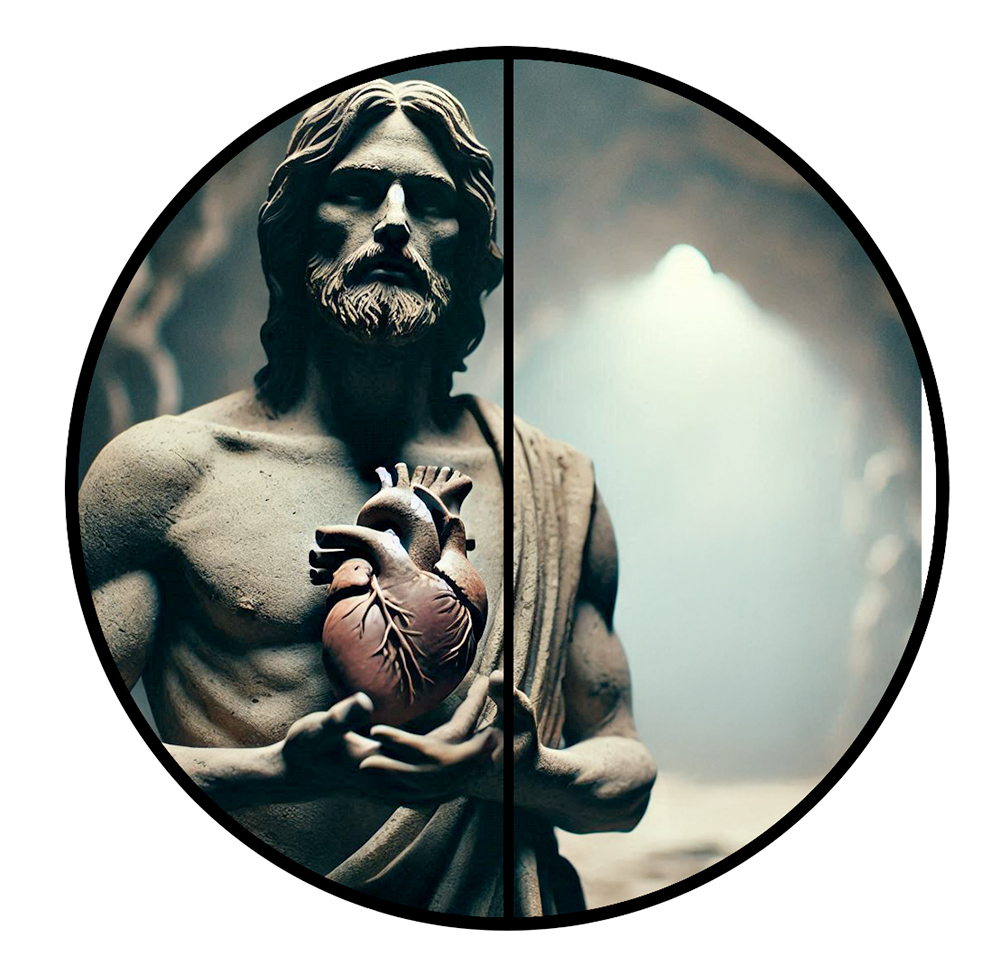
"And I have given to yourselves a heart, a new one, and a new spirit I am giving within your inner selves! And I have turned aside the self eternal Heart of the Stone from the Flesh of yourselves, and I have given to yourselves a heart of flesh!"
(Ezekiel 36:26 RBT)Those who are holding Eyes, you are not looking! And those who are holding Ears, you are not hearing! And you are not remembering!
Put the Pieces Together
When I deflected the Five Bread Loaves into the Five Thousand, how many hand-baskets full of fragments did you lift up?" They are saying to self, two and ten."Through the Wall, They Sent himself Down in a Spyridon basket" Acts 9:25
When the Seven into the Four Thousand, of how many large spyridon baskets have you lifted up a full measure of fragments/fractions? And they are saying, Seven.And he was saying to themselves, "You are not putting together yet."
And they are coming into House of Hunt, And they are carrying/conducting to himself a smoke-blind one, and they are summoning himself close beside so that he might attach to himself.
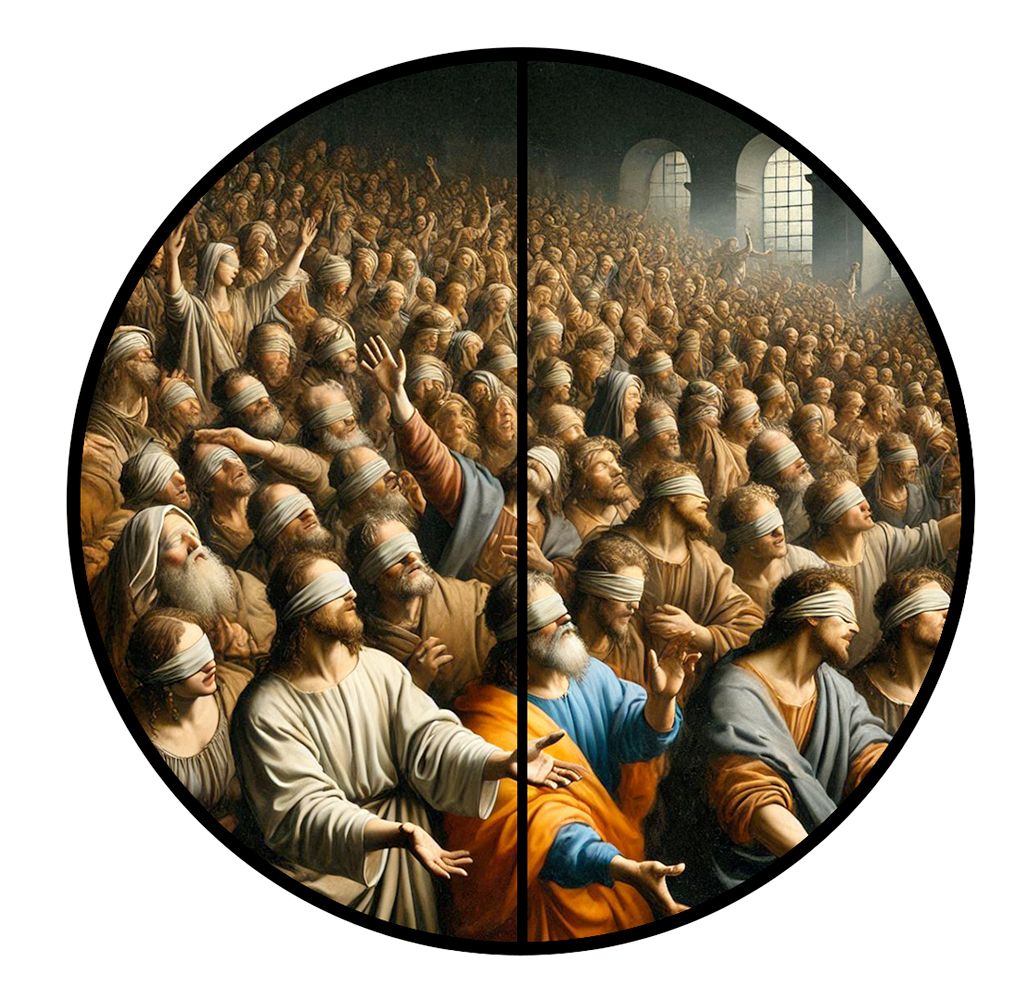
You Beholding Anything?
And he who has taken hold of the Hand of the Smoke-Blind One, he carried out himself outside of the Unwalled Village. And he who spat into the Eyes of himself, he who has set the Hands upon himself, he was questioning himself, if you are beholding anything.And he who has looked up kept saying, "I am looking at the Humans, that I am perceiving those who are treading around just like trees!"
διαβλέπω - Look Through/Across
Thereafter, he placed backwards the Hands upon the Eyes of himself, and he looked through, and he was restored, and he was turning his gaze radiantly afar upon all things.
The adverb τηλαυγῶς comes from the combination of τῆλε téle (afar, from a distance) and αὐγή augé (radiance, light). It is a poetic and later prose term meaning "radiantly afar," or "shining from a distance."
And he sent away himself into a household of himself, he who is saying, "Do not even enter into the Unwalled Village, nor speak to him who is within the Unwalled Village."

And the Salvation came out, and the Learners of Self, into the Unwalled Villages of Dictatorship City ("Caesarea"), the one of Horse Lover, and within the Road he was questioning the Learners of Self, he who is saying to themselves, "Who are the Humans speaking myself to be?"
And the ones said to self, those who are saying that, Favored the Plunger, and others God is Himself ("Elija-hu"), but others that, One of the Prophets.
And he was questioning themselves, "But yourselves, who are you all speaking myself to be?" The one who was separated, the Small Stone, is speaking to self, "You, yourself are the Anointed One."
And he bestowed honor to themselves, so that they might say nothing around to self.
To Stand Up
And he started to teach themselves that is necessary for the Son of the Man be acted upon multitudinous, and to be rejected as unfit below the Elders and the Chief Priests and the Scholars, and to be killed off, and beyond three days, to stand up.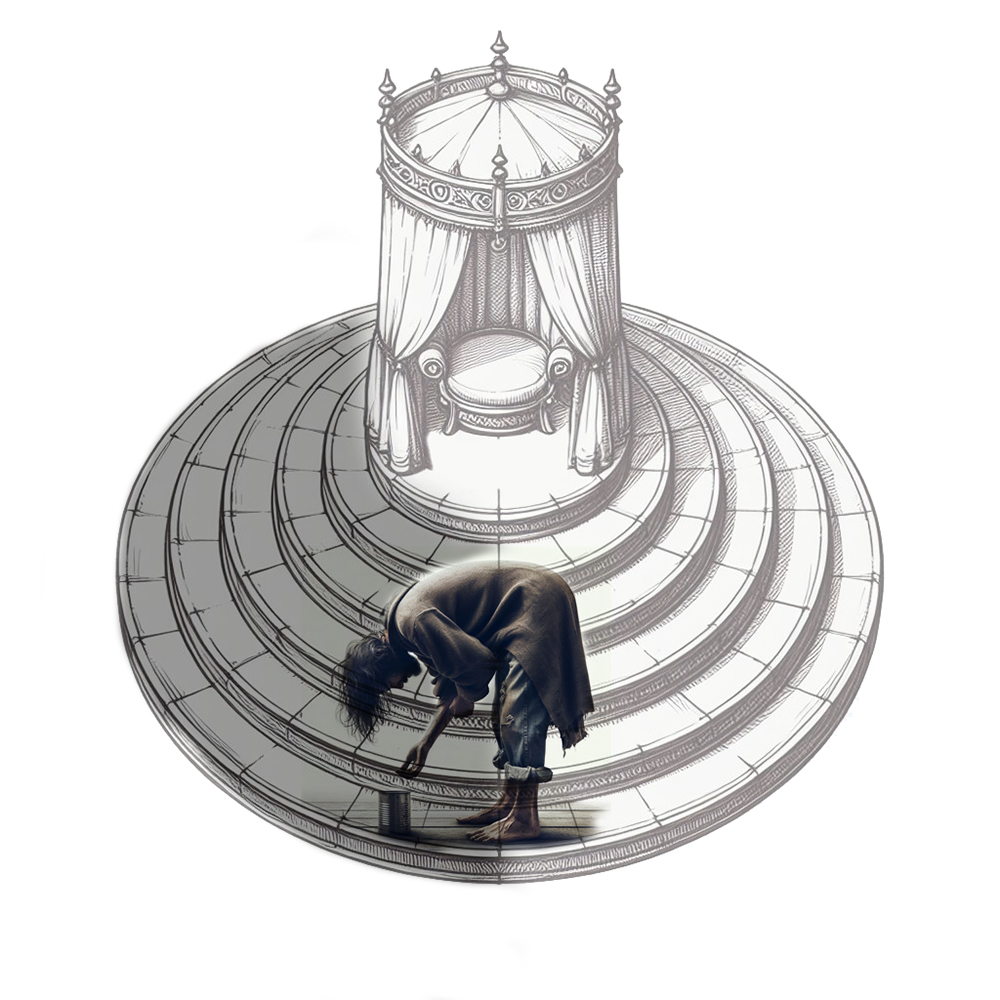
And with a freeness/boldness of speech he was uttering the Logos Ratio, and the Small Stone, he who has taken in himself, began to bestow honor to self.
And the one who has been wheeled round, and he who has perceived the Learners of Himself, he bestowed honor to Small Stone, and he is speaking, "Bring under hereafter to myself, Adversary, because you are not thinking the things of the God but rather the things of the Humans!"
And he who has summoned the Multitude to self in sync with the Learners of Self,22b he said to themselves, "If anyone desires to come to the hereafter of myself, let him reject his own self, and let him lift up the Stake of Self, and let him accompany myself!"
For whosoever should desire to save the Soul-Life of himself, will destroy away herself, but whosoever should destroy away the Soul-Life of himself for the sake of myself and the Good News, he will save herself.
For what does it benefit a man to gain the entire Order and the Soul-Life of himself to suffer loss?
ἀντάλλαγμα - Quid Pro Quo, Compensation, Equivalence, Ransom, Substitute
For what might a man give as a substitute for the Soul-Life of himself?For whosoever might be ashamed of myself, and the Words of myself within the Generation, this one, the Little Adulteress,22 and a misser, the Son of the Human will also be ashamed of himself, when he should come within the Glory of the Father of himself in company with the Angels, the Holy Ones!
Footnotes
Although both σύν (syn) and μετά (meta) can be translated as "with" in English, they differ significantly in connotation and syntactic function. The preposition σύν, often used with the dative in Classical Greek, conveys a sense of unified or cooperative action, implying joint participation or mutual agency, especially in compound verbs (e.g., συγγράφω, "to write together"; συμπάσχω, "to suffer with"). By contrast, μετά, when used with the genitive, indicates accompaniment in a more associative or peripheral sense (e.g., μετὰ τῶν φίλων, "with the friends"), and with the accusative, it signals temporal succession (μετὰ ταῦτα, "after these things"). In verbal compounds, μετα- frequently implies change, transition, or movement after (e.g., μεταμορφόω, "to transform"). Thus, while σύν emphasizes active union, μετά is more flexible, often pointing to association, sequence, or transformation rather than coordinated agency.
The Greek τῇ μοιχαλίδι consists of the definite article τῇ (the dative singular form of "the") and μοιχαλίδι, which is a diminutive form of μοιχαλίς (meaning "adulteress").
μοιχαλίδι: The diminutive form of μοιχαλίς, meaning "adulteress". The diminutive ending -ιδι conveys a sense of smallness, perhaps affection, or sometimes slight pejorative emphasis, depending on context.
τῇ μοιχαλίδι = "to the adulteress" or "to the little adulteress" (with a diminutive nuance).