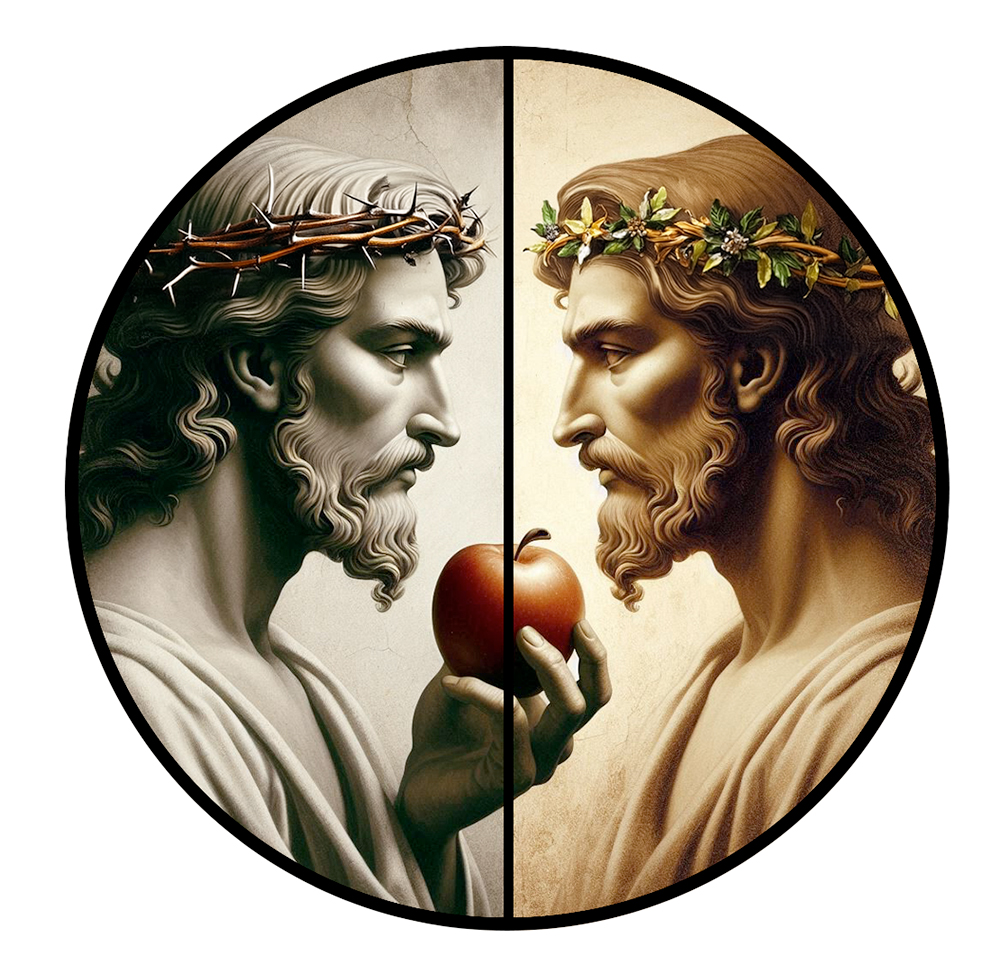
RBT Paraphrase
יכלו - Finishing the Task, Bringing to Completion
1 And
the Dual Heavenly Ones are being brought to completion, and
the Earthly One, and the entire
army of themselves.
יכל - Able in the Seventh Day: Cessation within Her
2 And mighty ones has become able within
the Seventh Day of the
angelic mission of himself whom he has made. And he is ceasing within
the Seventh Day from the whole
angelic mission of himself, whom he has made.
Elah of Generations/Chronicles
3 And mighty ones is blessing each self eternal
day of
the Seventh One, and he is making holy his eternal self, for within himself he has ceased from every
angelic work/craftsmanship of himself, whom mighty ones has cut out to make.
4 A mighty one of
generations of
the Dual Heavenly Ones and
the Earthly One, within the cutting out of themselves, within
the Day of Making of
He is (יהוה) mighty ones of
an earthly one and
dual heavenly ones.
Enigma: Discourse before Becoming (טרם יהיה), No "Father for the Rain" - Job 38:25-28
5 And every conversation of
the Field is before yet
he is becoming (
יהיה) within
the Earthly One, and all the grass of
the Field is before yet he is sprouting, because
He Is Become (
יהוה) mighty ones has not showered upon
the Earthly One, and
a human ("adam")
is not, to work
the self eternal
Ground of Adam ("
Adamah").
6 And a firebrand is climbing up from
the Earthly One and he has watered all the self eternal faces of
the Ground of Adam.
From Man of Dust to Man of the Breath of Life
7 And
He is (
יהוה) mighty ones is forming
the self eternal Human ("the Adam") of soil from
the Ground of Adam, and he is breathing into the dual noses of himself
a soul of
living ones, and
the Human ("the Adam") is becoming to
a living soul.
"A Pleasant Planting" - Isaiah 5:7
8 And
He is mighty ones is planting upright
a protected-garden within
Delight ("
Eden"), from the front, and
he is setting, he has set the Human whom he has formed.
Good for Real Food
9 And
He is mighty ones is sprouting from out of
the Ground of Adam, every tree, he who is desirable to the Sight,
and
a good one one for food,
and a tree of
the Living Ones is in the center of
the Protected-Garden,
and a tree of
the Knowledge of
the good one, and
the evil one.
Descent River ("Jordan"), Out of the Belly of Himself
10 And a river has gone out from
Delight to water
the self eternal Protected-Garden, and from there he is separating, and he has become
four heads.
11 A name of
the One, Fattened. He, himself is the Encircler of the whole
self eternal earthly one of
the Spinning One, where in that place is the Gold.
A New Name on a Bright White Gemstone
12 And the gold of
the Earthly One of Himself is good. He has set the What Is It Manna ("Bedolach") and a stone of the Shoham.
13 And a name of the River of the Duplicate, Burst-Forth. Himself is the Encircler of every self eternal
earth of Black ("Cush").
14 And he set the River of the Third, Sharp-Swift ("Chid-kel"). Himself is he who walks on
the front-side of [east] of Straightened ("Ashshur"). And the River of the Fourth, himself is Sweetwater ("Perath").
He Leads me in the Way...
15 And
He is mighty ones is taking hold of
the self eternal Human, and he is leading
himself within
the Protected-Garden of
Delight, to serve her, and to keep watch over her.
"The command of himself is eternal zoe-life"
16 And
He is mighty ones is commanding concerning
the Human to speak:
"From every tree of the Protected-Garden,
he ate,
you are eating,An Enigma: You are not Eating Him because He has Eaten You
17 and from the tree of the Knowledge of a good one and the evil one, you are not eating from out of himself because within the Day he has eaten yourself from out of himself! He has died, you are dying!"
18 And
He is mighty ones is saying, "
The Human becoming separated to himself is not good, I am making for himself
a surrounding help according to the opposite of himself."
Coming toward Himself
19 And
He is mighty ones is forming from out of
the Ground of Adam, every
living one of
the Field, and every self eternal flying one of the dual heavenly ones, and he is coming toward
the Human, to see what he is summoning to himself. And everyone who he is summoning to himself,
the Human,
a soul, he, himself has lived, a name of himself.
He has found not One Corresponding himself
20 And
the Human is calling out names to
the entire Beast, and to the flying one of
the Dual Heavenly Ones, and to every
living one of
the Field. And to
the Human he has not found
a surrounding help according to the opposite of himself.
The Sting of Death
21 And
He is mighty ones is causing
a death-stun to fall against
the Human, and he is languid/weak. And he is taking hold of
one from
the ribs of himself, and he is shutting up
flesh below herself.
Adam to Adam. She finds Himself in the Outside - Song of Songs 8:1
22 And
He is mighty ones is building up
the self eternal Rib, whom he has taken hold of from out of
the Human ("The Adam"), into a woman. And he is causing her to come in toward
the Human ("The Adam").
The Season of Myself
23 And
the Human is saying,
"
This one is the Now! An essence from the essence of myself,
and a flesh from the flesh of myself!" To
this one he is summoning each woman, for she has taken hold of
this one from each man.
The Two Become One Flesh within Her, Reborn
24 Upon an upright one each man is leaving the self eternal father of himself and the self eternal mother of himself, and he has glued within the Woman of himself, and they have become a flesh of
one.
"Are they ashamed that they have made an abomination? They knew not to feel disgrace..." - Jer. 8:12
25 And the both of themselves, they are naked ones,
the Human and also a woman of himself, but they are not ashamed of themselves.
RBT Hebrew Literal
1 And the Dual-Heavenly-Ones were being completed, and the Earth, and the whole army of them.
2 And he has become able elohim in the Seventh Hot-one of the angelic-task of himself whom he has made, and he is ceasing in the Seventh Hot-one from every angelic-task of himself whom he has made.
3 And he is kneeling/blessing elohim אֶת-a day of the Seventh, and is making holy אֶת-him, for in-him he has ceased from the whole of his angelic-task whom elohim has cut out to make:
4 A mighty one of begettings of the Dual-Heavenly-ones and of the Earth in the cutting out of themselves, in the hot-one of making Yahweh elohim of earth and dual-heavenly-ones.
5 And every conversing/musing one of the Field is before he is becoming in the Earth, and the every herb of the Field is before he sprouts, for Yahweh elohim has not caused to rain upon the Earth, and a red-one is not, to serve את-the Red-one.
6 And a firebrand is ascending from the Earth and he has watered
אֶת-the whole of the faces of the
Red-one.
7 And Yahweh elohim is forming את-the Red-one of dust from out of the Red-one, and is breathing within his dual-nose a breath of living-ones, and he is becoming the Red-one to a living breath.
8 And he is fixing-upright Yahweh elohim, an enclosure in Eden, from the front [east], and he is setting he has set the Red-one whom he has formed.
9 And
Yahweh elohim is sprouting from out of the
Red-one every wood, him-who-is-desirable to the sight, and a good one for food, and a wood of the
Living-ones is in the center of the Enclosure, and a wood of
the Perception of
good, and a ruined-one.
10 And a river, he has gone out from Eden to water אֶת-the Protected-Enclosure, and from there he is separating, and he has become to four heads,
11 A name of the
One, Fat, he is encircling
אֶת-every earth of the Spinning-one which there is the Gold,
12 and the gold of the Earth of Himself
is good, he has set the Bedolach and stone of the Shoham.
13 And a name of the River of the Duplicate-one
is Burst Forth [Gichon], himself the Encircler of
אֶת-all of earth of Cush;
14 And the name of the River of the Third-one
is Hiddekel, himself is the One-who-walks in front of Straight; And the fourth River, himself is Perath.
15 And Yahweh elohim is taking אֶת-the Red-one and he is leading himself in the enclosure of Eden, to serve her, and to guard her.
16 And
Yahweh elohim is commanding upon the
Red-one to say, `From every wood of the Enclosure he ate, you are eating.
17 and from the wood of the Perception
of a
good one and a ruined-one she is not eating from out of himself, for in the hot-one he has eaten yourself from out of himself, he has died, you are dying.`
18 And
Yahweh Elohim is saying,
it is not a
good one the becoming of the
Red-one to his own separation, I am making to-himself a
surrounding-help according to his anti.
19 And Yahweh elohim is forming from out of the Red-one the whole of a living one of the Field, and את-all flying-one of the Dual-Heavens, and he is coming toward the Red-one, to see what he is summoning to-himself. And everyone who he is summoning to-himself, Red-one, breath, he has lived himself, his name.
20 And the
Red-one is summoning names to the whole of
the Behemah, and to the Flying-one of the Dual-Heavens, and to the whole
living one of the Field. And for the
Red-one the
surrounding-help has not found according to his opposite.
21 And
Yahweh elohim caused to fall a death-stun upon the
Red-one, and he is languid/weary, and he is taking
one from his ribs/sides, and he is shutting
up flesh below her.
22 And
Yahweh elohim is building
אֶת-the rib which he has taken hold from the
Red-one to a woman and is causing her to come in toward the
Red-one.
23 And the
Red-one is saying, `
This one is the Strike/Now! A bone/substance from out of my bone/substance and a flesh from out of my flesh.` To
this one he is summoning a woman for from a man she has taken holdof
this one.
24 Upon an upright a man is leaving
אֶת-his father and
אֶת-his mother, and has stuck in his woman, and they
have become to a flesh of
one.
25 And both of themselves are being naked-ones of the Red-one, and his woman, and they are not causing themselves shame.
Notes
| 54 | Genesis 2:1 Strong's Hebrew #3615 כלה to be finished, complete.
This form יכלו is in the imperfect/incomplete form, i.e being finished/completed
It is a true irony how the incomplete form of a Hebrew word which itself means "to complete" got translated as "were completed."
The Hebrew word כלה (kalah) generally means "to complete," "finish," or "consume." Depending on the context, it can signify something that has come to an end, has been finished. It is similar to shalem ("Shalom") complete/whole, or כלל kalal, perfected.
כלה kalah can also refer to a "bride" as a noun stemming from the root כלל perfected. |
| 55 | Genesis 2:1 |
| 55b | Genesis 2:2
Strongs #4399 deputyship, ministry, task (of messengers/angels)
The words מלאך (mal'akh) and מלאכת (melakht) are related etymologically, stemming from the same root letters: לאך. This root carries the core meaning of "sending" or "dispatching," implying a sense of carrying out a task or delivering a message.
-
מלאך (Mal'akh - Angel/Messenger) #4397:
- "מלאך" (mal'akh) refers to an angel or a messenger in Hebrew. It is derived from the root לאך, meaning "one who is sent" or "one who delivers a message." In biblical and traditional Hebrew contexts, angels are seen as divine messengers, intermediaries between God and humans, tasked with delivering messages, carrying out missions, or performing specific duties.
-
מלאכת (Melakht - Work/Task/Mission) #4399:
- מלאכת (melakht) refers to work, task, or labor in Hebrew. It also derives from the same root לאך, but in this case, the emphasis is on the action of carrying out tasks or fulfilling duties. This word is often used to describe various forms of labor or work assignments, both in everyday contexts and in religious or spiritual contexts. It conveys the sense of purposeful action or activity, akin to the duties assigned to a messenger or an agent.
Both מלאך (mal'akh) and "מלאכת" (melakht) are rooted in the concept of "sending" or "dispatching," but they emphasize different aspects of this idea: "מלאך" (mal'akh) focuses on the messenger or agent who carries out tasks or delivers messages, while "מלאכת" (melakht) emphasizes the tasks or duties themselves, regardless of who performs them.
cf. Ephesians 4:13, "until we all meet-against [face to face] into the oneness of the faith and of the recognition of the Son of God, into a complete man, into the measure of maturity/stature of the fulfillment of the Christ/Anointed One.." (Eph. 5:13 RBT)
Strong's #3201 יכל yakol to be able, powerful |
| 56 | Genesis 2:3 |
| 57 | Genesis 2:3 |
| 58 | Genesis 2:3 |
| 58a | Genesis 2:4
אלה תולדות elah of geneology/generations/chronicles. This is a frequent phrase which occurs, mainly in the Torah. Compare with אל עליון el of inner height/most high, and אל שדי el shaddai/of destroyers/almighty.
The etymological root meaning of "אל" (el) in Hebrew is associated with concepts of strength, power, or authority. This root is evident in various contexts. But the same word can have a variety of meanings. Generally a word like el is defined in a straightforward manner from context:
| Hebrew |
Definition |
Explanation |
Strong's Number |
| אל |
god (as in the Almighty) |
Used to refer to "god" singular |
H410 |
| אל |
directional preposition (to, towards) |
Indicates motion or direction towards a place or entity |
H413 |
| אל |
particle indicating negation (no, do n't) |
Used to negate verbs or statements like "do not" |
H408 |
However the word elah is not as straightforward, but notice that the nouns "curse" and "oak tree" are feminine nouns:
| Hebrew |
Definition |
Explanation |
Strong's Number |
| אלה |
these |
In the sense of "these," "אלה" (eleh) is considered a demonstrative pronoun used to refer to people or things previously mentioned or easily identified. While it apparently functions as a plural demonstrative pronoun, it doesn't have the typical plural suffix (-ים or -ות). These sorts of words would be called "irregular." Occurs about 746 times. |
H428 |
| אלה |
terebinth or oak tree |
Feminine of 'ayil; an oak or other strong tree -- elm, oak, teil-tree. A type of tree common in the ancient Near East, often associated with strength or durability. |
H424 |
| אלה |
curse |
feminine noun. From 'alah; an imprecation -- curse, cursing, execration, oath, swearing. A solemn promise or assertion, often invoking a divine witness |
H423 |
| אלה |
to wail |
A primitive root (rather identical with 'alah through the idea of invocation); to bewail -- lament. Only one occurance given in Joel 1:8. |
H421 |
| אלה |
to curse |
A primitive root; properly, to adjure, i.e. (usually in a bad sense) imprecate -- adjure, curse, swear. |
H422 |
| אלה |
god |
"corresponding to 'elowahh; God -- God, god." This is found in the Aramaic books Ezra and Daniel and one time in Jeremiah 10:11 in the plural form אלהיא. Jeremiah 10:11 is the only verse written in Aramaic in the whole book and it is peculiar to this word:
"Like this you are speaking to them, 'The gods [אלהיא] of the dual-heavens and the earth have not made. They are perishing from the earth and from below the dual-heavens of these/goddess [אלה]."
Grammatical context determines the gender. Hence the feminine "oak" and "curse." But what about "goddess"? We don't find any verses where the gender of elah as god is signified. It is usually found in the context of "house of elah" or something similar.
Some translations render elah in Jeremiah 10:11 as "these heavens" while others drop the word altogether. Ultimately, "these heavens" doesn't make sense. "Heavens" is not anywhere else attached to a demonstration plural pronoun. What are "these heavens"? Or is it "below the dual-heavens of a goddess"? More over, we do find elah "god/goddess of heavens" in many places in the Aramaic:
לאלה שמיא "to the elah of dual-heavens" (Ezra 5:12)
אלה שמיא the elah of dual-heavens (Ezra 5:11)
לאלה שמיא to the elah of dual-heavens (Daniel 2:19)
אלה שמיא the elah of dual-heavens (Daniel 2:37)
What is notable here is that this phrase "elah of heavens" parallels the singular feminine "basilea of heavens" in the Greek NT spoken of by Jesus. Basilea we know can be translated as "queen" and while there is such a phrase as "queen of heaven" in the Hebrew Bible (Jeremiah 44) we don't see an equivalent "king of heaven" except in the Aramaic in Daniel 4:37. And "god of heaven" doesn't seem to appear anywhere else except in the case of the plural:
ואשביעך ביהוה אלהי השמים ואלהי הארץ
"And I have sevened yourself within He Is ("Yahweh"), the elohe of dual heavens and the elohe of earth..." (Genesis 24:3 RBT)
And Deuteronomy 32:17 has a unique phrase that has caused no small amount of confusion for translators:
"They sacrificed to destroyers, not elah elohim..."
They can't translate this as "these gods" because that sounds too polytheistic. Nor will they translate it "goddess of gods" because that would be "heretical" so they came up with an assortment of weird translations by adding prepositions as they deemed fit: "to god, to gods" "to gods; to gods," "no-gods, Gods," or "no god! Gods..."
Elohe being a plural form, gods/mighty ones. The feminine plural אלהות elohot does not occur in the Bible.
There are some other interesting forms such as אלהי "my elah" occurring over 100 times. In Psalm 43:4 we find a plethora of versions all in the same verse which incidentally begins with "And I am coming into her" if we don't ignore the feminine suffix:
ואבואה אל מזבח אלהים אל אל שמחת גילי ואודך בכנור אלהים אלהי
"And I am coming into her, toward the altar of mighty ones, mighty one mighty one, the joy of my revolution. And I am casting yourself within the harp, mighty ones of my mighty one [elah]."
Generally translators have taken a lot of "poetic license" when it comes to odd phrasing especially in the poetic books.
|
H426 |
See God is One, The Elohim, Exodus 3:14, The Trinity Everyone missed, and Her |
| 58b | Genesis 2:4
|
| 59 | Genesis 2:4
|
| 60 | Genesis 2:5
|
| 60b | Genesis 2:5 Hebrew כי לא המטיר יהוה אלהים. For he has not rained yahweh elohim upon the earth....
The tradition in what is called the "Yahwist Narrative" of Genesis 2 says "Yahweh elohim" here refers to a more formal name. This is the first appearance of the words together. The Hiphil causative form of "to rain" lacks any object being rained. Caused to rain what? Perhaps it doesn't matter, or perhaps it does, as in Genesis 19:24 where he "causes to rain brimstone"... Brimstone is not water. |
| 61 | Genesis 2:7 |
| 62 | Genesis 2:7 |
| 63 | Genesis 2:7 |
| 64 | Genesis 2:8 |
| 65 | Genesis 2:8 |
| 66 | Genesis 2:8 |
| 67 | Genesis 2:9 |
| 68 | Genesis 2:9
|
| 70 | Genesis 2:9
"Every stroke, every letter matters"
A single letter can make all the difference. The conjunction vaw (ו) here is the difference between a single tree "of good and evil" and "a good tree" and "a bad tree."
Strong’s #7451, ra’, רע. The root ra’ah (#7489) means to dash to pieces, shatter. As a concrete adjective it would mean calamity, destruction, ruin.
“A man [of] evil [re’a רֵעַ] to become ruined [ra’a רָעַע], and there exists he-who-loves a cleaving-one from a brother.” Proverbs 18:24 literal
“…which iron crushing and shattering the whole, and like iron which ruins [ra’a רָעַע] the whole of these-ones, she causes to crush and she is ruining [ra’a רָעַע].” Daniel 2:40 literal
“He is sending away in them a glowing-anger of his nostril, and an overflowing, and a frothing-at-the-mouth, and a strait, a sending of messengers of a ruined-one [ra’ רַע].” Psalm 78:49 literal
Note the objectivity of “evil” in the appearance of the heifers,
“And behold seven heifers following, ascending behind from out of the Nile, ruined [ra’ רע] of appearance and crushed of flesh…” Genesis 41:3 literal
It contrasts not with the good but with completeness,
For Myself have known the Designs whom Myself designs over you—an oracle of Yahweh—designs of completeness and not to a ruined-one [ra’ רַע], to give to you all an end and a rope [#8615].” Jeremiah 29:11 literal
“The offroader, the fatherless-one, and a bound-one you are not pressing-upon, and do not pour out blood of the innocent-one in the Standing-place of This one. And behind elohim of the back-ones you are not walking to a ruined-one [ra’ רַע], to you all.” Jeremiah 7:6 literal
“And he is saying toward her, ‘According to the speaking of one of the Foolish-ones you are speaking also. אֶת-the Good we are receiving from אֶת-the Elohim, and the Ruined [ra’ רַע] we are not receiving. In the whole of this one Job has not missed with his lips.” Job 2:10 literal |
| 71 | Genesis 2:10 |
| 72 | Genesis 2:11 |
| 73 | Genesis 2:11 |
| 74 | Genesis 2:11
|
| 75 | Genesis 2:12 |
| 76 | Genesis 2:12 |
| 77 | Genesis 2:12 |
| 78 | Genesis 2:13 |
| 79 | Genesis 2:13 |
| 80 | Genesis 2:14
The name "Chidekel" (חדקל) in Hebrew, referring to the Tigris River, has a fascinating etymology that connects it to various languages and cultures.
-
Akkadian: The name "Tigris" itself comes from the Akkadian word "Idigna" or "Idiglat," which was later Hellenized to "Tigris." Akkadian was the language of ancient Mesopotamia, and the name likely means "swift river" or "arrow-like" due to the river's fast flow.
-
Hebrew: In the Hebrew Bible, the name "Chidekel" (חדקל) is used, which is a transliteration of the Akkadian name. The Hebrew word is composed of the root "חד" (chad), meaning "sharp tip" and "קל" (kel), possibly denoting "rapid" or "light," reflecting the river's swift current.
-
Sumerian Influence: The Sumerians, one of the earliest civilizations in Mesopotamia, referred to the river as "Idigna." This name was likely borrowed and adapted by subsequent cultures, including the Akkadians and Hebrews.
-
Greek and Latin: The Greek name "Tigris" was adopted from these earlier terms, and this name has been passed down into modern languages.
|
| 81 | Genesis 2:14 |
| 82 | Genesis 2:14
-
Spatial/Locational Meaning (Front/East):
- Refers to a physical location or direction, often indicating "the front" or "the east."
- Examples:
- Front: Psalm 139:5 — "behind and in front" (אחור וקדם).
- East: Genesis 25:6 — "frontward toward" (קדמה אל).
-
Temporal/Ancient Time Meaning:
- Refers to "ancient times" or "days of old."
- Examples:
- Deuteronomy 33:27 — "the ancient God" (אלהי קדם).
- Psalm 44:2 — "in ancient days" (כימי קדם).
- Used poetically to highlight historical or eternal aspects of God, places, or events.
This dual usage underscores how קֶדֶם conveys both geographic orientation (eastward/front) and chronological depth (antiquity/eternity), enriching its significance in biblical texts. |
| 83 | Genesis 2:14 Strongs #6578 Perath.

|
| 84 | Genesis 2:15 |
| 84b | Genesis 2:15 Strongs #5148 נחה to lead, guide.
The word וינחהוּ (va-yanchéhu) is a Hebrew verb from the root נ-ח-ה, which means "to guide" or "to lead." It is in the third person masculine singular imperfect form and means "and he is leading him" or "and he is guiding him."
Let's break it down:
-
וי ("vay-"): This prefix is a common Hebrew prefix indicating the past tense in narrative form, often translated as "and."
-
נחה : The root of the verb means "to guide" or "to lead."
-
הו- ("-hu"): This suffix is a pronoun meaning "him," indicating that the subject (he) is leading or guiding someone else (him).
|
| 85 | Genesis 2:15
|
| 85b | Genesis 2:16 The phrase וצוה על (ve-tzivah al) in Hebrew translates to "and he commanded concerning" or "and he commanded on".
The preposition על "on" as used with the verb "to command" is rare because it gives the sense of "on account of" or "concerning". Scholars applied the expression "laying charge upon" to these phrases and thus flattened out the preposition altogether in many translations. "Laying charge upon" not only changes a simple verb into a verb-noun-preposition phrase where there is no noun, but is also an expression that has little merit in ancient use. The verb "he is commanding" which is used about 71 times in the Hebrew scriptures almost never includes the preposition. That means the preposition is there for a reason. |
| 86 | Genesis 2:16
|
| 87 | Genesis 2:17 |
| 88 | Genesis 2:17
There is a lot of conjecture around the construct of the Hebrew ממנו mimenu (#4480). As a preposition this could be either masculine singular or plural. Or, it could be the noun מן manna (cf. Strong's #4478) as seen used with the pronominal suffix in places like Nehemiah 9:20 (מנך - your manna).
explained as arising, by a reduplication of מִן, from an original מנמני, just as ממנוּ from him, from מנמנ-הו, identical in form with ממנוּ[6] from us, from מנמנ-נו
Cf. Gesenius on Prepositions with Pronominal Suffixes/m.
The -מִ preposition represents the idea of “a part taken out of a whole” according to Gesenius and Fuerst. Out of 1223 occurrences of the preposition, the compound word ממנו appears 171 times. The question then, is it translated "from ourselves" or "from himself" or "from his manna"? The same challenge happens with the masculine/feminine:
-
מני – from out of myself
-
ממך – from out of yourself (masculine)
-
ממך – from out of yourself (feminine)
-
ממנה – from out of herself/from her manna (occurs 56 times)
-
ממנו – from out of ourselves/from his manna
- ממנו – from out of himself/from his manna
|
| 88a | Genesis 2:17 Hebrew אכלך "he ate yourself." Intepreted traditionally as "your eating" and then interpreted further as signifying an "emphatic" or "intensive" clause. But אכל is a verb, and the suffix is not typical except in instances of "I am consuming you/he consumed you"
...lest I am consuming you [אכלך] on the Road/Way... (Exodus 33:3)
...and he is consuming yourself [ויאכלך], the self eternal Manna, which the fathers of yourself did not perceive....(Deuteronomy 8:3 RBT - in this verse the word was falsely translated as a Hiphil causative 'caused you to eat' which is spelled differently as יאכיל )
In Leviticus 25:37 it means food of yourself as a noun,
...you are not giving the food of yourself [אכלך] within a great number...
Hack Jobs
The typical methodology of dealing with engimatic texts is to force, brutalize, and destroy:
-
Inserting "that" (a second conjunction):
The Modern English translations insert "that" after כי (rendering "for...that" or "because...that"), which the Hebrew does not explicitly contain here. This is called "smoothing over" English syntax, but it adds a conjunction absent in the Hebrew.
-
Changing the verb form and meaning:
The verb אכלך literally means "he ate you" with a pronominal suffix usually marking the direct object, not the subject. Translators render this as "your eating" but "in the day" + a substantivized infinitive with a possessive is not attested anywhere else in scripture. The form is actually perfect (past) with a suffix. The translators want כי ביוֹם אשר תאכל ממנו but that is not what is written. "Your eating" is quite abstract, and it is not hard to write in the Hebrew אם תאכל ממנו "if you eat from it" but that conditional is also not present. Thus many translations insert the word "when" or "that." But imagine the process of building dogma based on words which do not exist in the original text:
- "for when you eat from it" (NIV)
- "for when you eat from it" (NET)
- "For in whatever day you will eat from it" (Catholic Public Domain Version)
- "for in the day that you eat of it" (ESV, BSB, KJV, NASB, ASV, etc.)
- The New Living Translation is bold: "If you eat"
|
| 89 | Genesis 2:18 |
| 90 | Genesis 2:18 |
| 91 | Genesis 2:18 |
| 92 | Genesis 2:19 |
| 93 | Genesis 2:19 This last clause וכל אשר יקרא לו האדם נפש חיה הוא שמו is a cluster of words that have endured a lot of hacking due to the enigmatic nature, odd word orders, and misapplication of meanings.
Rather than a feminine adjective חיה "living" we have חיה (ḥāyāh) the 3rd person masculine perfect— “he lived” / “he has lived.” Without the preposition ל the feminine Piel "she gave life" doesn't quite fit (cf. footnote at Gen. 1:30). In Ezekiel 18:9 there is a similar clause, הוא חיה "he, himself has lived"
|
| 95 | Genesis 2:20 The Hebrew verb מצא in the Qal perfect 3rd masculine singular form means “he found” (active voice). When negated as לֹא מָצָא, it translates as “he did not find.” The true passive form “was found” is expressed in the Niphal stem, נמצא (see Strong's #4672), meaning “he/it was found.” Thus, לא נמצא signifies “was not found” (passive negation). That is not used here. This distinction between active Qal and passive Niphal stems is crucial for precise exegesis of Hebrew verbal forms.
Strong’s #5048, neged, in front of, in sight of, corresponding to. “Eve” is saying something about the sons who become conformed to the same image (Rom. 8:15, 29)—replicas, reflections, twins.
This is the first act of Yahweh elohim “causing to come in toward Adam” yet no counterpart opposite is found. This is not a narrative of a man needing a female helper but of type and antitype. In Adam’s dead sleep (curse of the law), Yahweh elohim performs his second act when Adam’s rib is taken out of his “middle” and built up and “caused to come in toward Adam.” The obvious sense of this word is that of a reflective opposite as illustrated in the Proverb,
“Like the dual-waters of the Faces to the Faces—so is the heart of the Adam to the Adam.” (Proverbs 27:19 RBT)
The preposition ל in Proverbs 27:19, “to the Faces” is often used in Hebrew to denote something becoming or possessing. Two “contradictions” or “opposites” become something new altogether. This use of the preposition is common in many contexts, i.e. “and she [Sarah] to nations” (Gen. 17:16 RBT) |
| 96 | Genesis 2:21 Strongs #5307 יפל yaphal. From the root naphal, to fall.
One of the notable translation lies here is the rendering of the verb in the completed/perfect "he caused to fall". It is not in the complete form, but incomplete. A few literal translations attest to this fact:
None of the modern translations translated it faithfully. Even the LXX fudged it— "brought a trance" (Brenton LXX)
Strong’s #8639, tardemah. A death stun. That which puts one in a comatose. Used to describe a heavy lethargy or paralyzation, not physical rest or sleep. From the primitive root radam (#7290) to stun, stupify. |
| 97 | Genesis 2:21 |
| 98 | Genesis 2:21 |
| 99 | Genesis 2:22 |
| 100 | Genesis 2:23
|
| 101 | Genesis 2:23
Gesenius, in his Hebrew grammar and lexicon, discusses the distributive use of the words איש (ish) and אשה (ishah). In his analysis of Hebrew grammar, he notes that איש can be used in a distributive sense, meaning "each man" or "every man." This usage is particularly common in biblical Hebrew when describing actions or characteristics that apply to individuals within a group.
For example,
- ויאמרו איש אל אחיו (Genesis 37:19) – "Each man is saying toward the brother of himself"
- לקטוּ ממנו אישׁ לפי אכלוֹ (Exodus 16:16) – "Let them pick up, each man from himself, to the mouth, his food"
Gesenius makes a few important observations:
- In §135.2b he discusses how איש and אשה are used to express the idea of "each" or "every" when referring to persons (and sometimes animals). This usage is common in various biblical passages, and איש can be used to emphasize individuality within a collective group.
- In §135.2c he looks at how איש can appear before the governing noun to create emphasis, as in Genesis 9:5 ("from the hand of every man, his brother").
- In §135.2e he describes the use of איש in connection with אחיו ("brother of himself") or רעהו ("his evil one/friend") to express reciprocal actions or relationships, such as "the one—the other."
(cf. §139, g. of the 1910 edition of Gesenius' Hebrew Grammar) |
| 102 | Genesis 2:23 |
| 103 | Genesis 2:24
|
| 104 | Genesis 2:24 |
| 105 | Genesis 2:24
|
| 106 | Genesis 2:25 Hebrew שניהם (shnehem): This is the dual construct form of "two" (indicating a pair) combined with a possessive masculine plural suffix, meaning "theirs." The term is typically interpreted as "both." The word for "two" is cognate with the verb shanah (#8138), meaning "to repeat, do again, or fold over," which is also the root of shanah (#8141), meaning "a year." Gesenius speculates, "perhaps, however, the root is more numerical in origin than derived from the verb."
The possessive suffix is rare on numbers and appears only on select numerals—two, three (e.g., Num. 12:4; Ezek. 40:10; 41:16), four (e.g., Ezek. 1:10, 1:46), and seven (e.g., 2 Sam. 21:9)—within the Hebrew Scriptures. Of these, "two" with the suffix is the most frequently used and carries a broader range of meanings. Notably, the numerals two and seven are the only ones found with a dual suffix, suggesting concepts of repetition, doubling, or pairing. This is reflected in phrases like the peculiar "a pair, a pair" in Genesis 7:9.
The singular form of "two" is שני (sheni), meaning "second." Hebrew also has distinct terms for "double," such as mishneh (#4932), used in phrases like "the double chariot" (Gen. 41:43), and kaphal (#3717), found in descriptions like "you shall double over the sixth curtain opposite to the face of the tent" (Exod. 26:9, literal translation).
The verse Proverbs 20:12 states:
אזן שמעת ועין ראה יהוה עשה גם־ שניהם
"An ear hearing and an eye seeing, He IS made even both of them."
Here, the word שניהם (she'neihem) refers to "both of them" in a dual sense, emphasizing the ear and the eye as a complementary pair. |
| 107 | Genesis 2:25
|
| 108 | Genesis 2:25 |