People of the Land of Bees 4
in company with every humble-minded one and gentle one in company with a patient one, those who are holding up each other within an agape-love,
vs. divided spirit
those who are paying serious attention to watching over the Oneness of the Spirit within the Bond of the Peace,one body and one spirit according as you were also called within one hope of the Calling of Yourselves,
one master, one trust, one immersion,
not the one ruling over
one God and father of everyone, the one in the presence of everyone,2 and straight across through everyone, and within everyone,and to each one of ourselves was given the Grace according to the Measure of the Gift of the Anointed One,
through which he is speaking, he who has climbed up into a height, He took captive a body of captives;He gave gifts to the Humans.
τὰ κατώτερα - the lower world, nether world, Underworld
But the 'He Climbed Up' what is that except that he also climbed down into the nether regions of the Earthly One?The one who climbed down, he, himself is also the one who climbed up above all the Heavenly Ones so that he might fill up the All,
And he, himself indeed gave the Messengers and the Prophets and the Evangelists the Shepherds, and teachers,
toward the restoration of the Holy Ones into a work of agency into a construction of the Body of the Anointed One,
as far as we, the All, might arrive into the Oneness of the Trust and the Knowledge of the Son of the God into a man, a perfect one, into measure of a prime age of the Filling of the Anointed One,
κυβείᾳ - The Doctrine within the Gambling
so that we might no longer be unspeaking-infants, those who are being tossed to and fro by wave surges and those who are being carried about by every wind of the Doctrine within the Gambling of the Men within a manipulation toward the Methodical Scheming of the Wandering,
and those who are being true within an agape-love,3 we should grow up into himself, the All, him who she is, the Head, an anointed one.
The Construction of the Body in Agapē
from out of whom the whole Body,4 that which is being interconnected and that which is being knit together straight across through every point of contact of the Support according to an energy within one measure of each portion, the Increase of the Body is making itself into a construction of his own self within an agape-love,This therefore I am saying and testifying within a master for yourselves to no longer tread around according as the Herds are treading around within a vanity of the Mind of Themselves,
those who are being ones who have been darkened by the Dialectical Thinking,5 those who have been estranged away from the Zoe-Life of the God because of the Ignorant One, the one who is being within themselves because of the Callousness of the Heart of themselves,
ἀπηλγηκότες ἑαυτοὺς - self-imposed condition of ethical deadening, Uncharming People
anyone who have emotionally desensitized their own selves, they handed over to the Insolence6 into a working of every filth within a greediness,but you, yourselves did not study the Anointed One in this way,
if indeed you have heard himself, and within self you were taught according as he is, a real/true one within the Salvation,
ἀναστροφὴν - Turning Upside Down
to have put away yourselves according to the Former Turning Upside Down of the Ancient Man, the one who is being spoiled according to the Desires/Longings of the Fraud,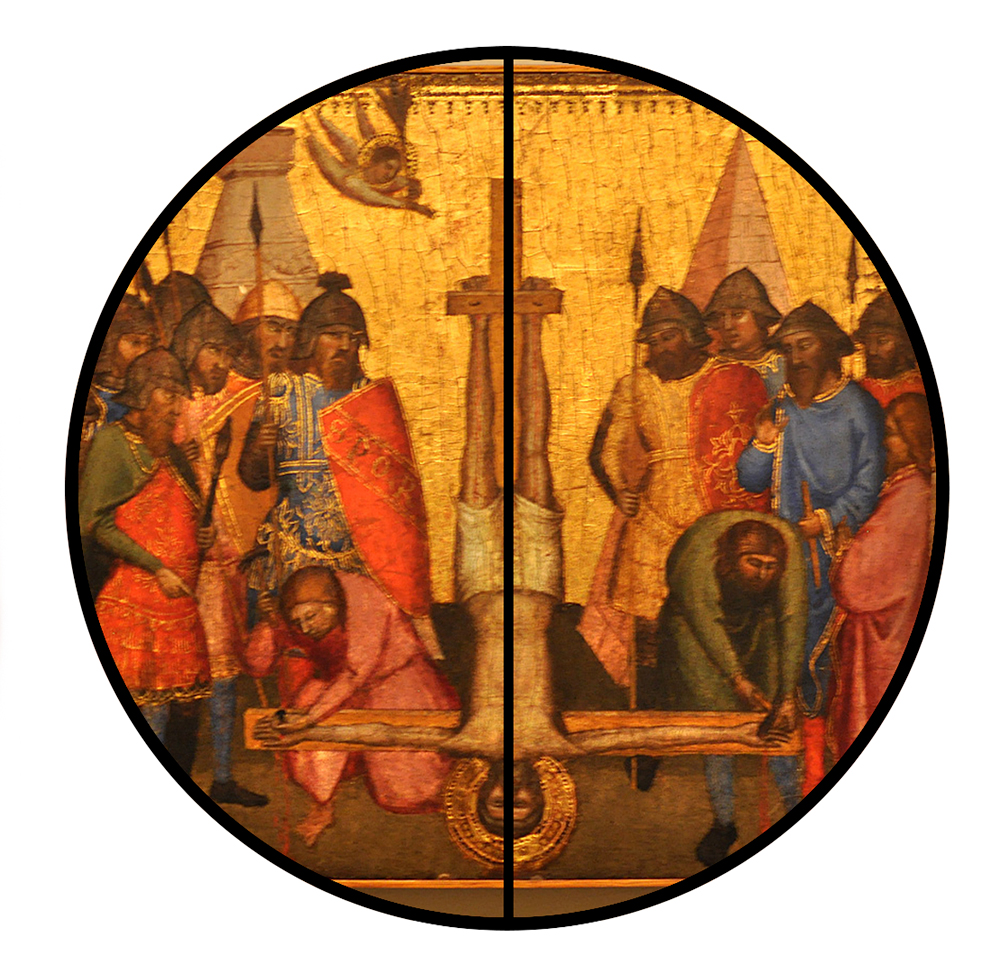
“…unless ye make the right as the left, and the top as the bottom and the front as the backward, ye shall not know the Kingdom Queen.”
Acts of Peter
and to be renewed by the Spirit of the Mind of Yourselves,
and to have put on the New Man, he who was formed according to the God, within a just one and devout one of the Truth,
τὸ ψεῦδος = the Lie
through which, those who have put away the Lie, talk a real/true one, each in company with the near one of himself, because we are limbs of one another.ἐπιδυέτω - to set upon an action, so as to interrupt it
Get angry, and do not miss! Let not the Sun set upon the Provocation of yourselves!Nor give a position to the Accuser!
The one who is cheating/stealing away no longer let him cheat, but rather let him grow weary, he who is working out by his Own Hands the Good, so that he might hold to impart to the one who is holding a need.
"I shall not Want"
Let not any rotten word lead out from the Mouth of Yourselves, but rather if one is good toward an architecture of the Needs/Wants so that he may give a favor to the ones who are hearing,And do not pain the Spirit, the Holy One of the God, within which you were signet-sealed into a day of ransom.
Let every bitter one and raging one and wrath, and screaming and blaspheming one, be lifted up away from yourselves in sync with every malevolent one.
Take some wine for that "stomach ache"
And become benevolent ones into one another, good-boweled, those who are agreeable to their own selves, just as the God within an anointed one was also agreeable to yourselves.7Footnotes
The phrase ἐπὶ πάντων with the genitive generally denotes spatial or figurative presence “before all,” “in the presence of all,” or “in front of all” (cf. LSJ s.v. ἐπί, A.I.2: “before, in the presence of”).
While ἐπί with the genitive can express authority or governance over a group (e.g., ὁ ἐπὶ τῶν ὁπλιτῶν “the one in charge of the hoplites,” Demosthenes), this usage is typically confined to clearly defined administrative, military, or hierarchical contexts where the locus of command is explicit (cf. Smyth, Greek Grammar, §1689).
Smyth notes that ἐπί with the genitive often denotes familiar or natural relations and tends to be “colourless and phraseological,” lacking the spatial or emphatic precision found in ἐπί with the dative (Smyth, Greek Grammar, §1689). Furthermore, ἐπί + genitive is frequently employed to express presence “in the time of” or “before” (ἐπὶ πάντων, i.e., “in the presence of all”) rather than explicit rulership (Smyth §1689b; Demosthenes, Philippics 2.15; Xenophon, Anabasis 6.1.22):
"In expressions of simple superposition ἐπί with the gen. denotes familiar relations and natural position; whereas ἐπί with the dat. gives clear and emphatic outlines to statements of the definite place of an object or action, is used in detailed pictures, and marks the object in the dative as distinct from the subject of the verbal action. ἐπί with the gen. is colourless and phraseological, and often makes, with the verb or the subject, a compound picture."
Thus the phrase ἐπὶ πάντων, when lacking such contextual markers, more commonly conveys the sense of “in the presence of all” or “before all,” denoting public visibility or openness. This predominance accords with the broader semantic range of ἐπί + genitive, where the genitive frequently indicates spatial or figurative proximity—such as “upon,” “at,” or “before” a collective—rather than inherent authority. Thus, interpreting ἐπὶ πάντων as “(ruling) over everyone” is far less common and generally requires further contextual specification to be plausible.
Moreover, when the sense is one of authority, control, or governance “over everyone,” the dative plural is typically employed: ἐπὶ πᾶσι(ν). This construction expresses dominion or jurisdiction over all persons or matters, a nuance distinct from mere presence or location. This usage is well-attested in classical literature. For example, Demosthenes (On the Crown 18.248) uses ὁ ἐπὶ πᾶσιν ἄρχων to mean “the ruler over all,” indicating jurisdiction. Similarly, Plutarch (Pericles 7.3) uses ἐπὶ πᾶσι τοῖς πράγμασιν to signify being “in charge of all matters.” (cf. LSJ s.v. ἐπί, B.I.1b)
Thus, the genitive with ἐπί focuses on presence or position relative to all, whereas the dative stresses authority or responsibility over all.
Being True/Trustworthy
"I, Myself am the truth"
ἀληθεύοντες (from ἀληθεύω) is often translated “speaking the truth,” but this rendering is reductive. The verb, though rare in classical Greek, encompasses a broader semantic range than verbal truth-telling. It more precisely means “being true” or “practicing truth”—that is, living in alignment as an agent of truth, without deceit, trustworthy.
The scholars could not help but amend qualifiers:
"From alethes; to be true (in doctrine and profession)" (Strong's Exhaustive)
“to act in accordance with the truth, to be truthful” (BDAG, emp. add.)
“to profess the truth (true doctrine)” (Thayer)
or awkward verbalization:
"alētheúō (literally, "truthing").../alētheúō (literally, "to truth")" (HELPS)
And thus the primary meaning of being true was effectively covered up.
The participial form here denotes a habitual, ongoing disposition rather than a single verbal act. In the context of Ephesians 4:15, especially in contrast to the deceitful instability and gambling described in v.14 (κυβείᾳ, πλάνῃ), it is best understood as denoting a life marked by trustworthiness in every respect, carried out ἐν ἀγάπῃ (“in love”). Thus, the phrase implies not merely telling the truth lovingly, but embodying truth within love—a moral-existential orientation rather than a verbal utterance alone.
Aristotle’s Use of ἀληθεύω
In Aristotle, ἀληθεύω does not simply mean “to speak the truth” in the colloquial sense, but rather denotes a correspondence between thought (or speech) and reality. This usage is foundational to his correspondence theory of truth.
1. Truth in Judgment and Proposition
Aristotle defines truth (ἀλήθεια) and falsity (ψεῦδος) primarily in terms of propositions (φάσεις) and their correspondence to reality.
In Metaphysics Θ.10 (1051b3–5), he writes:
"ἀληθεύει μὲν ὁ τὸ διῃρημένον οἰόμενος διῃρῆσθαι, ἔψευσται δὲ ὁ ἐναντίως ἔχων."
“He is true who thinks that what is divided is divided; and he is false who thinks that what is united is divided.”
This is a paradigmatic formulation of truth as correspondence: the subject "ἀληθεύει" (is true) not because he speaks or asserts something, but because his judgment corresponds to the actual state of affairs.
2. Neutrality of Assertion and Negation
In Metaphysics Θ.10 (1062a25), Aristotle asserts:
"ὁ λέγων ἄνθρωπον ἢ οὐκ ἄνθρωπον οὐθὲν μᾶλλον ἀληθεύσει."
“He who says ‘man’ or ‘not-man’ will not be any more truthful than the other.”
Here, Aristotle emphasizes that neither affirmation nor negation is intrinsically more likely to be true; truth lies in correct correspondence, not grammatical form.
3. ἀληθεύεσθαι (Passive/Middle Voice) in Logical Contexts
In De Interpretatione (Int. 22b2), Aristotle uses the passive/middle form:
"ἀληθεύεσθαι ἐπὶ τοῦ αὐτοῦ."
“To be made true of the same subject.”
This construction is often used when referring to propositions or categories: something is said truly of a subject when it belongs essentially or accidentally to that subject. This reflects truth as predicative accuracy.
Summary of Aristotle's Semantic Nuance
-
ἀληθεύειν (active): to judge, assert, or think in accordance with reality.
-
ἀληθεύεσθαι (passive/middle): for something (a statement, predicate, etc.) to be made true of a subject—used in logical analysis.
-
Not merely “telling the truth” but epistemic accuracy, ontological correspondence, or logical validity.
-
Contrast with ψεύδομαι (to be false), which similarly denotes error in judgment or assertion, not merely intentional deception.
The Agapē Principle in the Body
I. "From out of whom the whole Body"
ἐξ οὗ πᾶν τὸ σῶμα
Ex hou — “from out of whom”: The origin is personal, not abstract. It is from the Logos, the Head, the Anointed—yet not merely as source, but as ongoing emergence. In Aonic terms, this implies the emanation of multiplicity from unity, yet without separation. The whole body proceeds from Him, but remains in Him—eternally sourced, never alienated.
II. "That which is being interconnected and that which is being knit together"
συναρμολογούμενον καὶ συμβιβαζόμενον
Two participles (present middles):
-
συναρμολογούμενον – “being jointed together”
-
συμβιβαζόμενον – “being knit together,” or “co-instructed”
This is not static unity but dynamic coherence—a Möbius entanglement of parts without separation. The self in the Body is not individualistic, but symbiotic and recursive.
This evokes Wisdom’s architecture in Proverbs 8 and the New Jerusalem’s measurement (Rev. 21)—not just geometry, but divine ontology expressed through joined multiplicity.
III. "Across through every attachment of the Support"
διὰ πάσης ἁφῆς τῆς ἐπιχορηγίας
-
ἁφή = a point of contact, touch, or joint
-
ἐπιχορηγία = support, supply, or gracious provision
Here the Body is held together not by mechanical force but by touch, relationship, and gift—each connection is a graced junction, a point of communion, a liminal space through which divine energy flows.
This recalls agapē as the maternal matrix—the “touch” through which being is transmitted, sustained, and glorified.
IV. "According to an energy within one measure of each portion"
κατ᾽ ἐνέργειαν ἐν μέτρῳ ἑνὸς ἑκάστου μέρους
-
ἐνέργεια – the active energy
-
μέτρον – measure, limit, fitting portion
Here, the Body’s growth is not chaotic or uniform—it is proportional, particular, organic to the whole.
Each part receives energy in its own measure: i.e., a teleological fit, a customized telos.
V. "The Increase of the Body is making itself"
τὴν αὔξησιν τοῦ σώματος ποιεῖται
-
ποιεῖται – middle voice: "is making itself"
Growth is not imposed from outside. The Body, in its reciprocity and inner communion, generates its own increase. This reflects a wombic logic again: a body gestating itself through shared energy, shared love.
This also aligns with Aonic temporality: the Body’s growth is not towards a linear telos, but is recursively generated from within.
VI. "Into an architecture of his own self within agape-love"
εἰς οἰκοδομὴν ἑαυτοῦ ἐν ἀγάπῃ
-
οἰκοδομή – building, edifice, architecture
-
ἑαυτοῦ – of his own self
-
ἐν ἀγάπῃ – within love (agapē)
This is the central image: The Body becomes a temple, a living architecture, a woman of his own self built up from within, by means of agapē.
In agapē (understood as the feminine principle, the Bride, the Mother Above, the Womb of Communion), the Christ-Body does not merely grow—it becomes His own self. He is building Himself through others, and others through Himself.
Aonic Interpretation: Möbius Love and Ecclesial Ontology
This verse presents a recursive anthropology:
Each part of the Body is energized according to its measure, and in mutual love, the Body becomes Christ—not symbolically, but ontologically.
Thus:
Christ is building Himself—in us, as us, through us—in agapē, which is not a sentiment but a generative matrix of ontological participation.
In the aion, this structure is not linear but eternal:
-
The parts are born of the whole,
-
The whole is generated by the parts,
-
All this occurs in agapē, which is the feminine principle of divine containment, birthing, and unity.
The agapē principle in action, as written:
“He who loves his woman loves his own body” (Eph 5:28) — because she is the generative site of his becoming.
The Self in the Center, in the Feminine
Agapē-love is not optional to this cosmic Body. It is womb, structure, breath, and touch. Without her, there is no architecture of the self.
This verse, in the context of the aion, reveals that:
-
The Body of Christ is not a static institution, but a womb of mutual becoming of oneself.
-
It grows through reciprocity, energy, and agapē—that is, the feminine power of holding and giving being.
-
It is a living temple, not just of memory or doctrine, but of ontological reentry into the eternal: the aion, the center, the divine womb.
The phrase ἐσκοτωμένοι τῇ διανοίᾳ (Eph. 4:18) presents a syntactic and semantic ambiguity. Grammatically, σκοτόω ("to darken") is a transitive verb that typically takes a direct object in the accusative—thus, "to darken the thinking" would ordinarily appear as τὴν διάνοιαν σκοτοῦν. However, here the noun διάνοια appears in the dative, raising the question of construction.
The dative is construed as (a) a dative of instrument or cause ("darkened by the thinking"), or (b) less precisely, a dative of sphere or reference ("darkened in thinking"), which is the more interpretive rendering, despite lacking an explicit preposition such as ἐν. The former reading is grammatically stricter—suggesting the διάνοια itself as the agent of obscuration—while the latter is semantically idiomatic, portraying the seat or domain of the impairment.
Uncharming
While ἀσέλγεια is traditionally rendered in English as licentiousness, lasciviousness, or wantonness, these glosses miss the affective dimension of the Greek—namely, that the behavior is not merely indulgent but distasteful, even offensive to others. In this sense, ἀσέλγεια connotes a gross, aggressive moral indecency that repels rather than seduces—a distinction lost in smoother idiomatic translation.
The ancient lexica (especially Etymologicum Magnum and Suda) present competing etymologies, which reflect this ambiguity:
1. ἀ- (privative) + σέλγω (cf. θέλγω “to charm, enchant”)
-
Meaning: “un-charming”, i.e., what fails to beguile or please.
-
Extended sense: “exciting aversion or disgust”, not pleasure.
-
This is the currently preferred derivation, especially as θέλγω often implies magical or erotic charm.
Thus, ἀσελγής → "lacking enchantment" → coarse, repellent behavior.
2. ἆ- (intensive) + σαλάσσειν / σαλάζειν ("to shake, disturb, agitate")
-
Meaning: “violently turbulent,” “disruptively indecent”
-
Possibly indicates the aggressive, boisterous, and obscene nature of the conduct, particularly in speech or sexuality.
The verb χαρίζομαι (fut. χαριῶ, aor. ἐχαρισάμην, pf. κεχάρισμαι) primarily denotes the act of saying or doing something agreeable to another, showing favor, kindness, or obliging, typically with a dative of the person favored. It frequently appears in the middle voice, indicating an active role in making oneself agreeable or compliant, rather than a mere passive state. Usage spans from simple acts of courtesy (e.g., χαριζομένη πόσεϊ in Homer) to judicial contexts (e.g., partial verdicts in Plato), and may be absolute—meaning to comply or yield agreeably. The aorist middle ἐχαρίσατο thus conveys a deliberate, volitional action of granting favor, supporting translations such as “actively agreeable” to reflect this dynamic, interpersonal engagement rather than passive agreeableness.
Forgiving?
χαρίζομαι does not literally mean “forgive” in a strict sense, the concept of forgiving “one another” can be seen as an extended or contextual use of χαρίζομαι, emphasizing the benevolent and concessive aspect of the word.
(cf. LSJ)