Romans 2
We have seen that the Judgment of the God, is in accordance with a truth against the ones who are practicing such things.
And do you reckon this, omega man, the one who is separating the ones who are practicing such things, and he who is making these things, that you, yourself will escape from the Judgment of the God?
Or do you think little of the Wealth of the Goodness of himself and the Tolerance and the Patience, he who is unaware that the Good Quality of the God is leading yourself into a change of mind?
But according to the Hardness of Yourself, and a heart without a change of mind, you are treasuring up to yourself wrath within a day of wrath, and an unveiling of a just decision of the God.
He who will give back to each one according to the Works of Himself.
To the ones who are seeking, indeed according to perseverance of good work, a glory and an honor and immortality zoe-life eternal (aionos).
ἐριθείας - Intrigue, underhanded or partisan maneuvering
But to the ones from out of intrigue6 also those who are unpersuaded to the Truth, and to those who are persuaded to the Unjust One, a wrath and a rage,a pressing together, and a confined space against every soul-life of man, the one who is working out the Evil of both Caster ("Judaean") first and of Greek.

(1) Narrowness of space; a confined area — e.g., in Hippocrates, Art. 14:
στενοχωρία τῇ φάρυγγι παρέχειν(a constriction in the throat).
(2) Want of room, whether by sea or land — e.g., Thucydides 2.89, 4.26, 4.30; Plato, Laws 708b.
but a glory and an honor and a peace to everyone who is working out the Good to both Caster ("Judaean") first and to Greek.
For there is no receiving of face alongside the God.
For as many as have lawlessly missed, they will also destroy away lawlessly. And as many as within a usage missed, they will be separated straight across through a usage.
For the Hearers of a usage are not just ones close beside the God, but rather the Makers of a usage will be justified.
For when herds of people, the ones who are not holding a usage, by nature should make the things of the Usage, these ones who are not holding a usage are a usage to their own selves.
συνείδησις - co-consciousness, co-awareness
Anyone of those who are displaying the Work of the Usage inscribed within the Hearts of themselves, she who is jointly bearing witness with themselves of the Co-Consciousness and the Reasonings: those who are either accusing or who are speaking in defense in between each other.

(a depraved mind)
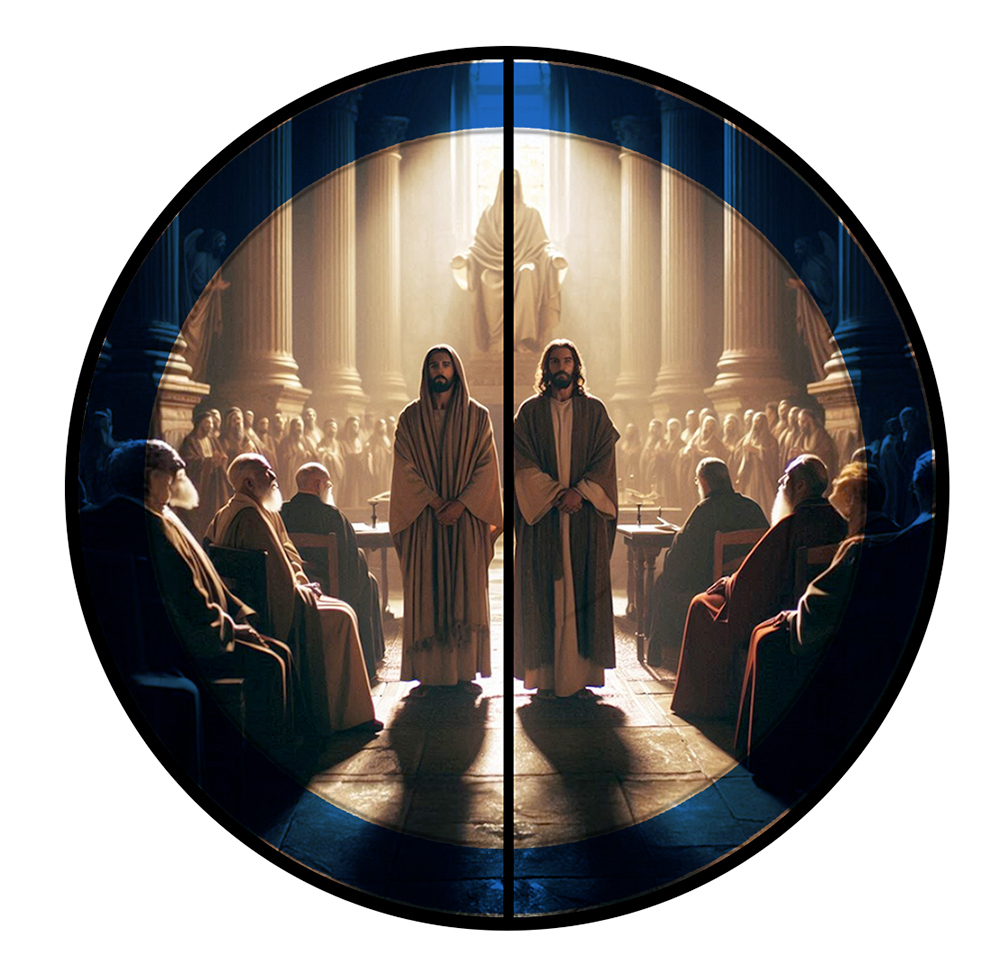
(a sound mind)
within which day the God is separating the Concealed Things of the Humans according to the Good News of Myself, straight across through an anointed one, Salvation.7
καυχᾶσαι - loud speaking, vaunting
And if you, yourself are named a Caster, and are settling on a usage, and you are loud-speaking within God,
κατηχούμενος - Sounded down into, indoctrinated
and you are recognizing the Desire, and you are approving the things that are differing, he who is being indoctrinated from out of the Usage,and have been persuaded, both of your own self to be a way-guide of smoke-blind ones, a daylight of the ones within darkness,
a disciplinarian of foolish ones, a teacher of unspeaking-infants, he who is holding the Shaping of the Knowledge and the Truth within the Usage!
Therefore the one who is teaching another one, you are not teaching your own self! The one who is preaching to not steal, you are stealing!
εἴδωλον - phantoms, unsubstantial forms, reflected images
The one who is saying to not commit adultery, you are committing adultery! The one who is loathing the Phantoms, you are temple-robbing!
- Phantom or apparition: Iliad 5.451; Odyssey 4.796; Histories 5.92; Laws 959b — illusions or deceptive appearances often created by gods.
- Ghosts of the dead: Odyssey 11.476; Proclus Institutio 64 — spirits or shades of the deceased.
- Insubstantial forms: Agamemnon 839; Ajax 126; Philoctetes 947; Pindar Fr. 131.3 — images or shadows lacking substance.
- Reflections: Sophist 266b; De Insomniis 464b9 — mirrored images or dream-like visions illustrating perception and illusion.
Whom within a usage you are loud-speaking, straight across through the Overstepping of the Usage you are lightly esteeming the God.
For the Name of the God, because of yourselves, is blasphemed within the Herds just as it has been written!
For indeed, a cut around benefits if you should practice a usage, but if you are being a side-stepper of a usage, the Cut Around of yourself has become an uncircumcised one!
Therefore if the Foreskin keeps watch over the Just Acts of the Usage, will not the Foreskin of himself be counted into a cut around?
and she, the Foreskin from out of nature, she who is completing the Usage, will separate yourself, the Side-Stepper of a usage straight across through a drawing and a cut around.
For not the one within the outward appearance is a Caster, neither the Cut Around within the outward appearance within a flesh.
but rather, the one within the Hidden One, a Caster, and a cut around of a heart within a spirit, not in drawing, of him whom the Praise not from out of humans but rather from out of the God.
Footnotes
ἐριθεία: Originally denoting labor for hire (cf. ἔριθος), the term developed pejorative connotations in classical and later Greek. In Aristotle (Pol. 1302b4, 1303a14), ἐριθεῖαι refers to canvassing for office, implying ambitious self-seeking and political scheming. In Hellenistic and Koine usage—particularly in the New Testament (e.g., Gal. 5:20; Phil. 1:17; Jas. 3:14)—it denotes selfish or factious ambition, translated aptly as "intrigue" in the sense of underhanded or partisan maneuvering. See LSJ, s.v. “ἐριθεία,” esp. meanings II and III.
The authoritative manuscripts have
ἐν ᾗ ἡμέρᾳ "in which day" — with ᾗ as a relative pronoun, dative feminine singular agreeing with ἡμέρᾳ "day".
later copies removed the relative pronoun and added in ὅτε "when" :
ἐν ἡμέρᾳ ὅτε "in the day when" — ὅτε as a temporal conjunction, introducing a finite clause.
The relative pronoun refers the reader back to the previous words, e.g. the Heart, she who jointly bears witness...
We found no translations following the authoritative texts on this verse.
Every translation follows the change — that is, nearly all modern translations render Romans 2:16 using a temporal clause, e.g., “on the day when God judges...,” even though the critical text preserves ἐν ᾗ ἡμέρᾳ, a relative clause.
The Scholar might call it "semantic smoothing" or maybe "an avoidance of wooden literalism" or some sort of crafty-speak of which there are endless ways a tongue can sway thoughts. But this isn't a matter of "wooden literalism" versus "dynamic fluency." It's a case of lexical substitution that erases the embedded doctrinal structure the author is trying to convey. The same translation committees that will appeal to "authoritative" sources will, at the same time, lean toward traditional renderings, theological bias, and reader familiarity, over authoritative sources when it is convenient. In this way variant readings become more of a tool to help scholars translate according to how they want things to read. With variant texts, they can pick and choose what they want as they go. This undermines the notion of the critical text being the true "final authority" in practice, and truly shows the "forked-tongue" nature of traditional translation practices. Are the authoritative texts authoritative or not? And if so, why are you choosing to deviate from them?
For our part, the RBT adheres to the authoritative texts as consistently as possible. When we see obvious changes, deletions, insertions, etc. that conflict with the authorities, we stick to the authorities, plain and simple.