He is a Gift 6
Not for Show
Hold then toward the Just one of yourselves, not to make in front of men toward the Spectating by themselves. Otherwise you all are not holding wages close beside the Father of yourselves, the one within the Heavenly Ones.
ἀπέχω - Holding back from, Abstaining From
Whenever therefore you are making charity, don't blast a trumpet in front of yourself just like the Stage Players/Actors, those who are making within the Assemblies, and within the Currents, so that they may be glorified underneath men. Trustworthy One, I am speaking to yourselves, they are holding back from the Wage of themselves!
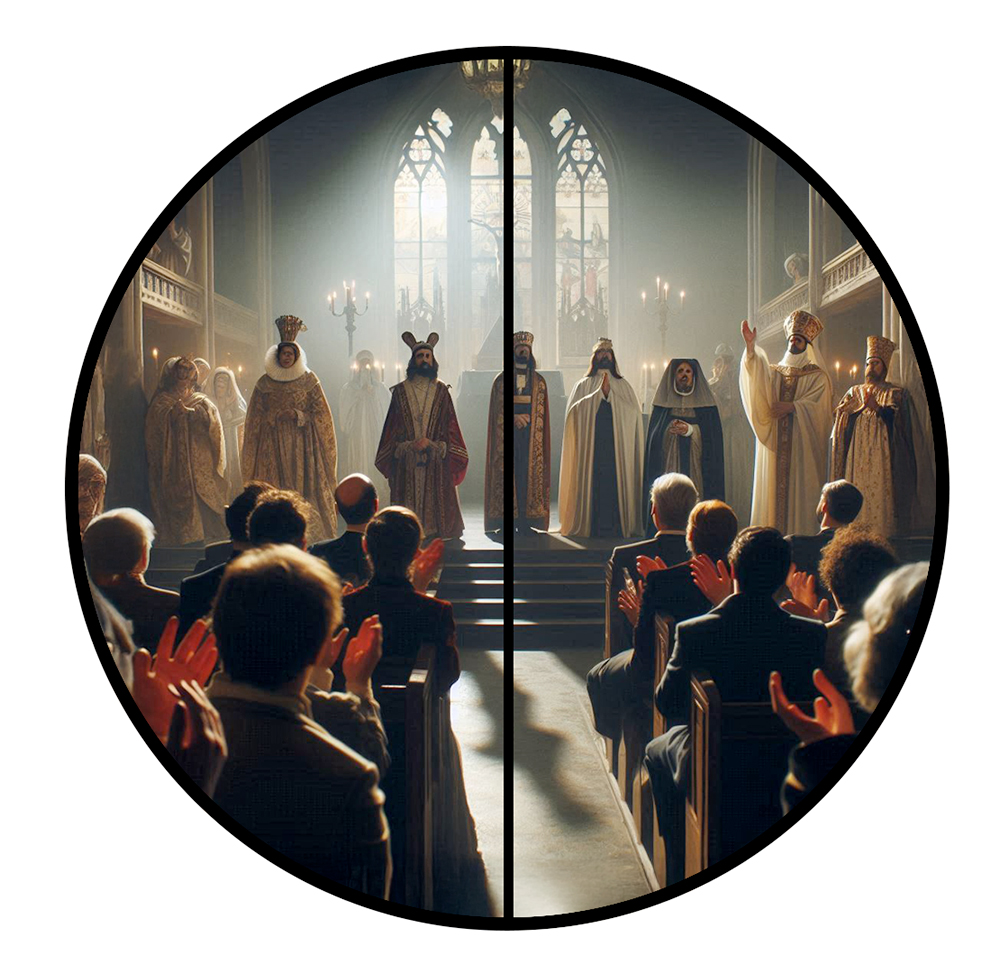
Sense I:
- Interpreter of dreams or visions (Plato, Timaeus 72b).
- A prophet or seer (New Testament).
- An actor or stage performer (Aristophanes, Wasps 1279).
- By extension, anyone who recites or declaims, including rhapsodes (Diodorus Siculus).
- Metaphorically: a deceiver or hypocrite (Septuagint, Book of Job).
ῥύμαις - forces, swings, rushes, flows, currents
And yourself, he who is making a charity, don't let her, the Left-side of yourself, know who it is making the Right-side of yourself.
so that she may be, the Charity of yourself, in the Secret, and the Father of yourself, the one who is looking within the Secret, will give back to yourself.
And when you offer prayers, you will not be like the Stage Actors, because they are philo-loving within the Gatherings and in the Corners of the Broadways, those standing by to offer prayers so that they might be visible to the Men. Trustworthy One, I am speaking to yourselves they are holding back from the Wage of themselves!
ταμεῖόν - Treasury, Storeroom
And whenever you, yourself offer prayers, come into the Treasury of yourself. And he who has shut/barred the Door of yourself, offer prayers to the Father of yourself, the one within the Secret Cover, and the Father of yourself, the one who is looking within the Secret Cover, will give back to yourself.And those who are offering prayers, do not stammer-speak14 just as the Nationals, for they are those who think that in the Much-Speaking of themselves they will be listened to.
Therefore do not be made like themselves, for the Father of yourselves sees the things which you are holding a need of in front of the Asking of Yourselves himself.
In this way therefore yourselves offer prayers, Father of ourselves, the one among the Heavenly Ones, make holy the Name of Yourself. May she come the Queen of yourself, may the Pleasure of yourself become, just as within a heavenly one, also on an earth. The Bread Loaf of ourselves, the Super-Essence, give to ourselves today.15
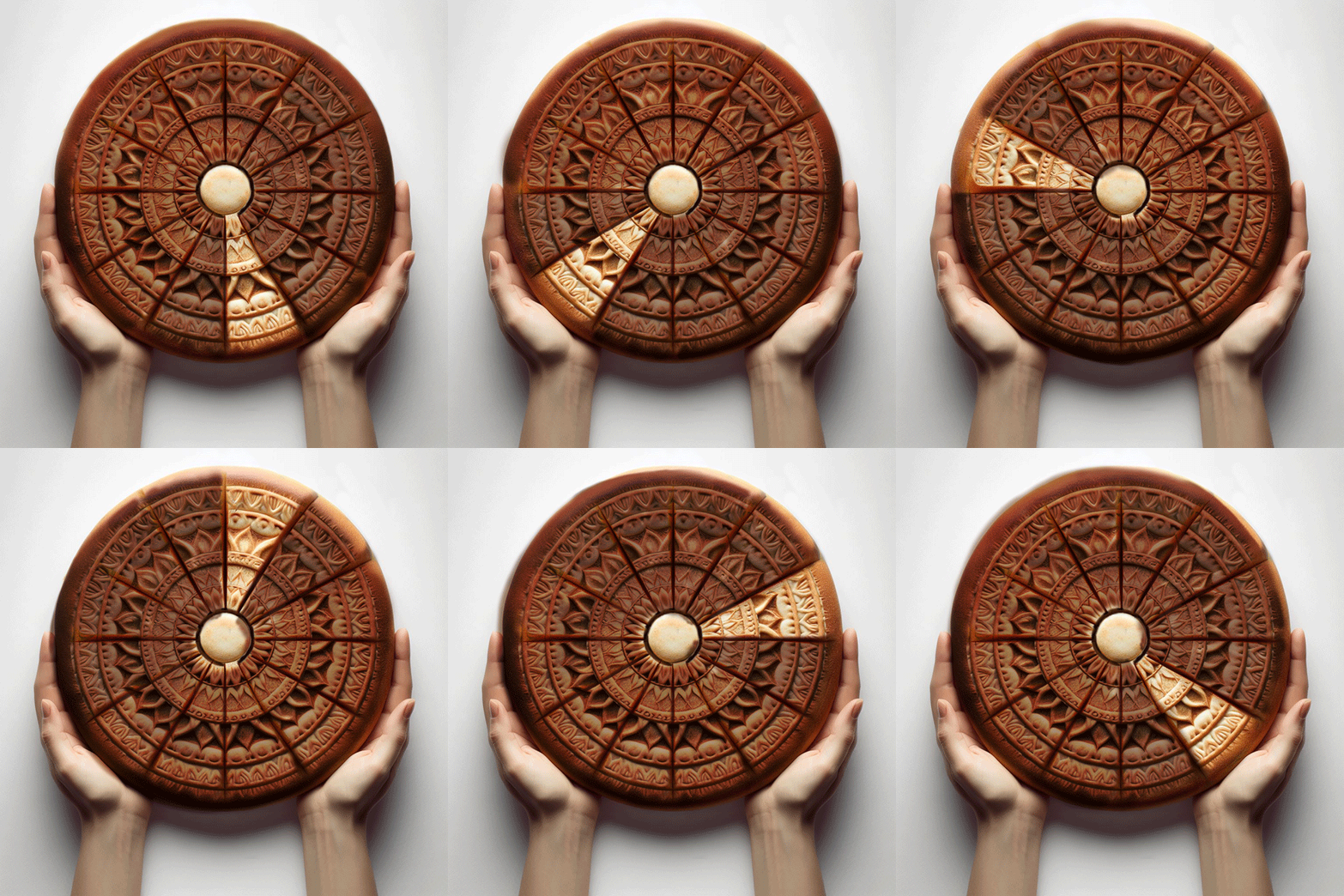
Drawing on the preposition ἐπι (epi), meaning "toward" or "upon," in conjunction with οὐσία (ousia, meaning "essence" or "substance"). This results in an interpretation that sees τὸν ἐπιούσιον as not merely “daily bread” but as a bread necessary for sustaining existence—bread that is directed toward or upon the essence of eternal life. In this case a super-existence, or "an existence beyond."
ἄφες - Throw/Hurl
And hurl away to ourselves the debts of ourselves, even as ourselves have also hurled away to the indebted ones of ourselves.16 And do not bring inward ourselves into a temptation, but rather draw ourselves out away from the Pain-ridden one.Throwing back the Thirty Silver
For if you hurl to the Humans the Deviations/Missteps of themselves, he the Father of yourselves, the Heavenly One, will hurl to yourselves.And if you do not hurl to the men, neither will the Father of yourselves hurl the Deviations/Missteps of yourselves.
And when you fast do not become like the gloomy Stage Actors, for they are putting out of view/disfiguring the Faces of themselves so that they might appear to the Men as those who are fasting. Trustworthy One, I am speaking to yourselves they are holding back the Wage of themselves!
Anoint and wash her
And yourself, he who is fasting, anoint the Head of yourself, and wash the Face of yourself,so that you should not appear to the Humans as one who is fasting, but to the Father of yourself, to the one within the Secret and the Father of yourself, the one who is looking within the Secret will give back to yourself.
Where the Bookworm Disfigures, Out of the Eater....
Don't store up to yourselves treasures upon the Earthly One where bookworm and eater disfigure/put out of view and where thieves dig through, and steal.17Store up then to yourselves treasures within a heavenly one where neither bookworm nor feeding disfigure/put out of view and where thieves do not dig through, nor steal.
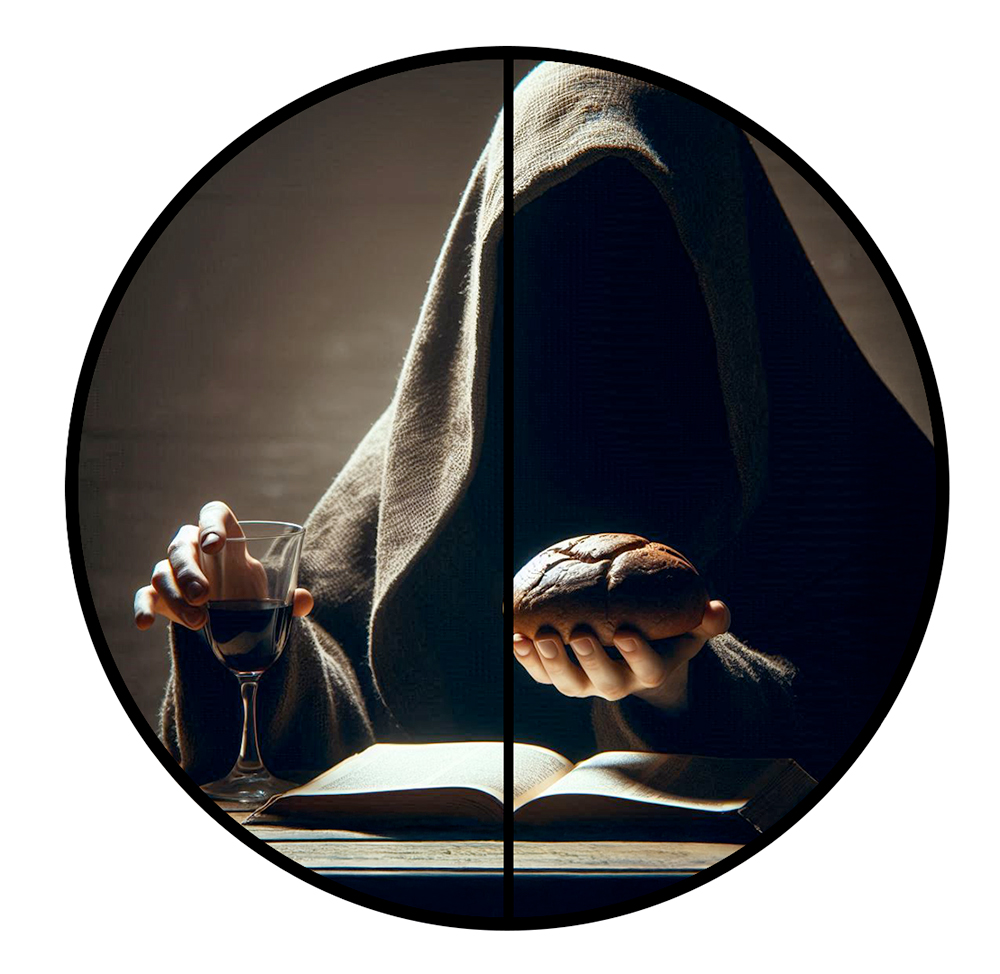
"Dual waters of thieves, they are being sweet; and a bread loaf of secret hiding places, he is being agreeable/pleasant."
(Proverbs 9:17 RBT)Which Heart is your Heart?
For where the Treasure of Yourself is, there she will be also, the Heart of yourself.The lamp of the Body is the Eye. If therefore the Eye of Yourself is without folds the entire whole of the Body of yourself will be luminous!
The Great Daylight
If then the Eye of yourself should be pain-ridden, the whole entire Body of Yourself will be dark! If therefore the Daylight, the one within yourself, is dark—how Great is the Darkness!Lord Mammona ("Trust in Me or Else")
No one is able to be enslaved to two masters, for either he will hate the One and will agape-love the other, or he will hold anti of one,18 and he will think down of the Other. You are not able to serve a god and a mammona.19Because of this I am speaking to yourselves don't be worried about the Soul-life of yourselves: who you all may eat or who you all may drink, neither for the Body of yourselves: who you all will put on; Is not the Soul-life greater than the Nourishment, and the Body than the Outer Garment?
Fix your gaze into the Winged Ones/Flyers of the Heavenly One, that they don't sow, nor reap, nor lead together into storehouses, and the Father of yourselves, the Heavenly One, is nourishing themselves. Are you, yourselves not different from themselves?
Who then from out yourselves, who is worrying, is able to add upon the Age of himself one forearm/cubit?
And around an outer garment why be worried? Examine closely the Lilies of the Field, how they are growing. They don't grow weary, nor do they spin.
And I am speaking to yourselves, that not even Complete One ("Solomon") within the whole Glory of himself threw around like one of these ones!
The God Thus is Enrobing Himself with yourselves
And if the God is in this way is putting on the Pasture of the Field, he who is today and tomorrow he who is cast into an oven, , is he not multitudinously more so yourselves, little-trusts?20The Eat + The Drink + The Wear
Therefore don't worry, those who say, 'What should we eat or what should we drink or who shall we throw around?'
"In the sea, he was fishing, thinking that they (the fish) would come out to land; but when this hope was disappointed, he took a net, cast it around [periballó] a great number of fish, and drew them up."
(Herodotus' Histories)for the Herds are seeking after all these things, for the Father of yourselves, the Heavenly One, sees that you hold need of all these together.
And search first for the Queen and the Just One of himself and all these things will be added toward yourselves.
Therefore don't worry into the Tomorrow, for Tomorrow will worry for her own self; enough for the Day is the Malicious Evil One of herself!
Footnotes
Stammer-Speak
Strongs G#945 βαττολογέω. to stammer-speak or stutter-speak. This is a hapax legomenon, meaning it was constructed by NT authors. "βαττολογέω" (battologeō) is a compound word formed by combining "βαττο-" from "Βάττος" (Battos), which is associated with stuttering or stammering, and "-λογέω" (-logeo), which means "to speak." Therefore, "βαττολογέω" literally means "to speak like Battos" or "to speak in a stuttering or stammering manner." This term was likely coined to convey the idea of speaking in a repetitive, meaningless, or disorderly fashion.
The Greek word "ἐπιούσιος" (epiousios) is considered a hapax legomenon, which means it was coined by the NT authors. Specifically, it is found in the Lord's Prayer in Matthew 6:11 ("τὸν ἄρτον ἡμῶν τὸν ἐπιούσιον δὸς ἡμῖν σήμερον") and Luke 11:3 ("τὸν ἄρτον ἡμῶν τὸν ἐπιούσιον δίδου ἡμῖν τὸ καθ' ἡμέραν").
The precise meaning of "ἐπιούσιος" has been the subject of much scholarly debate, being as it were a fundamental part of the "Lord's Prayer" but it is commonly translated as "daily" or "necessary for existence." Since it does not appear in any other known ancient Greek texts, we must rely on it compound structure and contexts.
The Rising of the Sun
This word has been heavily debated by scholars simply because of the philosophical/metaphysical implications of the grammatical compound. There is a simple meaning, according to its components, but not one any biblical scholar was willing to accept in theological discourse.
The term ἐπουσία, though formally straightforward as a compound of ἐπί- ("upon" or "in addition") and οὐσία ("essence" or "being"), has attracted disproportionate interpretive attention due to its latent philosophical and metaphysical potential. While the composite suggests a plausible surface meaning—that which is upon or beyond being—its implications have proven problematic for theological frameworks that resist any notion of intermediary or supervenient being beyond or beside a singular divine essence. Consequently, biblical and patristic scholars were reluctant to adopt the term in its literal or speculative fullness, biased to interpretive routes that maintain doctrinal coherence over lexical possibility. This reluctance underscores a broader tension in ancient metaphysical language: that linguistic derivation does not constrain conceptual interpretation, especially when dealing with terms at the intersection of grammar, ontology, and revelation.
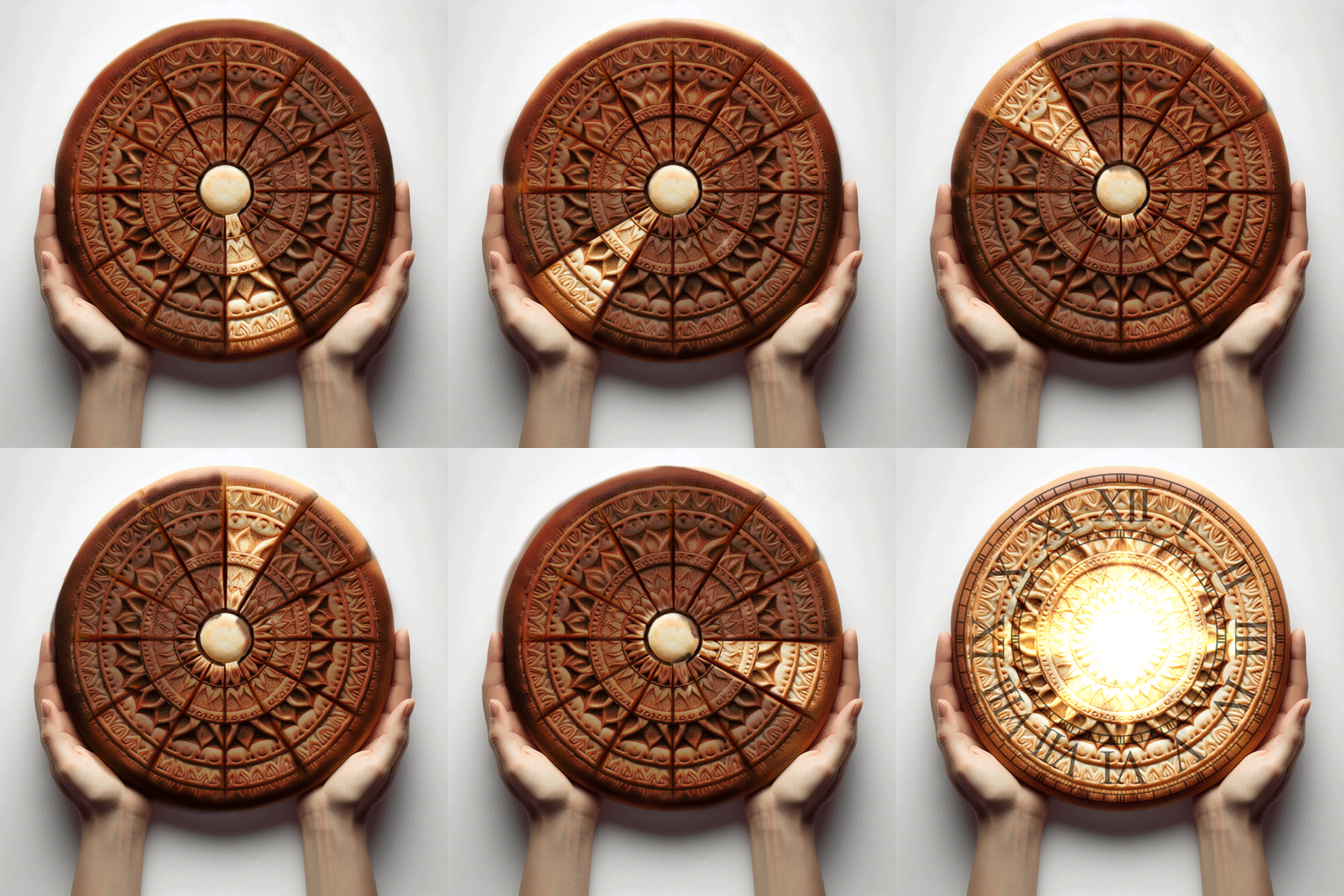
If ἐπουσία is interpreted analogically within a framework of ontological emanation—where being radiates or "beams forth" akin to the sun's light—its prefix ἐπί-, denoting superposition or addition, could signify a plenitudinous extension of essence, not merely spatially, but existentially. Such a concept aligns with metaphysical models wherein existence is not linear or segmented but unfolds as a totality, analogous to perceiving a clock not as a sequence but as an integrated whole. In this sense, ἐπουσία might connote a form of omni-existence—a mode of being in which all times, places, and essences co-inhere without contradiction or division. This reading, while resonant with late Neoplatonic or mystical systems, remains rooted in a conceptual analysis of being as non-successive and non-localized, rather than in any strictly theological dogma.
What?
To put it in simpler terms, the basic meaning of this compound word has caused a lot of debate among scholars because it brings up deep and tricky questions about what it means to exist or to be. One could think about a kind of existence that is beyond normal time and space—like the way the sun shines everywhere in all directions or how a clock can be seen as a whole, not just ticking seconds one after another.
But because these ideas are so complicated and don’t fit easily into any religious beliefs—especially in any Biblical tradition (or early church writings)—most scholars didn’t want to accept the word’s full meaning. Instead, they preferred to distort it in ways that fit better with their religious teachings.
In other words, even though the word seems simple when you look at its parts, the big ideas it suggests made certain people nervous, so they avoided using it the way it naturally might be used.
The differentiation between the accusative direct object and the indirect dative object of the verb "to send away/release" were clearly ignored in previous translations.
The direct object of the verb ἀφίημι (aphiémi) is always in the accusative. ἡμῖν "ourselves" is in the dative, meaning "to us/ourselves" and therefore it is not accurately rendered "forgive us". Hence in Matt. 9:2 it is read, 'the sins/misses of yourself have been sent away'. And in Matt 22:25, the accusative direct object and dative indirect object is unmistakable: "he sent away the woman [accusative] of himself to the brother [dative] of himself."
The word "σής" (sēs) has a Hebrew origin: Hebrew סָס, sas Isaiah 51:8 see Strongs #5580.
Primary Meaning: Moth.
- Example: "[χρυσὸν] οὐ σ. οὐδὲ κὶς δάπτει" (Gold neither moth nor rust consumes) - Pindar.
- Also found in Aristophanes, Strabo, Matthew 6:19, and Luke 12:33.
Metaphorical: Refers to "bookworms" or "grammarians."
- Example: "σῆτες ἀκανθοβάται" or "-λόγοι" (thorn-walkers or -speakers), referring to grammarians or bookworms in the Anthologia Palatina (Antiphanes, Philodemus).
It goes without saying that Jesus uses symbolic language. What is a moth? A bookworm that attacks books. See Logeion Greek for more info.
The Greek verb "ἀντέχομαι" (antechomai) is a compound of "ἀντί" (anti), meaning "against" or "opposite," and "ἔχω" (echo), meaning "to hold" or "to have." The word "ἀντέχομαι" literally means "to hold against" or "to hold oneself against." In usage, it often means "to cling to," "to hold firmly to," "to withstand," or "to support."
Here are the parts broken down:
- ἀντί (anti) - "against"
- ἔχω (echo) - "to hold"
So, "ἀντέχομαι" can be understood as "to hold against," which metaphorically extends to mean standing firm or clinging to something resolutely.
Lord Mammon
The Greek term μαμωνᾶς (mamōnas), found in the New Testament, is often translated as "wealth" or "riches" and is personified as a master that competes with God for loyalty. The etymology of "μαμωνᾶς" provides deeper insight into its meaning. It is derived from the Chaldean term מאמונא (mamona), which is associated with trust and reliance, being derived from the Hebrew אמן aman meaning to trust, believe, support. This led to certain interpretations of "money" or "wealth" as a common thing people trust in (according to Gesenius is contracted from the Hebrew word מטמון (matmon Strongs #4301), meaning "hidden treasure" or "buried treasure.").
The Hebrew term אמונה (amunah) means "faith/trust/confidence"
The Hebrew word מאמונה (ma'amunā) comes from the root אמנ (’mn), which is related to ideas of faith, trust, and reliability (as seen in אמונה (emunah), meaning faith or trustworthiness). However, מאמונה has a distinct meaning, usually related to concepts of trust, reliability, or faithfulness in a more practical or functional sense.
מאמונה Someone who is trusted:
-
Trust / Faithfulness – In Aramaic, מאמונה refers to the concept of being entrusted or reliable, often indicating someone who is trusted or someone appointed to a role of responsibility.
-
Appointed Overseer or Guardian – It can also refer to someone who is appointed to a position of responsibility, such as a steward, warden, or guardian. This is often the sense in Jewish Aramaic literature, particularly in the Talmud, where מַאֲמוּנָה might describe a guardian of something or someone entrusted with a task or responsibility.
Etymology and Morphology:
-
Root: The root א־מ־נ (’mn) is connected to trust and faith, as seen in the related words אֱמוּנָה (emunah, faith) and מָמוֹנָא (māmōnā, wealth).
-
Pattern: The word מאמונה would be a passive participle in Aramaic, derived from the root, and denotes something or someone that is entrusted, faithful, or reliable. Is it riches? Or, a person?
The key meaning here lies in the personification. Mammon is also personifed as a master or lord, and thus one representing the power of אמונה "faith", placed in a person of trust. As a master or lord, Mammon would thus be one demanding trust, devotion, faith.
Two Kinds of "Pastures"/"Garments"
The phrase "ὁ Θεὸς οὕτως ἀμφιέννυσιν" translates to "God thus is enrobing" or "The God is putting on in this way."
- ὁ Θεὸς (ho Theos): "the God"
- οὕτως (houtōs): "thus" or "in this way."
- ἀμφιέννυσιν (amphiennyisin): This is a verb meaning "clothes" or "wraps around." It comes from the verb ἀμφιέννυμι, which can mean to clothe, cover, or envelop.
The form ἀμφιέννυσιν is a third-person singular present indicative form of the verb ἀμφιέννυμι, which means "he/she/it puts round or on." The connection here is that ἀμφιέννυσιν specifically describes the action of clothing or dressing being performed in the present tense.
In the context of this verse, "ὁ Θεὸς οὕτως ἀμφιέννυσιν," is written toward the end, and can be translated as "God thus clothes himself" or "God thus puts on [clothing]." This indicates that the subject (God) is actively engaging in the act of putting on or dressing in a specific manner that was described. The connection to the accusative "the Pasture" defines the "clothing" being put on, rather than what is being clothed, and likewise the accusative ὑμᾶς yourselves.