 John 11:49

|
Strongs 1520
[list] Λογεῖον Perseus Heis Εἷς One Adj-NMS |
|
Strongs 1161
[list] Λογεῖον Perseus de δέ however Conj |
|
Strongs 5100
[list] Λογεῖον Perseus tis τις anyone IPro-NMS |
|
Strongs 1537
[list] Λογεῖον Perseus ex ἐξ from out Prep |
|
Strongs 846
[list] Λογεῖον Perseus autōn αὐτῶν of themselves PPro-GM3P |
|
Strongs 2533
[list] Λογεῖον Perseus Kaiaphas Καϊάφας Caiaphas N-NMS |
|
Strongs 749
[list] Λογεῖον Perseus archiereus ἀρχιερεὺς high priest N-NMS |
|
Strongs 1510
[list] Λογεῖον Perseus ōn ὢν he who is being V-PPA-NMS |
|
Strongs 3588
[list] Λογεῖον Perseus tou τοῦ the Art-GMS |
|
Strongs 1763
[list] Λογεῖον Perseus eniautou ἐνιαυτοῦ year N-GMS |
|
Strongs 1565
[list] Λογεῖον Perseus ekeinou ἐκείνου that one DPro-GMS |
|
Strongs 2036
[list] Λογεῖον Perseus eipen εἶπεν said V-AIA-3S |
|
Strongs 846
[list] Λογεῖον Perseus autois αὐτοῖς to themselves PPro-DM3P |
|
Strongs 4771
[list] Λογεῖον Perseus Hymeis Ὑμεῖς yourselves PPro-N2P |
|
Strongs 3756
[list] Λογεῖον Perseus ouk οὐκ not Adv |
|
Strongs 1492
[list] Λογεῖον Perseus oidate οἴδατε you have seen V-RIA-2P |
|
Strongs 3762
[list] Λογεῖον Perseus ouden οὐδέν In nothing Adj-ANS |
And a certain one of them, Caiaphas, being chief priest that year, said to them, Ye know nothing,
But a certain one of them, Caiaphas being high priest of that year, said to them, You know nothing,
Footnotes
| 95 | Joh 11:49 Strongs NT #2533 Καϊάφα. Caiaphas. The Depressed One "supposed by many to be the same as כֵּפָא, a stone, a rock; others more correctly equivalent to כָּיְפָא, depression, Targ. on Proverbs 16:26 (according to Delitzsch (Brief and. Röm. ins Hebrew etc., p. 28) קַיָפָא)" Thayers Greek Lexicon In the Targum, specifically on Proverbs 16:26, the word appears to be associated with the latter meaning, signifying a "depression, low place, hollow." Proverbs 16:26 says "for he has pressed/drove down upon himself the mouth." The Hebrew for "pressing/driving" is אכף (akaph). The verb אכף is only found in this verse. In Arabic it came to mean "saddle". Cf. Strongs Hebrew #404. A saddle is a concave "depression." The Targumim are ancient Aramaic translations and interpretations of the Hebrew Bible, originating during the Second Temple period to provide explanations and translations for Aramaic-speaking Jewish communities. These oral traditions were eventually codified into written texts, with Targum Onkelos and Targum Jonathan among the most well-known, believed to have been standardized around the early centuries CE but reflecting much earlier origins. |
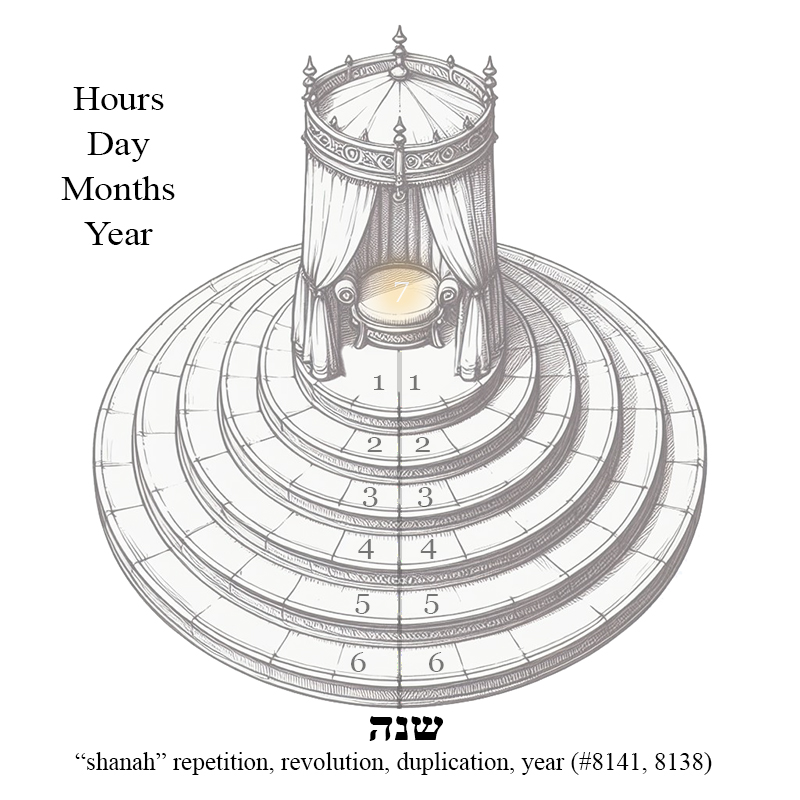
| 95b | Joh 11:49 Self Cycle Initially, ἐνιαυτός referred to an object with a circular shape, such as a ring-shaped item or specific cup (Ath. 783c), later “the completed cycle of a year." Homeric and archaic examples preserve this cyclic sense:
Hence the semantic extension: In inscriptions (e.g., Delphi, Crete):
The term marks a closed temporal loop, not simply the number 12 months. Because the base meaning is “a completed cycle,” Greeks extended it to any recurring temporal pattern, especially astronomical ones. Thus: a. The Metonic Cycle 19 years = period after which lunar and solar calendars realign. b. The 600-year cycle Josephus (AJ 1.3.9) mentions a 600-year ἐνιαυτός for a long astronomical period. c. “ἀΐδιος ἐνιαυτός” (Apollodorus) The “eternal cycle” = an unending cosmic recurrence. Pythagorean usage — ὁ μέγας ἐνιαυτόςEudemus (ap. Theon Smyrnaeus 198H) gives the Pythagorean doctrine: μέγας ἐνιαυτός = the cosmic cycle after which the entire configuration of the heavens returns to the same starting-point Characteristics:
Thus for the Pythagoreans: This turns “year” into a metaphysical notion: The root of ἐνιαυτός is transparently cyclic:
Hence: ἐνιαυτός = a completed, self-returning period. The Pythagorean cycle (μέγας ἐνιαυτός) is the extension of the basic meaning of ἐνιαυτός—a completed, self-returning temporal loop—to the largest possible astronomical recurrence. The term naturally expands because its core sense is cyclic completion, not merely “year.” |