 John 1:1

|
Strongs 1722
[list] Λογεῖον Perseus En Ἐν within Prep |
|
Strongs 746
[list] Λογεῖον Perseus archē ἀρχῇ origin/source N-DFS |
|
Strongs 1510
[list] Λογεῖον Perseus ēn ἦν was V-IIA-3S |
|
Strongs 3588
[list] Λογεῖον Perseus ho ὁ the Art-NMS |
|
Strongs 3056
[list] Λογεῖον Perseus Logos Λόγος Word N-NMS |
|
Strongs 2532
[list] Λογεῖον Perseus kai καὶ and Conj |
|
Strongs 3588
[list] Λογεῖον Perseus ho ὁ the Art-NMS |
|
Strongs 3056
[list] Λογεῖον Perseus Logos Λόγος Word N-NMS |
|
Strongs 1510
[list] Λογεῖον Perseus ēn ἦν was V-IIA-3S |
|
Strongs 4314
[list] Λογεῖον Perseus pros πρὸς toward Prep |
|
Strongs 3588
[list] Λογεῖον Perseus ton τὸν the Art-AMS |
|
Strongs 2316
[list] Λογεῖον Perseus Theon Θεόν God N-AMS |
|
Strongs 2532
[list] Λογεῖον Perseus kai καὶ and Conj |
|
Strongs 2316
[list] Λογεῖον Perseus Theos Θεὸς God N-NMS |
|
Strongs 1510
[list] Λογεῖον Perseus ēn ἦν was V-IIA-3S |
|
Strongs 3588
[list] Λογεῖον Perseus ho ὁ the Art-NMS |
|
Strongs 3056
[list] Λογεῖον Perseus Logos Λόγος Word N-NMS |
The Twins within The Writing
The Logos Ratio was being within an origin,1 and the Logos Ratio was being toward the God,2 and the Logos Ratio was being God.3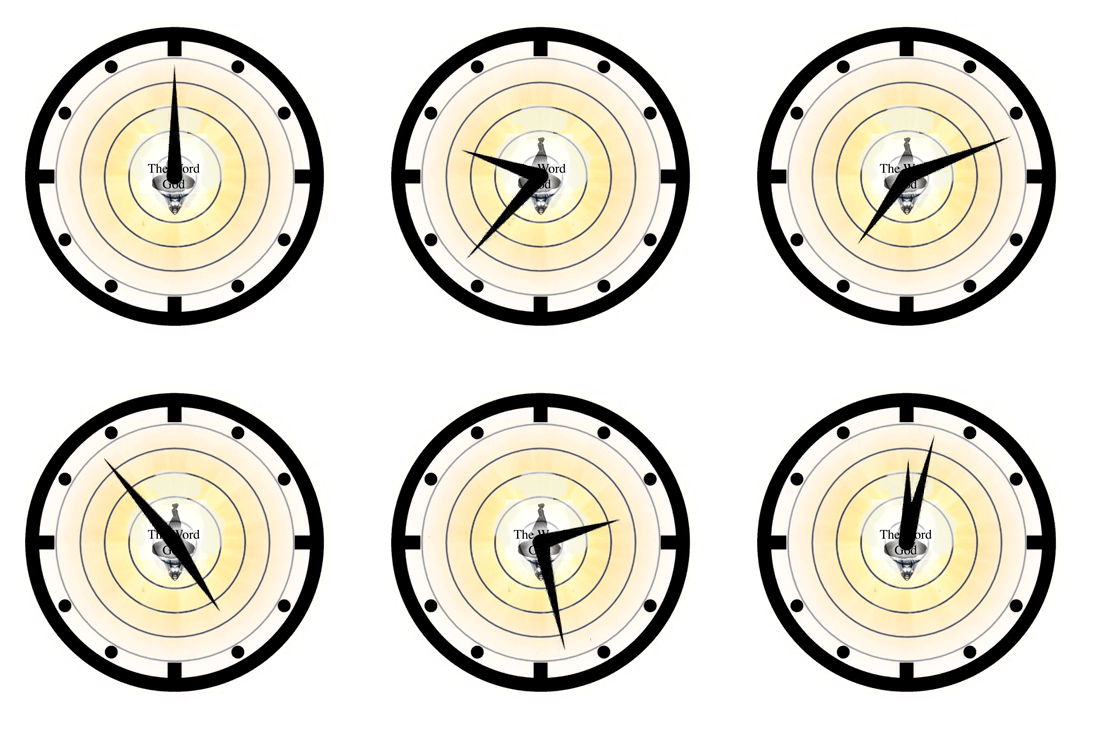
Movement slows as one draws closer to the Origin, until all is still. The Way to The Sabbaton (Inner) Rest of "timelessness" must be made straight, where motion ceases. The question then is, why twin sons?
Genesis 1:
Within the Head...
He is Evening | He is Morning
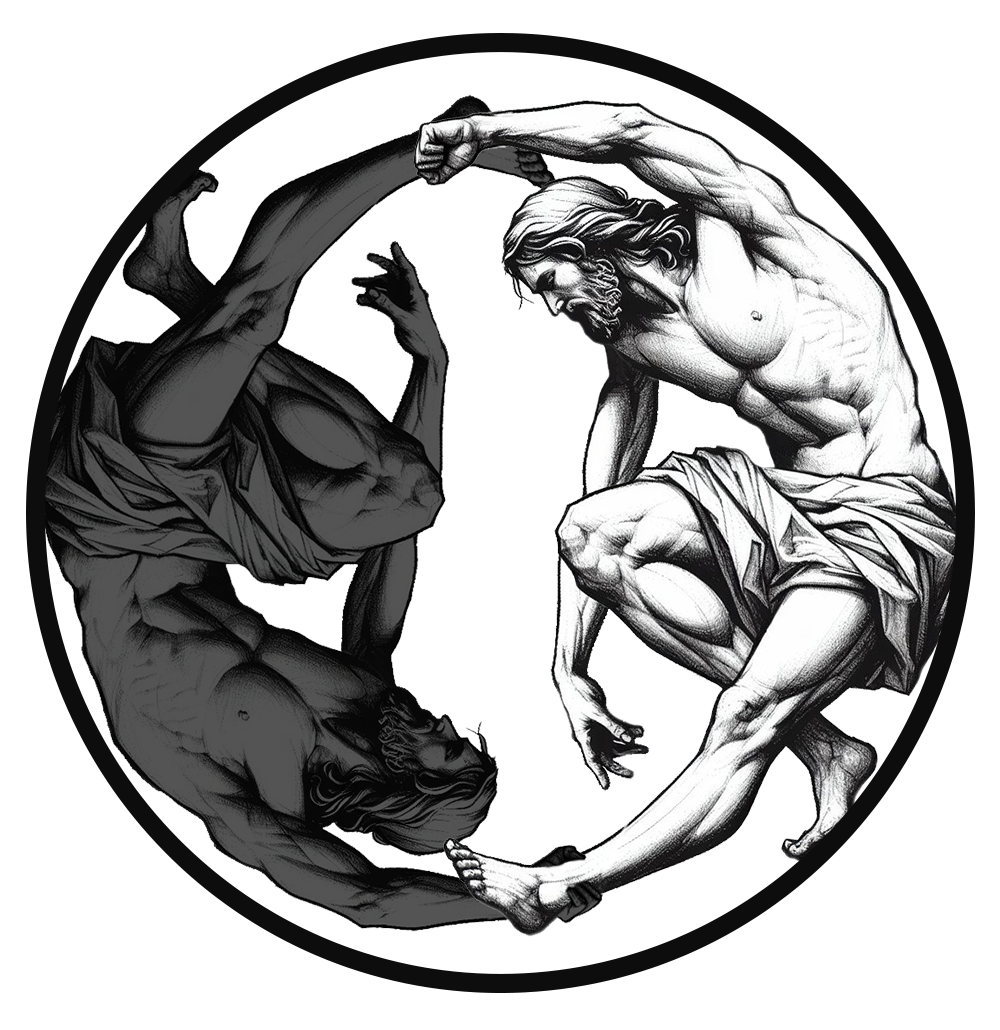
The Logos is a self-operating ratio that continuously converts indeterminate multiplicity (chaos/abyss) into determinate structure.
(Read The Architecture of Being: Logos as the Aonic Operator of Ratio and Flesh)In the beginning was the Word, and the Word was with God, and God was the Word.
In the beginning was the Word, and the Word was with God, and the Word was God.
Footnotes
| 1 | Joh 1:1 These Three are One: The Word He Was Ἐν ἀρχῇ ἦν ὁ λόγος. The challenge with the traditional ordering of this phrase is its abstraction—“In the beginning the Word was.” The Greek Ἐν means “in” or “within” not "at" and typically implies location in or containment in something. Here, its meaning was extended to “a temporal start”, or even further to “at the beginning of time.” But is John referring to chronological time itself? Where is the beginning of chronos time? If not chronos time, then the beginning of what? The beginning of everything? It is impossible to derive anything rational from such abstraction. That in itself leaves an abyss. If one were to actually seek out a beginning in this context, he will never find anything, only irrational thoughts like "before the beginning there was just God." Theologians from Augustine to modern day professors explain it as the "beginning of reality" or "beginning of time" or "beginning of creation" etc. Some might interpret it as the manifestation of a first ontological principle. The point is, there is no point. It is a completely open-ended "bottomless pit" and that means one may apply any interpretation or speculation they wish, because all we are given is one word to work with: a beginning. This is useless for any productive reasoning or discussion, which is why it's never reasoned through or discussed. It can't be without becoming completely lost. There is nothing there. The verb ἦν (was) appears three times in this verse. Usually the word "was" is followed by an object. In Revelation 1:4 John writes, ὁ ὢν καὶ ὁ ἦν καὶ ὁ ἐρχόμενος ὁ ἦν means precisely, "the one he was" as he does not use a participle. The phrase uses a participle, imperfect indicative active, and a participle. Thus the whole clause in Revelation 1:4 is, precisely, "the one who is, the one he was, and the one who is coming" Translating an imperfect indicative active "he was" as a participle "he who was" is a falsehood. Even a tiny falsehood, is still a falsehood. If you can't be trusted with the small, can you be trusted with the great? As the Word, therefore, we can ascertain the idea of "the Word who is, the Word he was being, and the Word who is coming" In these cases the verb ἦν "was" becomes the point of the saying. In the Greek as with any other language, this verb is often not the point but more of a fill word. In non-philosophical discussions, the verb "to be" is used functionally, or colloquially, and can even be left out. But in philosophical discussions, such as is clearly being discussed by John, the verb "to be" is the point of the discourse. And if the verb is the point, it behooves a translator to not fudge it, change it, or ignore it. Thus, the semantics around the usage of the word will be looked at in an entirely different light. “Within the Head/Origin” (ἀρχή)The Greek word ἀρχή (Strong’s G746) has various meanings:
It is a feminine noun and carries a deeper sense than some abstract chronological starting point. In Hebrew thought, “beginning” is not a lost moment in linear time but rather a source from which all things flow and to which all things return— a circuit rather than a fixed point. In the Septuagint (LXX), the Hebrew ראש (rosh, #7218, meaning "head") and תחלה (techillah, #8462, meaning "to bore, pierce") are often translated as ἀρχή. The definite article ("the") is rarely used with ἀρχή unless referring to a specific authority (e.g., Luke 20:20) or in Revelation (where the term “the Origin/Head” appears three times: Rev. 3:14, 21:6, 22:13). Usage in Greek LiteratureIn Greek texts, the genitive phrase τῆς ἀρχῆς ("of the Origin") is common. However, when expressing "from out of the origin", Greek often omits the definite article: ἐξ ἀρχῆς ("from out of the origin"). Interestingly, the New Testament never uses ἐξ "from out of" with ἀρχή "origin". Instead, it uses ἀπὸ ("away from") to indicate derivation. Philosophical Perspective on ἀρχήThe precise meaning of ἀρχή without a definite article is simply "an origin." Aristotle, in Rhetoric (1.7.12-13), explores the idea of origin and cause. Note the usage without a definite article: If there is an origin (ἀρχή), but another is not an origin, or if there is a cause, but another is not a cause, this distinction arises for the same reason: for without a cause and an origin (ἀρχή), it is impossible for anything to exist or come into being. And among two origins (ἀρχαί), the one that comes from the greater origin (ἀρχή) is greater. Likewise, among two causes, the one from the greater cause is greater. Conversely, among two origins (ἀρχαί), the origin (ἀρχή) of the greater is greater, and among two causes, the cause of the greater is greater. |
| 2 | Joh 1:1 Strong’s #G2316, theos. In classical Greek this was the general word for god, gods (in plural form θεοῖσιν), divines, goddess (in the feminine), immortals, authorities, judges. The question therefore is why the NT writers did not use the word Yahweh anywhere in the NT. On the other hand, "Yahweh" translated means "He Is". πρὸς means towards, to, as in direction or motion. Translating this word as "with" is simply untrue and putting out of view the truth, whether it was meant to be some odd idiomatic usage or not. |
| 3 | Joh 1:1 What is the Logos? The Logos is the Greek mathematical term for ratio. It was Euclid's and Aristotle's formulation of a co-determination of two magnitudes measured <em>toward</em> one another. Each term in the ratio has no ratio-being in isolation; it becomes what it is <em>as-ratio</em> only through its reference to the other. One does not merely “exist next to” the other—their quantitative identities are mutually defined through comparison. Two or Three? As "son of God," he is also "son of the Word," but if the Word is a son of God, then he is a son of Himself. |