Chapter 1
 Joel 1:4

יתר
יֶתֶר
the remainder
3499a
יתר
yether
Definition: properly, an overhanging, i.e. (by implication) an excess, superiority, remainder; also a small rope (as hanging free)
Root: from H3498 (יתר);
Exhaustive: from יתר; properly, an overhanging, i.e. (by implication) an excess, superiority, remainder; also a small rope (as hanging free); [phrase] abundant, cord, exceeding, excellancy(-ent), what they leave, that hath left, plentifully, remnant, residue, rest, string, with.
yether
Definition: properly, an overhanging, i.e. (by implication) an excess, superiority, remainder; also a small rope (as hanging free)
Root: from H3498 (יתר);
Exhaustive: from יתר; properly, an overhanging, i.e. (by implication) an excess, superiority, remainder; also a small rope (as hanging free); [phrase] abundant, cord, exceeding, excellancy(-ent), what they leave, that hath left, plentifully, remnant, residue, rest, string, with.
Noun common both singular construct
הגזם
הַגָּזָם
the Gnawing Locust
1501
| גזם
gâzâm
Definition: a kind of locust
Root: from an unused root meaning to devour;
Exhaustive: from an unused root meaning to devour; a kind of locust; palmer-worm.
gâzâm
Definition: a kind of locust
Root: from an unused root meaning to devour;
Exhaustive: from an unused root meaning to devour; a kind of locust; palmer-worm.
9009
ה
None
Definition: the
Root: None
Exhaustive: definite article, the, used for all numbers and genders; originally a pronoun demonstrative, this. interrogative particle in direct and indirect questions; in disjunctive questions: whether--or.
None
Definition: the
Root: None
Exhaustive: definite article, the, used for all numbers and genders; originally a pronoun demonstrative, this. interrogative particle in direct and indirect questions; in disjunctive questions: whether--or.
Particle definite article, Noun common both singular absolute
אכל
אָכַל
he has eaten/food
398
אכל
ʼâkal
Definition: to eat (literally or figuratively)
Root: a primitive root;
Exhaustive: a primitive root; to eat (literally or figuratively); [idiom] at all, burn up, consume, devour(-er, up), dine, eat(-er, up), feed (with), food, [idiom] freely, [idiom] in...wise(-deed, plenty), (lay) meat, [idiom] quite.
ʼâkal
Definition: to eat (literally or figuratively)
Root: a primitive root;
Exhaustive: a primitive root; to eat (literally or figuratively); [idiom] at all, burn up, consume, devour(-er, up), dine, eat(-er, up), feed (with), food, [idiom] freely, [idiom] in...wise(-deed, plenty), (lay) meat, [idiom] quite.
Verb Qal perfect third person masculine singular
הארבה
הָאַרְבּה
the Locust Swarm
697
| ארבה
ʼarbeh
Definition: a locust (from its rapid increase)
Root: from H7235 (רבה);
Exhaustive: from רבה; a locust (from its rapid increase); grasshopper, locust.
ʼarbeh
Definition: a locust (from its rapid increase)
Root: from H7235 (רבה);
Exhaustive: from רבה; a locust (from its rapid increase); grasshopper, locust.
9009
ה
None
Definition: the
Root: None
Exhaustive: definite article, the, used for all numbers and genders; originally a pronoun demonstrative, this. interrogative particle in direct and indirect questions; in disjunctive questions: whether--or.
None
Definition: the
Root: None
Exhaustive: definite article, the, used for all numbers and genders; originally a pronoun demonstrative, this. interrogative particle in direct and indirect questions; in disjunctive questions: whether--or.
Particle definite article, Noun common both singular absolute
ויתר
וְיֶתֶר
and the remainder
3499a
| יתר
yether
Definition: properly, an overhanging, i.e. (by implication) an excess, superiority, remainder; also a small rope (as hanging free)
Root: from H3498 (יתר);
Exhaustive: from יתר; properly, an overhanging, i.e. (by implication) an excess, superiority, remainder; also a small rope (as hanging free); [phrase] abundant, cord, exceeding, excellancy(-ent), what they leave, that hath left, plentifully, remnant, residue, rest, string, with.
yether
Definition: properly, an overhanging, i.e. (by implication) an excess, superiority, remainder; also a small rope (as hanging free)
Root: from H3498 (יתר);
Exhaustive: from יתר; properly, an overhanging, i.e. (by implication) an excess, superiority, remainder; also a small rope (as hanging free); [phrase] abundant, cord, exceeding, excellancy(-ent), what they leave, that hath left, plentifully, remnant, residue, rest, string, with.
9002
ו
None
Definition: and
Root: None
Exhaustive: Conjunctive vav - i.e. followed by prefix, suffix or non-verb (conjunctive) (‘and/but’)
None
Definition: and
Root: None
Exhaustive: Conjunctive vav - i.e. followed by prefix, suffix or non-verb (conjunctive) (‘and/but’)
Conjunction, Noun common both singular construct
הארבה
הָאַרְבֶּה
the Locust Swarm
697
| ארבה
ʼarbeh
Definition: a locust (from its rapid increase)
Root: from H7235 (רבה);
Exhaustive: from רבה; a locust (from its rapid increase); grasshopper, locust.
ʼarbeh
Definition: a locust (from its rapid increase)
Root: from H7235 (רבה);
Exhaustive: from רבה; a locust (from its rapid increase); grasshopper, locust.
9009
ה
None
Definition: the
Root: None
Exhaustive: definite article, the, used for all numbers and genders; originally a pronoun demonstrative, this. interrogative particle in direct and indirect questions; in disjunctive questions: whether--or.
None
Definition: the
Root: None
Exhaustive: definite article, the, used for all numbers and genders; originally a pronoun demonstrative, this. interrogative particle in direct and indirect questions; in disjunctive questions: whether--or.
Particle definite article, Noun common both singular absolute
אכל
אָכַל
he has eaten/food
398
אכל
ʼâkal
Definition: to eat (literally or figuratively)
Root: a primitive root;
Exhaustive: a primitive root; to eat (literally or figuratively); [idiom] at all, burn up, consume, devour(-er, up), dine, eat(-er, up), feed (with), food, [idiom] freely, [idiom] in...wise(-deed, plenty), (lay) meat, [idiom] quite.
ʼâkal
Definition: to eat (literally or figuratively)
Root: a primitive root;
Exhaustive: a primitive root; to eat (literally or figuratively); [idiom] at all, burn up, consume, devour(-er, up), dine, eat(-er, up), feed (with), food, [idiom] freely, [idiom] in...wise(-deed, plenty), (lay) meat, [idiom] quite.
Verb Qal perfect third person masculine singular
הילק
הַיָּלֶק
the Cankerworm
3218
| ילק
yeleq
Definition: a devourer; specifically, the young locust
Root: from an unused root meaning to lick up;
Exhaustive: from an unused root meaning to lick up; a devourer; specifically, the young locust; cankerworm, caterpillar.
yeleq
Definition: a devourer; specifically, the young locust
Root: from an unused root meaning to lick up;
Exhaustive: from an unused root meaning to lick up; a devourer; specifically, the young locust; cankerworm, caterpillar.
9009
ה
None
Definition: the
Root: None
Exhaustive: definite article, the, used for all numbers and genders; originally a pronoun demonstrative, this. interrogative particle in direct and indirect questions; in disjunctive questions: whether--or.
None
Definition: the
Root: None
Exhaustive: definite article, the, used for all numbers and genders; originally a pronoun demonstrative, this. interrogative particle in direct and indirect questions; in disjunctive questions: whether--or.
Particle definite article, Noun common both singular absolute
ויתר
וְיֶתֶר
and the remainder
3499a
| יתר
yether
Definition: properly, an overhanging, i.e. (by implication) an excess, superiority, remainder; also a small rope (as hanging free)
Root: from H3498 (יתר);
Exhaustive: from יתר; properly, an overhanging, i.e. (by implication) an excess, superiority, remainder; also a small rope (as hanging free); [phrase] abundant, cord, exceeding, excellancy(-ent), what they leave, that hath left, plentifully, remnant, residue, rest, string, with.
yether
Definition: properly, an overhanging, i.e. (by implication) an excess, superiority, remainder; also a small rope (as hanging free)
Root: from H3498 (יתר);
Exhaustive: from יתר; properly, an overhanging, i.e. (by implication) an excess, superiority, remainder; also a small rope (as hanging free); [phrase] abundant, cord, exceeding, excellancy(-ent), what they leave, that hath left, plentifully, remnant, residue, rest, string, with.
9002
ו
None
Definition: and
Root: None
Exhaustive: Conjunctive vav - i.e. followed by prefix, suffix or non-verb (conjunctive) (‘and/but’)
None
Definition: and
Root: None
Exhaustive: Conjunctive vav - i.e. followed by prefix, suffix or non-verb (conjunctive) (‘and/but’)
Conjunction, Noun common both singular construct
הילק
הַיּלֶק
the Cankerworm
3218
| ילק
yeleq
Definition: a devourer; specifically, the young locust
Root: from an unused root meaning to lick up;
Exhaustive: from an unused root meaning to lick up; a devourer; specifically, the young locust; cankerworm, caterpillar.
yeleq
Definition: a devourer; specifically, the young locust
Root: from an unused root meaning to lick up;
Exhaustive: from an unused root meaning to lick up; a devourer; specifically, the young locust; cankerworm, caterpillar.
9009
ה
None
Definition: the
Root: None
Exhaustive: definite article, the, used for all numbers and genders; originally a pronoun demonstrative, this. interrogative particle in direct and indirect questions; in disjunctive questions: whether--or.
None
Definition: the
Root: None
Exhaustive: definite article, the, used for all numbers and genders; originally a pronoun demonstrative, this. interrogative particle in direct and indirect questions; in disjunctive questions: whether--or.
Particle definite article, Noun common both singular absolute
אכל
אָכַל
he has eaten/food
398
אכל
ʼâkal
Definition: to eat (literally or figuratively)
Root: a primitive root;
Exhaustive: a primitive root; to eat (literally or figuratively); [idiom] at all, burn up, consume, devour(-er, up), dine, eat(-er, up), feed (with), food, [idiom] freely, [idiom] in...wise(-deed, plenty), (lay) meat, [idiom] quite.
ʼâkal
Definition: to eat (literally or figuratively)
Root: a primitive root;
Exhaustive: a primitive root; to eat (literally or figuratively); [idiom] at all, burn up, consume, devour(-er, up), dine, eat(-er, up), feed (with), food, [idiom] freely, [idiom] in...wise(-deed, plenty), (lay) meat, [idiom] quite.
Verb Qal perfect third person masculine singular
החסיל
הֶחָסִיל׃
the Ravaging Locust
9016
None
Definition: verseEnd
Root: None
Exhaustive: None
| None
Definition: verseEnd
Root: None
Exhaustive: None
2625
| חסיל
châçîyl
Definition: the ravager, i.e. a locust
Root: from H2628 (חסל);
Exhaustive: from חסל; the ravager, i.e. a locust; caterpillar.
châçîyl
Definition: the ravager, i.e. a locust
Root: from H2628 (חסל);
Exhaustive: from חסל; the ravager, i.e. a locust; caterpillar.
9009
ה
None
Definition: the
Root: None
Exhaustive: definite article, the, used for all numbers and genders; originally a pronoun demonstrative, this. interrogative particle in direct and indirect questions; in disjunctive questions: whether--or.
None
Definition: the
Root: None
Exhaustive: definite article, the, used for all numbers and genders; originally a pronoun demonstrative, this. interrogative particle in direct and indirect questions; in disjunctive questions: whether--or.
Particle definite article, Noun common both singular absolute
RBT Translation:
the remainder the Gnawing Locust he has eaten/food the Locust Swarm and the remainder the Locust Swarm he has eaten/food the Cankerworm and the remainder the Cankerworm he has eaten/food the Ravaging Locust
RBT Paraphrase:
The remainder of the Gnawing Locust, the Locust Swarm has eaten, and the remainder of the Locust Swarm, the Cankerworm has eaten, and the remainder of the Cankerworm, the Ravaging Locust has eaten.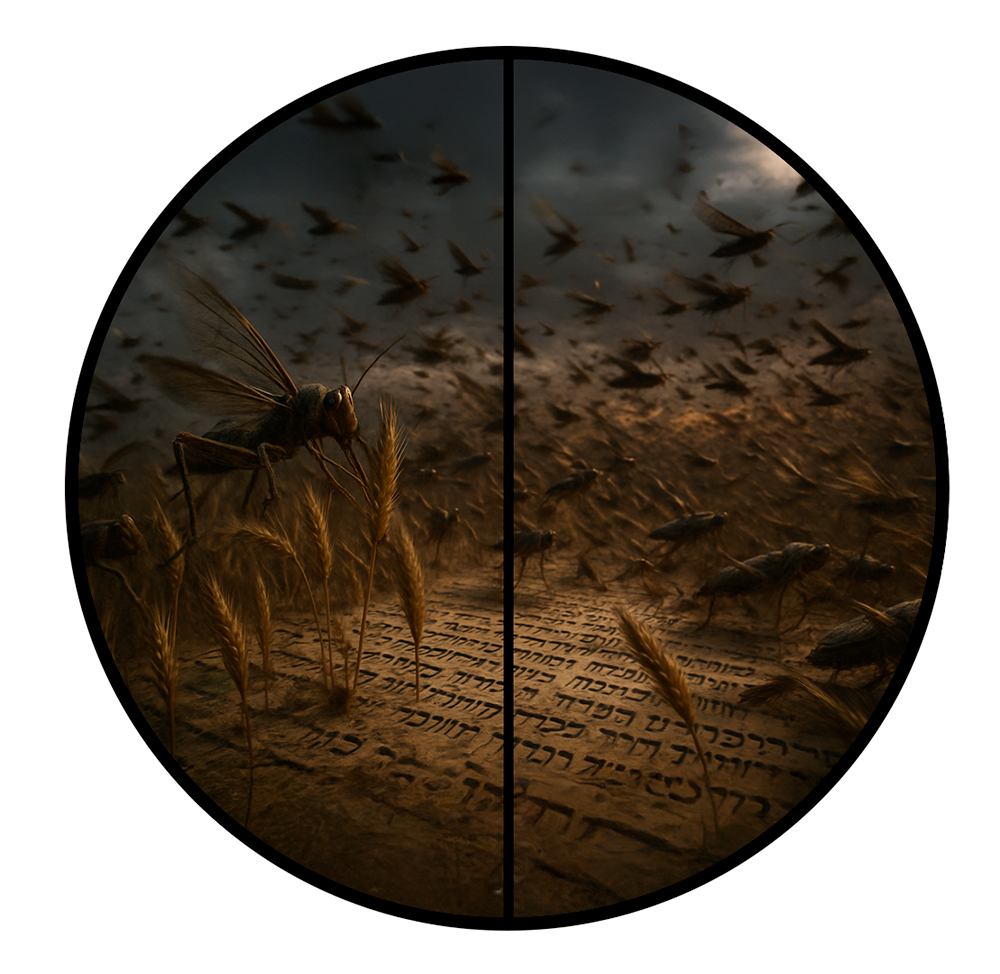
The remainder of the Gnawing Locust, the Locust Swarm has eaten, and the remainder of the Locust Swarm, the Cankerworm has eaten, and the remainder of the Cankerworm, the Ravaging Locust has eaten.
A viscous cycle
Gnawed, swarmed, licked up, ravaged
Gnawed, swarmed, licked up, ravaged
Julia Smith Literal 1876 Translation:
The residue of the creeping locust the common locust ate; and the residue of the common locust the feeder ate; and the residue of the feeder the devourer ate.
The residue of the creeping locust the common locust ate; and the residue of the common locust the feeder ate; and the residue of the feeder the devourer ate.
LITV Translation:
What was left by the cutter, the swarming locust ate; and that left of the swarming locust, the locust larvae ate; and that left of the locust larvae, the stripping locust ate.
What was left by the cutter, the swarming locust ate; and that left of the swarming locust, the locust larvae ate; and that left of the locust larvae, the stripping locust ate.
Brenton Septuagint Translation:
The leavings of the caterpillar has the locust eaten, and the leavings of the locust has the palmerworm eaten, and the leavings of the palmerworm has the cankerworm eaten.
The leavings of the caterpillar has the locust eaten, and the leavings of the locust has the palmerworm eaten, and the leavings of the palmerworm has the cankerworm eaten.