Genesis 1:4

And he is seeing elohim אֶת-the Light, for he became good,15b and he is being separated elohim in between the Light and in between the Dark-one.
Separated
And mighty ones is seeing the self eternal Light, for he became good. And mighty ones is being separated between the Light and between the Dark One.And God will see the light that it is good, and God will separate between the light and between the darkness.
And God saw the light, that it was good, and God separated between the light and darkness.
And God saw the light that it was good, and God divided between the light and the darkness.
Footnotes
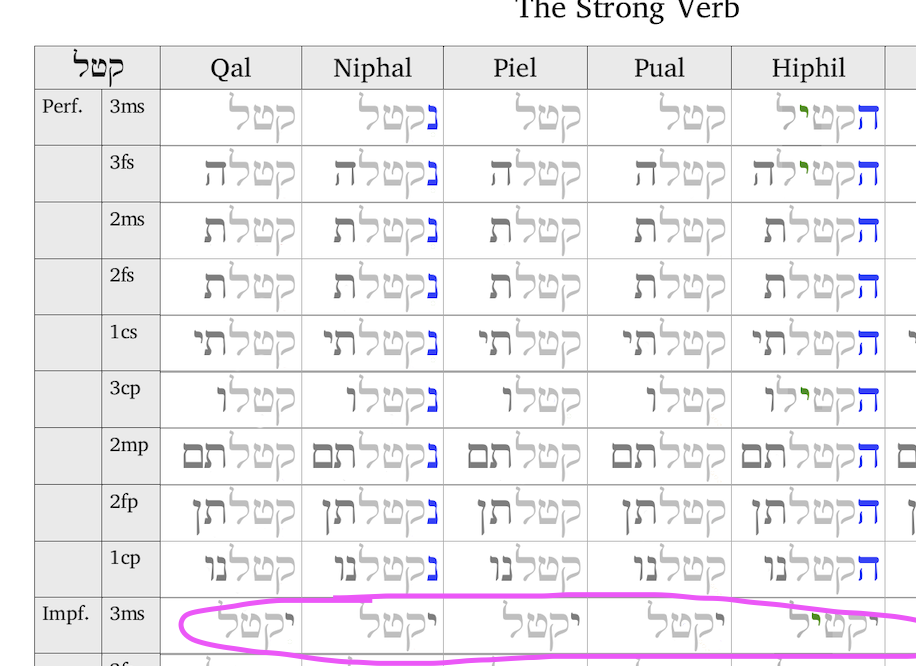
| 15b | Genesis 1:4 Elohim "Mighty Ones" as an Angelic Host The Hebrew verb ויבדל (vayibadel) can be in Qal "he is separating" or the Niphal (passive) form, "he is being separated." It is from the conjugation of the verb בדל (badal), which means "to separate" or "to divide." The Hiphil causative form generally should have the letter yod י which is missing.
Hebrew כי "ki". Gesenius and Fuerst both have extensive entries on this conjunction And other scholars have studied its use extensively. In its ~4500 occurances it is usually a relative conjunction "because" or "for" and used with verbs. The interpretation of כי טוב "that it was good" is problematic as it is adding the verb for "to be" where there is none in order to force the meaning of טוב as an adjective "good." However, טוב is also a verb meaning, "to be pleasing/good" (cf. Strong's #2895). In the complete/perfect form, it would mean "he became good." The entire structure in this phrase is attested elsewhere: וירא בלעם כי טוב בעיני יהוה "And Balaam is seeing, for he became good [טוב] in the eyes of He Is..." (Numbers 24:1 RBT) כי טוב לנו for he became good [טוב] to ourselves (Numbers 11:18 RBT) tov (טוב) is a great example of how language reveals the perceptual frame it grew out of. Hebrew, the Language of Beyond, treats “good” not first as a property but as a state-event. It’s something that happens. A configuration becomes aligned, fitting, well-ordered, pleasing. So the root ט-ו-ב comfortably forms a verb meaning “to be good / to become good / to be well-aligned.” English can’t do this cleanly because English is built around static adjectives. “Good” is a label you stick on a thing, not a process the thing undergoes. To express the Hebrew idea, English needs circumlocutions: to be good, to go well, to please, to be fitting. It slices the concept apart into states and judgments. If you zoom out, the mismatch ties straight into our chronos/aion tension. Hebrew’s verbal system is aspectual, not strictly temporal. A verb like tov doesn’t pin an event to a timeline; it describes the quality or shape of an unfolding. It’s closer to “this situation has come into rightness.” There’s no forced timestamp. English, meanwhile, wants to know: was it good, is it good, will it be good?—it locks the concept into sequence. So the challenge is that English thinks of being as a series of static snapshots, and Hebrew thinks of being as a relational becoming. The semantics lean more aionic than English can comfortably represent. That’s why certain Hebrew ideas feel larger than their translations—they weren’t designed for a chronological grammar in the first place. |