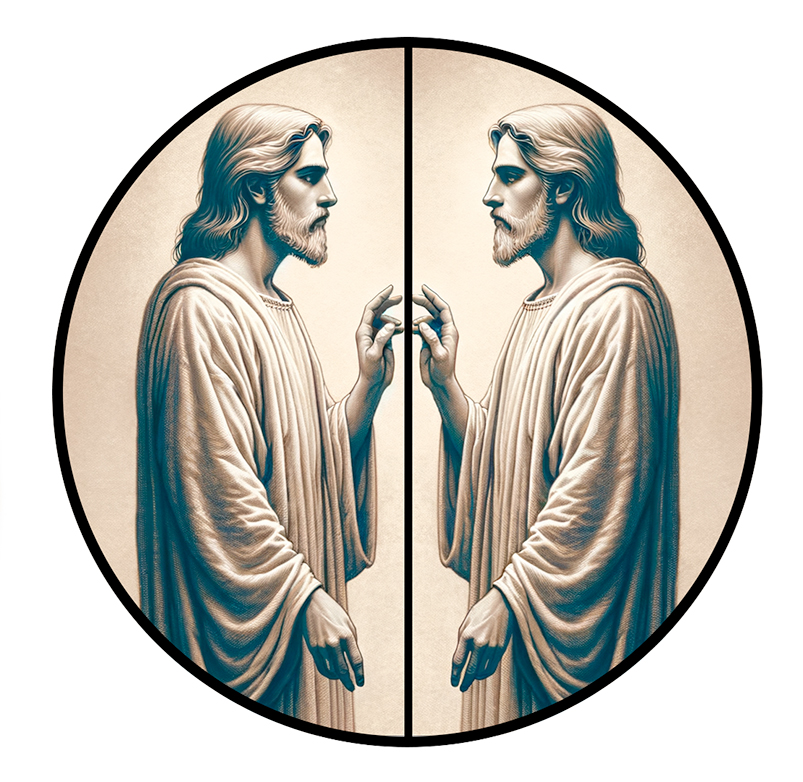
Genesis 1:27

 very rare as mark of accusative (for which
  is preferred), but used often in the sense of substance οὐσία, also in that of self, e.g.
 Recursively Creating Self
And mighty ones is cutting out the self eternal Human ("the Adam") within the shadow phantom of himself. Within the shadow phantom of mighty ones he has cut out his eternal self. A remembered one ("male") and a pierced one ("female") he has cut out their eternal self.
"Those who make a human to miss within an alignment, and to the one who argues/reproves within the Gate, they are baiting and causing to incline upside down a just one within Tohu."
(Isaiah 29:21 RBT)"a man is walking himself only in a shadow-image [tselem]! They are roaring only a vapor! He is heaping up and he is perceiving not who gathers themselves!"
(Psalm 39:6 RBT) is cutting out | has cut out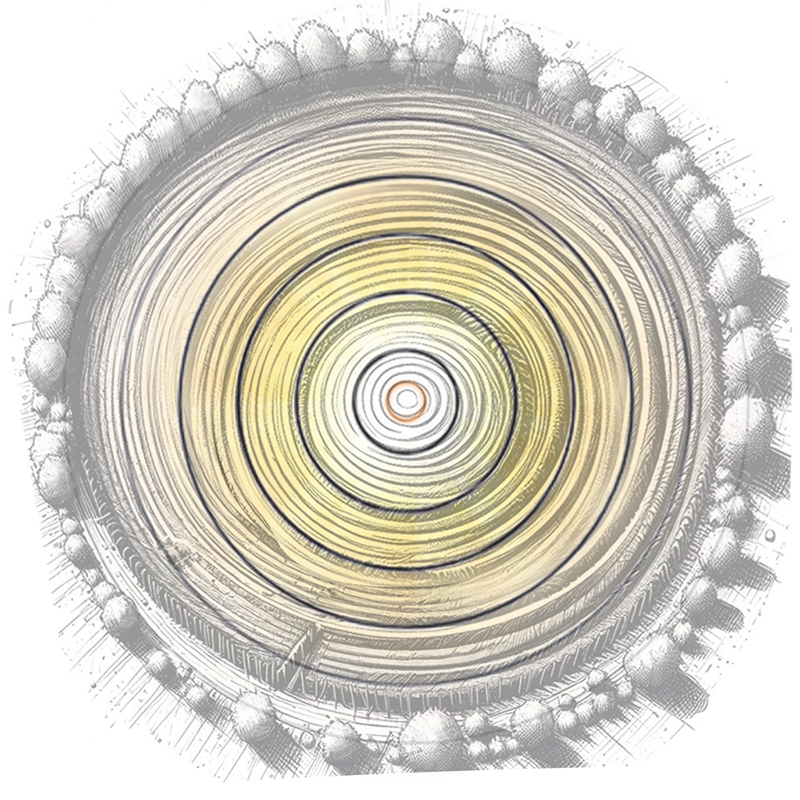
The Field: Cutting Out vs. Cut Out. The incomplete and complete Hebrew verb forms work together as one, or "a whole" circle. The oxen are plowing (cutting out) a circle, and the plowing is complete once a circle is made. Hence the ideas of "expansion" or "increase" from the origin, as well as Cutting Around (circumcision).
"For just as the woman from out of the man, so also the man across through the woman. And the whole from the God." (1 Corinthians 11:12 RBT)
And God will form man in his image, in the image of God he formed him; male and female he formed them.
And God created the man in His own image; in the image of God He created him. He created them male and female.
And God made man, according to the image of God he made him, male and female he made them.
Footnotes
| 48 | Genesis 1:27 The Man of Heaven
If the Heavens are dual (as is the noun shamayyim) the the man of heaven would be... ...dual. This second instance of the Hebrew word Adam, "Red One", has a definite article in front of it, ha-adam, which is literally “the Red-one”. The word Adam is a unique Hebrew word as it is considered both a common noun and a proper noun. See Strong’s #120. In any other case attaching a definite article to a proper noun is not done. According to Gesenius, “the article cannot be prefixed to a proper name” for Hebrew names (cf. §125) although some “gentilic” names can, i.e. the Hebrews, the Canaanites, the River (Nile), and the Jordan. It occurs with the definite article 552 times in the Hebrew Scriptures. Without the definite article it occurs around 368 times. Interestingly, the word philistines is almost always without a definite article as though it was meant to be taken for a common noun. This is a definitive and specific man, made in the image of elohim—a man of heaven. The Hebrew describes him first as one self "cutting himself out", then as two—"male" and "female", then as many "themselves." Speaking in Tonguesזכר zakar (Strong's #2145): remembered one. From the root zakar (#2142), meaning to remember, memorialize. The word for "male". נקבה neqebah (Strong's #5347): pierced one. From the root naqab (#5344), to puncture, literally (to perforate, with more or less violence). Other contexts give additional meanings such as blaspheme, bore, and curse. The word for "female", but not a favorable etymology. It is not the word for hole, but for piercing/stabbing. "You have pierced [naqab] with his staves the head of his leaders" (Habbakuk 3:14 RBT) "he is taking him with snares, he is piercing [naqab] his nose" (Job 40:24 RBT) Hoy to those secure in the desert place [Zion], and those confident on the mountain of Samaria: those who pierced [neqab] the head of the nations, and they are coming to them in the the house of God Straightened ("Israel"). (Amos 6:1 RBT) |
| 50 | Genesis 1:27 remembered-one and pierced-one (male and a female). Hebrew zakar ve-neqebah. These are two singular nouns, not adjectives. "Them" is also the mark of the accusative + them emphasizing them. Zakar is derived from the verb zakar which means to remember. Traditionally interpreted as signifying that the male is generally "remembered" over a female in carrying on family name. Neqebah is from the root to pierce or bore. The word is generally used in the context of a sharp object such as a sword, piercing something, i.e. making a hole where there was not one. Hence, the assumption that it had to do with sexual innuendo doesn't seem consistent. "Can you pierce [naqab] his jaw?" Job 41:2. See Strong's #2145, #5347 |